Showing posts with label childhood dream. Show all posts

Saturday, November 22, 2014

The left bank


My grandfather had a sister, a saga behen (own sister) as we say in India. Nothing unusual in that except that there has been no trace of her existence within the family in decades. That she had even existed in what is now called Bangladesh was just a chance discovery.

You’re like the Koreas, a friend quipped, alluding to the fact that North/South Korean divide has pulled entire families asunder. Still, in the Indian joint family structure where collectivism is key, it is bemusing that the only female sibling of three brothers remained unknown to their families for the longest time. 

In the Indian sub-continent, historically, Bengal has been the hotbed of socio-cultural activism. During the colonial era, Bengali Babus were the anglophiles that, at first, the British colonizers relied heavily on to consolidate their position in the region. But then, with Western ‘education’ and their subsequent political awakening, the Bengalis transformed to thorns in their flesh. 


To contain Bengal, the then representative of the Crown, Lord Conwalis I think it was, mooted its first partitioning circa 1911. The banks of the River Ganges that flows through the state became the East and West Bengals. Locally they were called apaar Bangla (Bengal on this bank of the river) and opaar Bangla (Bengal on that bank of the river). In the vivisection of India in 1947, East Bengal was made a province of the newly carved out nation, was renamed East Pakistan. Then, in 1971, with help from across the river to stop the genocide, it became an independent nation, Bangladesh. But the local reference continues to be apaar Bangla and opaar Bangla. 

My family originates from that side, although they retained no connections with it since they left its soil around the time of the partition of the country. But the parents never forgot their birthplaces, and in their childhood memories, opaar Bangla was like no other on earth. For years we have only heard stories of abundance in the fertile land they grew up in and the freedom to be they had as children in their respective joint families: the tasty hilsa fish, the numerous ponds they swam in and orchards overladen with fruit, the prajas (subjects) that cultivated their fields, the space they enjoyed, the football, the intellectual pursuits.

They spoke less about the horrors inflicted on its people, though the effects of that experience runs deep in remembrances of the oppressiveness of the colonial rule, the famine the foreign powers engineered, the freedom struggle that the young men joined into and were killed for, the sudden rise of communalism that put friends into opposing camps, the riots following the forcible partitioning of the nation that caused the river to run red… My father never got over the trauma or ever wanted to go back. Now, seventy years after she left her village as a bewildered teen, my mother has finally desired to revisit the paradise of stunning natural beauty.


Thinking of it as a pilgrimage, my objective became to find somebody in Bangladesh who might recall those times and the location of the villages my parents came from. At first, it appeared that possibly nobody in the know had survived time. Well, I thought, we have the village names, and perhaps they haven’t been changed too many times by successive governments! But, truth is, I wasn’t too hopeful myself.

Then, the very extended family network came through with a name and a contact number.  He was somebody’s relative, on a visit to Kolkata, and still lived in opaar Bangla. It seemed a godsend, and I made contact immediately. When we met face-to-face, the eager questions we asked one another were, and how are you related to so-and-so or to such-and-such family?

We compared notes on our respective family trees. We stared in surprise at our findings. We are blood relatives, the newfound cousin I shall call Umesh declared at last. The sister of my grandfather, apparently lost in the sands of time for two generations, turned out to be his grandmother!

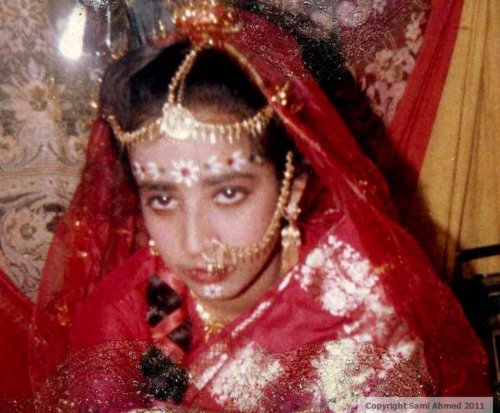
I was eager to hear her story. Her grandson, however, couldn’t quite recall her name. Something-sundari was the best he could come up with. In the traditional naming of the girl-child in those times, appends like Sundari, meaning beautiful, or Bala meaning ornament, was regular. I suppose they were meant to enhance their chances in the marriage market, where child-marriage was prevalent then.


Anyway, the story of this Sundari is the story of three families of my father’s village inter-linked by marriage. Let’s call them X, Y and Z. My paternal grandfather belonged to family Z. At the turn of the twentieth century, the patriarch of family X was a renowned practitioner of ayurvedic medicine. A young man of family Y had become his apprentice and proved himself ably to his mentor. He was welcomed into the fold of practitioners of traditional medicine and thereafter married a young woman of the family, obviously with the patriarch’s blessing. His wife produced two children, but she did not survive too long after. He couldn’t be expected to rear the children on his own, and hence another marriage was on the cards.

Family Z had three boys and one girl of the same generation. The youngest of the three sons, my grandfather, had also married a daughter of family X. Meanwhile, the young man of family Y set his sights this time on the girl of family Z. This was Sundari! It seems they married, although family Z kept no record of it.

Why has there been no mention of her within her family of origin? Was it sexism - did her three brothers consider her gender a burden to be rid of and forgotten at the earliest? Did she marry for love? Was the match against family wishes, and so she was spoken of no more? Or did the fact of Partition lead to the unraveling of ties? 


Sundari stayed back with her husband and children when two of her brothers left for the other bank of the river with the rest of the family members. Her eldest brother also remained to dispose of the family property, but then was found dead under suspicious circumstances. The second brother also died soon after, and it was left to the youngest brother, my grandfather, to anchor the relocation of this large extended family. It all seems pretty curious, and so many questions arise, especially about the constraints imposed on little girls in that age!

I hear that she bore three sons and two daughters, survived childbirth and lived to a ripe old age.  So there was nothing wrong with her physiologically. Was she indeed as beautiful as her name suggests or was loyalty her strength? Was she happy with her lot as wife, mother and grandmother, or was it an imprisonment of sorts? Did she accept her family’s indifference to her plight stoically or was she heartbroken at being so completely forgotten? She died some time ago, and hence unfortunately, there is no way of knowing her side of the story, except as her descendants retell. 

The separation of family members is probably the natural fallout of the partitioning of any nation, but still why forget a person altogether, an only daughter of the family at that? There is no one to provide the answers, and today, I can only speculate whether Sundari’s life has been the stuff of fairytales or as tragic as those times.


Monday, September 15, 2014

Save the last dance

In modern India, older age groups have a problem. Actually, they may even be the problem. After decades of nurturing others, they forget how to nurture themselves. Society forgets about them as well. Elsewhere in the world, we hear 60 is now the new 40! But that memo, for sure, is yet to be received here.

I visit an upcoming housing complex. Their marketing executive tells me that the place is self-sufficient. Residents do not need to step outside the area for any activity or entertainment. With a few thousand high-rise flats, it is like a little town in itself. He reels off the modern in-house facilities, now an inseparable part of urban living – shopping mall, multiplex theatre, gymnasium and health spa, children’s play centre, community hall, and so on. He is eager for me to understand that they have thought of everything. 

What about senior citizens? I ask. A flourish of his arm takes in a passageway with about a dozen armchairs. I stare in surprise. Is that all the activity retirees merit – a sit down and chat? It is almost like waiting to die. That the elderly are viewed as completely spent is disquieting. The metabolism may have slowed down, but the minds are still active, thinking, creating. May be more, in fact, now that the distractions of youth have been seasoned. I dream of ageing gracefully, not of being relegated to a trash heap of uselessness!

For years the older age-group shoulders responsibility for the future. First, it is more important to focus on a good education to go up in life, then, there are job priorities, and finally, family and children take precedence. The little time remaining in hand for them must look bleak when the social consideration they earn as returns is poor. Surely, the ageing deserve something a bit more imaginative!

Society may not mean to discriminate, but its majority associates this group with little other than medical needs. It pushes the elderly to think negatively about themselves too, when the opposite is just as true. Now that responsibilities are largely over, it is opportunity for them to refocus on the self. Post-retirement, one finally has time to develop freely what has been left remote for years. Maybe childhood aspirations saved in some corner of memory could be resurrected. Discovering the simple joy of learning new skills, for instance. 

Certainly, the assumptions of suspended animation need to be question, and yes, a few waves created in chasing dreams. From my very long-term memory, I dredge one up - Dance.  I was captivated with it, but was then too young to join the class the three older girls in our joint family were going to. Later, they told me. Alas, by then, the older girls gave up on it, one by one. The family was convinced that, by association, so would I. Dancers only get fat later on, they told me, better to learn to sing.


A dream shatters at a very impressionable age. It is not forgotten, just buried in memory as failure, never pursued again. I imagine putting the pieces together, to see what comes of it.  Out of respect for the childhood goal, I could at least give it a try. In fact, the exercise might be more interesting than the chatting envisaged as the appropriate old age pastime. 

My age-mates laugh at my craziness. Seriously, time to stop, they tell me in parental tones, you’ve danced around a lot before in your life. Yes, but that was a different spin of dancing. Bouncing around is perhaps a more appropriate term to use - changing subjects of study, changing job fields, and changing homes.

I suppose they mean for me to have stability in my life, to be completely predictable, and like furniture, to just be there. The mistake is in thinking there is safety in an environment controlled to keep everything the same. Fact is the only constant in life is change. Accept that, and one is ready to adapt to any new reality.

I set about finding the dance school to attend. I look them up and decided to ‘phone a couple located close by for details. Initially, they are most welcoming. I’m just the kind of enthusiastic person they need in their class, they tell me. There are two broad categories, Indian and Western, and under them, innumerable styles and specializations: bharatnatyam, kathak, odissi, salsa, samba, zumba, and more besides. For an absolute beginner, Indian or Western makes no difference. At the moment, it is more a question of what might be a little easier to do. The schools promise guidance, and incidentally, telephonic admissions are also possible.


In the end, I ask the most important question, the age limit. They assure me there isn’t any. Student over a-year-and-a-half in age is all. They misunderstand. At the other end, I clarify. My query puzzles them. Adult? They respond tentatively, like it is a question. I tell them I’m in search of a senior citizens class. The silence wafting down the telephone line is telling! I can feel their interest wane. Senior citizens don’t do these classes. But there is a sop. I can join in with the kids in the beginners' class, if I want.

I decide on not for now. Surely, senior citizens have the gumption to organize their own activities! It may feel a little awkward at first, but to just think, they don’t need to impress anybody or please the world any more. When there are no classes for seniors, go to Plan B. The point is to learn. Technology is freely available, so why not take advantage of online instructions. I search the ‘Net and find a slew of tutorials. They all say joining an actual class is the best way to learn, and I couldn’t agree more. However, a saying in India is that having a blind uncle is better than having no uncle at all. 

The dance is, at last, for me! I decide to choose something with rhythm. I close my eyes and make a stab at the computer screen. Salsa, it is, a sexy dance from Cuba. It may be an ambitious project, but well, I’m not about to become a performer. The aim is to prove that this also can be achieved. I try to emulate moves from the video clips. They don’t look impossible to remember. Right, left, right … Left, right, left … Like walking. With a wish held this long, touchwood, I might even get it.