Showing posts with label sensitivity. Show all posts

Friday, December 21, 2012

Heard of Dark Continent?

The little girl looked carefully at me. Had I ever heard of Dark Continent, she asked softly. I was surprised that she knew enough to quiz about it, considering her background. She was a child of the slums, and hardly ten years old, her clothes worn, frayed at the edges. Perhaps this is the habitual mistake the “educated” make. We look upon the poor as an undifferentiated mass of entrenched illiteracy, impediments to the nation’s economic progress. 
This country does its best to eradicate poverty, but with the population burgeoning, it is difficult to make much headway. I believe a Japan adds on in people numbers each year or so! Illiteracy is the other face of poverty; hence education for all is a part of social development in the socialist, democratic republic of India of the present.  Education is heavily subsidized to make it within the reach of the economically disadvantaged. 
In a bygone era of numerous monarchies, organized community living in the Indian sub-continent had strict social segregations based on birth. These divisions of society were hierarchical. The Brahmins were the academicians, teachers, custodians of the scriptures; the Kshatriyas were the royalty, the warriors; the Vaishyas were the business group; the Shudras were the menial labour, the untouchables. Social discrimination was rife. Males born into a particular family were forced to follow the trade of their fathers. There was no escape; caste was hereditary.  The “upper” castes hoarded wealth and privileges, and imposed upon those “lower”. 

The right to education was restricted to the top of the social ladder, and those born to families low on the totem pole were barred from it. The epic Mahabharata recounts the story of Ekalavya, the talented son of an untouchable. Unable to attend the martial arts academy run by the renowned Dronacharya, guru to the princes, Ekalavya practiced archery on his own before a statue of the teacher he revered. He caused consternation when he dared compete against Prince Arjuna, the guru’s favourite student. Teachers, during that period, were not paid salary, but received guru dakshina (returns in cash or kind) from the students or their families. Although not directly responsible for Ekalavya’s prowess, Dronacharya nevertheless claimed dakshina from him, and demanded his archer’s thumb in reward! 

Women of course, were entitled to a caste only after marriage. Thus the point of their education really did not arise outside of chores learned at home from childhood - cooking, cleaning and rearing children. Although social reformers fought long and hard through the colonization of India to remove the social discriminations, the perception of women being secondary to men continued far into the twentieth century. All that the marriage market required was the minimal ability to read and write; girls hardly needed to become pundits! In fact, the elders feared that prospective grooms would turn away from over-qualified brides, who would never get married and thus dishonour the family name. Even today many believe that investment in the education of boys bring returns in future, but girls are paraya (outsiders), soon to belong to another family. 

In the ‘sixties, my father broke family tradition, as it were, by sending daughters to English-medium schools to get what was then the best education. I remember that during university days, a classmate and I were in heated discussion of a certain project on the tram ride back home. While we argued our points, other passengers were listening in. After I got off the tram, the man that took my seat turned to my companion and inquired where I came from. His eyes popped when he heard that I was a local. Huh, he exclaimed in astonishment, Speaking English! Educated!


At the time, the tuition fees everybody paid were about two hundred rupees a year, that is, less than five dollars annually, even in the science subjects. This was because the political intent post-Partition was to rebuild the dismembered nation. They assumed that the intellectual crop so nurtured would take the country forward. But that idea backfired in the ‘seventies and ‘eighties. Unlike many other nations, India did not have a compulsory service scheme for its citizens. Thousands of top graduates and post-graduates winged their way to the West, lured into serving in the more lucrative workplaces overseas. The expendable patriotism of the already privileged sunk the nation deeper into debt, because there were no legal bonds to hold them back. With the actual cost of the university education for each a few hundred thousand rupees at least, the eventual loss to the national exchequer with the brain drain must have been in the billions. Without the IT boom and the outsourcing industry, the Indian economy might have still wallowed in the doledrums. 

Although scores of private autonomous universities have since mushroomed charging exorbitant amounts for better teaching facilities, the educational subsidy continues in governmental institutions, the university fees being raised minimally over decades.  Furthermore, in and around Kolkata, primary and secondary governmental schools waive tuition fees for the economically disadvantaged sections. After generations of illiteracy on the backs of social segregation and poverty, their offspring are exposed to the R’s, and graduate degrees. One parent told me that they would have been satisfied with their children being allowed to touch the benches of high school; to have a graduate in the family was beyond imagination. 

I visited the students of a governmental primary school recently to get a sense of their ability in the English language. Both boys and girls present were the first school-goers in their family. I looked at one young boy’s exercise book. He had made many mistakes in an earlier spelling test, and in one word, written “dee” instead of “deer”. Just carelessness, I presumed. I pointed to the word, and asked him what it was meant to be. He blinked at it a moment and then whispered to me that it was a very hard word. What is it, I insisted. Elephant, he replied glibly. Clearly the wiggles on the page made no sense to him at all! 

It seems to me that, with the decision to eliminate examinations in the school system, the point of education is being lost. The light of knowledge being spread is dim because the children are not pushed to rehearse, remember, think complex and compete intellectually. They are being uniformly promoted with no quality control of capability, simply pushed up to a new level of incompetence each year. Education to them thus becomes a meaningless trudging back and forth each day, uncomprehending. 

An interesting TV reality show is titled Are you smarter than a fifth-grader? Questions from science, math, history, geography, grammar, etc., are asked of adults locking horns with the academic level of the average American ten-year-old. It proves that the children really do have to study a lot, because most adults trip up in the programme. But sadly, amongst the economically disadvantaged groups in this state today, many children of the same age are stumped by anything to do with academics. 

Education for all is a commendable idea in democracy, but is the process in use the best for the country? The educators might boast of rising literacy numbers, but the quality of education differs widely between the social sections. Eliminating competition in schools for the disadvantaged encourages their students to avoid critical thinking, to seek the easy ways out. Where ability counts most, in the work world, they fail to impress employers.  The degrees they possess may not be worth the paper they are printed on. The joke is, toss a pebble on the street and you might hit such an “educated” unemployed. 

The little girl clued into the Dark Continent is one bright spot of intelligence amongst the general clueless. Surely, there are many more talents like her touched with the light of knowledge, passionate about learning, and waiting for the opportunity to excel.  Education is meant to enlighten minds, to create awareness of the environment for adaptability, and to dispel the darkness of ignorance, superstition and discrimination. The socially disadvantaged groups need out of dole dependency to develop as people. Else, lamp-lighting ceremonies in the educational institutions become mere rituals, while the dark continent of mindsets are preserved across society.


Saturday, October 1, 2011

The issue with Lookism

Although, in the present age, political correctness demands support for merit, the social preference for beauty continues around the world. Women especially have been caught up with carrying the social standards forward, as their self-esteem often depends on others’ approval. Physicality seems to become an equal-opportunity issue in  organizations in the West. However, lookism – that is, prejudice based on appearance – may be hard to prove in Diversity.

Women perceived aesthetically challenged attest that they have a harder time with social acceptance than their more physically endowed peers. Sharing her own humiliating experiences, Sibary asserts that good looks open doors, literally and metaphorically. She writes:
I may as well put a bin bag over my head for all the impact my face has … I recently went on holiday with an old school friend to celebrate our joint 40th birthdays. She is single, blonde and very attractive. Throughout our trip, men were holding doors open for her (and then letting them swing in my face); carrying her bag, but ignoring mine; and falling over themselves to buy her drinks and apply her sun lotion. 
Many women that might themselves have memories of being left on the shelf focus on forcing beauty treatments onto their baby girls. The little ones are taught to strut their stuff, and wear fake body parts, fake tan and botox if only to get ahead. Oblivious to possible psychological repercussions in future, the mothers believe that their daughters will thank them for their efforts to make them ‘stars’ before they learn the R’s. But for the moment, reality shows featuring toddlers beauty pageants owe their success to this relentless maternal drive to render advantage to their offspring at any cost.


Theorists imagine a beauty-related continuum in the social psyche, bound at the ends by two aesthetic poles – maximum unattractiveness (or ugliness) at the negative pole, and maximum attractiveness (or beauty) at the positive pole. Tietje and Cresap explain the significance of the poles:
Being judged to be at the negative pole is an aesthetic variant of … stigma: an immediately recognizable abnormal trait that works subliminally to turn others away and thus break social claims. Being judged to be at the positive pole is aesthetic charisma … is perceived to be a divine gift and … “star quality.”
Now, few people actually place at the poles, and most of the population occupies the middle of the imaginary line. People’s social worth then appears to be graded according to the subjective perception of the reality behind the appearance.

Perhaps as a consequence of the Darwinian concept of survival of the fittest, beauty has been stereotypically associated with productivity. Matrimonial matchmakers seemingly with a finger on the social pulse, advise women to dumb down on the one hand, and on the other, to raise their attractiveness quotient in order to ensnare rich, eligible men.

Unattractive people can expect poor treatment even if they work hard at developing personality because assumptions about beauty are hard-wired into people’s brains through evolution. In social research tests conducted, men were shown pictures of beautiful women while their brain activity was monitored with MRI imaging. The results, Stossel reports, are that:
… the same part of the brain lights up as when a hungry person sees food, or a gambler eyes cash, or a drug addict sees a fix. Essentially, beauty and addiction trigger the same areas in the brain.
Both visualization of beauty and the substances of addiction activate pathways to the brain’s reward centres. In each case, the respective individuals anticipate pleasurable experiences.

A litigious trend in the West rests on lookism, with complainants demanding measures against looks-based inequality in the workplace. Tietje and Cresap explain the serious implications of the practice:
According to recent labor-market research, attractiveness receives a premium and unattractiveness receives a penalty. For both men and women, results “suggest a 7–9-percent penalty for being in the lowest 9 percent of looks among all workers, and a 5-percent premium for being in the top 33 percent.”
Now, although any form of discrimination is unjust, it seems to me that the hurdles in establishing lookism as a discriminatory process increase with social diversity. 

Fact is people of a particular culture imbibe notions of beauty in collective social learning from their own earlier generations. Their subsequent evaluations are subjective associations with standards imbibed within the community. With little experience or ideation of standards outside of those racial and cultural boundaries, their beauty judgements of diversity must also be ineffective. Hence, for charges of lookism to stick, homogeneity is required for comparisons.


Consciously or unconsciously, people give much attention to the visage in interpretations of beauty and worth. Research shows that three areas of the brain are activated when people recognize or identify faces. However, the neural activities of these areas diminish when the faces are perceived alien. These signify the lack of recognition and identifications, which may indeed underlie culture clashes.

Presented with facial structures of other cultures, people not only have difficulty distinguishing one picture from another, latent prejudices may also become activated. For example, the ‘white’ community may perceive its members educated and successful, while more readily associating people of colour with lack of education and crime.

The stereotypical judgements of people extend to include the clothes they wear. A study with ambiguous faces (i.e., those not clearly categorized racially) pictured the models dressed in various types of clothing. A BBC report on the study says:
Faces were more likely to be seen as white when dressed smartly and black when in overalls … "[The results]... imply that our cultural knowledge, and what we are expecting to see stereotypically, can literately change what we do see in other people" … decisions about race or gender or age change the way we feel about people and affect the way we interact and behave towards them.
Clearly, people judge by the cultural standards and attitudes they have been brought up on. For instance, the socio-religious significance of the enveloping female attire, the burqa, to the Muslim community, is lost on the Western world. Post 9/11, the dress has been stigmatized, and some governments have approved its ban, perceiving it a symbol of terrorism.

Although there are myriad instances of demeaning preferences for ‘beauty’ within every social group, cross-cultural lookism would be hard to establish. This because social diversity has not yet developed common, rational standards of looks, and social judgements and interactions based on them continues to be subjective. In one demographic fraction, beauty may be perceived in veiled women blending unobtrusively into the traditional community. Elsewhere, women in revealing attire underscoring freedom from traditions may be deemed hot and sexy. Each group may accuse the other of lookism, but their evaluative contexts differ.

Swamped with differences of race and culture, ‘beauty’ means different things to different people. The effect of globalization has been social heterogeneity, and obviously differing beauty standards for physical structures, colour and clothes remain within the diverse social groups. In a multicultural society, discrimination on looks may be indistinguishable from that of race and culture.


References for this post: 

  1. Clothes influence race perception” bbc.co.uk. BBC News. 28 September 2011. 
  2. Dumas, Daisy. “’No harm was done’: Mother defends dressing daughter, three, as prostitute for Toddlers and Tiaras beauty pageant” dailymail.co.uk. Mail Online. 7th September 2011. 
  3. Greenaway, Naomi. “Why experts say it’s harmful to tell your little girl she’s pretty” dailymail.co.uk. Mail Online. 27th July 2011.
  4. How the brain recognises a face” bbc.co.uk. BBC News. 13 December 2004. 
  5. Sibary, Shona. “How I’ve learnt to accept feeling ugly: With startling honesty, one woman describes how her looks have affected her life” dailymail.co.uk. Mail Online. 8th September 2011. 
  6. Stossel, John. “The Ugly Truth About Beauty Like It or Not, Looks Do Matter” shortsupport.org. ABC News.com. August 23, 2011. 
  7. Tietje, Louis and Cresap, Steven. “IS LOOKISM UNJUST? THE ETHICS OF AESTHETICS AND PUBLIC POLICY IMPLICATIONS” mises.org. JOURNAL OF LIBERTARIAN STUDIES. JL VOLUME 19, NO. 2 (SPRING 2005): 31-50. 

Monday, September 12, 2011

The socialist attitude

Perceptions of socialist attitudes tend to the negative, especially in the West. The assumptions may be of some sort of discrimination against creative enterprise nurtured in poverty-stricken populations. However, the socialistic slogan generally attributed to Karl Marx: from each according to his ability, to each according to his need may actually owe its origins to the 'right' - the moral teachings from religious discourse of times gone by! 

In response to the socialist attitude perceived in our posts on the London riots, a reader comments: 
In my opinion most people, who start life with very little, have a socialist attitude that says “those that have should give some of it to everyone else (me)”.
In societies used to outlooks of individualistic enterprise, the thought may conjure up visions of large groups of poor people feeding off other groups in parasitic existence.  The  socialist attitude would then appear to sponsor the maintenance of poverty, facilitating hooliganism and apathy to honest labour. 

The reader also writes: 
As people earn more and get a better standard of living and more possessions their opinion tends to move to the right and they then think “those who have a lot more than me should share it BUT I don’t think I should share what I have worked for with those who don’t work”.

In other words, with the gradual accumulation of personal possessions, people's interests also change, turning to self at the expense of society. I should think the larger a social organisation is, the more it needs to subscribe to certain socialistic values, if only to keep the collective together in harmony. People that live in society, rich and poor, have certain duties to the collective, in the same way that members of a family are responsible for its identity and organization. 


Democratic societies with formidable Diversity, like India for instance, have had to incorporate these values into their Constitution, assuring justice, liberty, equality and fraternity to all members within its fold. That means to carry the entirety forward to a new level of competence irrespective of caste, creed, colour and class. That also means to decrease divides between diverse social groups, and to fail to do so is to fail democracy. 

Psychologist Adler perceived the balance between social interest and self-interest, crucial for harmony. Since none can exist in isolation, people join with other people of similar background, employment, or status to form social groups. Groups co-exist with other groups, having interrelationships for the same reason, essentially to help themselves. 

Kronemyer explains:
“Social interest” … translates as “community feeling,” as opposed to one’s private interests or concerns. … If one has social interest then one evidences or enacts a “useful” style of life. If one does not have social interest then one is self-absorbed and is concerned only with one’s self. Such a style of life is “useless.”
With overt preoccupations with own wants and expectations, people desensitise to the needs of others in the same universe. In coping with the daily stresses of being in the world, they prefer to adopt the selfish style of living. It should be of no surprise then that within the prevailing sense of individualism in a rapidly complicating world, many more people believe that they alone should enjoy the fruits of labours. 

The concentrated devotion to owning more possessions, tilts the balance towards self-interest at the expense of social interest, and ultimately leads to the ethical bankruptcy witnessed in recent times. In many parts of the world, the powers-that-be as well as groups lower on the social hierarchy appears to thus lose their moral compass. 

In the community living of Christian apostles centuries earlier that the scriptures provide glimpses of, the so-called socialistic values seem to be upheld in their fair distribution among the ordinary people in society. In Acts 4, it says:
The community of believers was of one heart and mind, and no one claimed that any of his possessions was his own, but they had everything in common… There was no needy person among them, for those who owned property or houses would sell them, bring the proceeds of the sale, and put them at the feet of the apostles, and they were distributed to each according to need.
It seems logical to infer therefore that, when individuals and groups share resources between them respectfully, neither question of resource control nor of unmet needs arise. True, the simplicity of the earlier times has been lost in the complexities of the present day. However, much of the change in people’s minds from then to now has been in negativity. Attitudes have not expanded to encompass Diversity, but have instead shrunk to in-groups, and competitive self-interest.

The Parable of the Bags of Gold (Matthew 25:14-30) provides insight into an effective process of harnessing abilities that could be relevant even today. It says:

Again, it will be like a man going on a journey, who called his servants and entrusted his wealth to them. To one he gave five bags of gold, to another two bags, and to another one bag, each according to his ability. Then he went on his journey. The man who had received five bags of gold went at once and put his money to work and gained five bags more. So also, the one with two bags of gold gained two more. But the man who had received one bag went off, dug a hole in the ground and hid his master’s money.
The master of the house in the parable was fully cognisant of the differential abilities of his employees. Present day wisdom might have advised investing all of his wealth in schemes guaranteeing maximum returns. But rather than simply boost the bottomline for himself alone, the man in power opted to provide opportunity to all his workers in accordance to their individual abilities, and share the proceeds of their work with them. 

The point is the socialist attitude does not demand doles, but exhorts those blessed with privilege to talent manage those less fortunate. Over the centuries of their existence, the scriptures have taught no different. On his return from the journey, the master in the parable rewarded each person proportionate to the labour they put in. The man that not only did no work, he further justified his action with presumptions that the employer's profit sources were dubious, got not reward but punishment for his brand of selfishness. 

In the context of the riots in London, criminal activity should indeed be dealt with in accordance to law. However, the punishments should fit the crimes. Prejudicial judgements, concerned solely with exercising power, usher in retribution, not justice. The organizational machinery has the positional clout to to make development happen; they perhaps need the will to bring outlying groups into mainstream. 


Similarly, to help others help them achieve their targets, it behoves businesses to also invest in social development; however very few do. When focused on the bottomline, corporate bodies tend to become insensitive to both people and environment. In the drive for immediate gains, they refuse to consider the future effects of depletion of natural resources. They forget that they are dependent on people within and outside the company for their survival; profit making is a distant dream unless goods and services are sold and bought.

In earlier posts on this site, on the effects of businesses reneging on their corporate social responsibility (CSR), we wrote:
The abuse of resources by production and manufacturing houses, like the indiscriminate release of industrial wastes into rivers, toxic gases polluting the air and thinning the ozone layer, have been implicated in global warming, changing climate patterns and new diseases. Indiscriminate hunting has also endangered many animal species … Multinational corporations (MNCs) have at opportunity, flouted human rights and environmental concerns in developing nations… 
Perhaps prophetically, we also wrote about a year ago, that:
Business and political compulsions have created the “conflicts” that divide people. The single-minded pursuit of advantage has retarded healthy development in human relations. It has instead borne bitter fruit – us-and-them polarizations on the basis of race, religion and culture, and vengeful reactivity. The privileged have grown richer and greedier while the poor, more disadvantaged and resentful. The accumulated negativity displays in their eagerness to embrace any cause that advocates the removal of perceived “inequalities” through violence.
In the present context of the outpouring of reactive violence, it seems clear that social interest has all but died as ethical bankruptcy becomes socially generalized. The connivance of corporate and political circles accentuates divides creating polarized groups of haves and have-nots in terms of privilege and opportunity. 

The unhealthy competition for resources raises inter-group tensions, mistrust and perceptions of social inequality. Leaders in democracies need to resurrect the values of justice, liberty, equality and fraternity in social dealings. If they are to forestall the growing disgruntlement spiralling into anarchy, they need to encourage citizenship amongst all groups of society, political, corporate and others. 


References for this post: 

1. “Chapter 4. Life in the Christian Community” usccb.org 

2. Kronemyer, David. “Alfred Adler’s Concept of “Social Interest”” phenomenologicalpsychology.com. Phenomenological Psychology. October 3rd 2009. 

3. The Diva. “CSR 3: The exercise of domination” thedivaatlarge.blogspot.com. TheDivaAtLarge. February 26, 2010. 

4. “The Parable of the Bags of Gold” biblegateway.com. BibleGateway.com. 

Monday, August 29, 2011

End of India’s democratic system?

Unrest is sweeping around the world rather like mass hysteria. After authoritarian regimes, democracies now face the heat. The question arises whether here the attempts of social groups are to uphold democratic freedoms, or to holdup systems to ransom.

The tidal wave of protests has now hit India. A section of civil society has chosen to confront the Union Government on it executive functioning. The social group, led by Anna Hazare and dubbed Team Anna in the media, demand the Parliament should make into law the anti-corruption bill they have drafted.

The practice in law making to date has been that civil servants draft bills at the behest of the ruling party. That bill is presented to Parliament and should it receive the majority vote of its members, it becomes law.

Writing in Time, Thottam comments:

It's not clear that the Lokpal bill would be much of an improvement. It's also hard to imagine how the world's largest democracy would function if it gave way every time a prominent protestor demanded a new piece of legislation.

Over 42 years, and despite eight bill presentations, however, successive Parliaments have failed to create a comprehensive anti-corruption law. Hence, Team Anna take it upon themselves to draft the Jan Lokpal Bill that seeks to appoint an ombudsman, and empower them to investigate corruptions charges at all levels of the bureaucracy.

Earlier, the civil society group did manage to compel the forming of a special panel of 5 ministers and 5 activists to discuss their bill draft. The aim is to arrive at a consensus on the bill to be presented to Parliament. But the talks stall over six sticking points. The Government then goes ahead to table before the House their own version, the Lokpal Bill, which effectively protects key positions from the investigative scrutiny.

Team Anna turns to street politics in the effort to garner support for their bill. They accuse the Administration of lacking the political will to tackle rampant corruption and protecting it, in fact. To protest the ineptitude, they announce a hunger strike to be launched publicly.

That earns a crackdown; perhaps the fear in accommodating them is of setting a dangerous precedent. Police swoop in with preemptive arrests of the protest leaders. About twelve hundred others are also detained to stamp out the imminent agitation.  Perhaps the Administration’s strategy is also influenced by events in London, where lawlessness ruled rife for several days. 

However, the move backfires, and is seen by the nation as heavy-handed stifling of dissent.  Two hours later, their release is offered on condition they eschew the agitation. Undaunted, the activists refuse to leave until their demands are met – of the right to conduct public dissent, and of the right to draft the legislation to be made law. Lodged in the Tihar Prison, they kick off their fast on the premises itself.

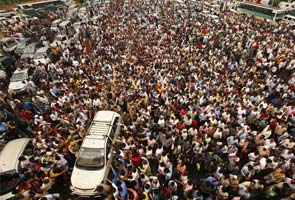
Meanwhile, news of the arrests sparks demonstrations all over the country. Thousands join in very vocal processions across states demanding their release. People in Delhi congregate around the jail as well, holding placards that read, please arrest me.


Unprecedented media coverage publicizes the events. Constant information feeds from private news channels add fillip to the cause. Tech savvy activists make the most use of the tools of Internet – twitter, facebook and youtube to ensure messages from prison reach the world. Their strategy seems to a step ahead, with the authorities having to play catch up.

74-year-old Anna Hazare, the man at the centre of the storm, was virtually unknown outside his home state earlier. He is now a national icon, and his supporters project him as the second Gandhi, leading the second freedom struggle of India through Satyagraha, the path of non-violence.

Reuters’ reporter de Bendern sees the makings of a revolt in the unrest, similar to elsewhere. He writes:
… a galvanised and frustrated middle class and the mushrooming of social networking sites combined with an aggressive private media may be transforming India's political landscape … "The new corporate middle class has little patience with the politics of dignity and identity that are -- for better or worse -- central to Indian politics"…
Perhaps the ruling coalition assumes that the stir will soon die down, as middle-class resolve tends to be tenuous.  They thus try initially to wait out the agitators’ fervour. But as passions whip up instead, party members resort to character assassinations of the social group’s leaders. They also claim them to be media creations set up to blackmail the Administration.

The unrest is branded a subversion of democracy, fronting the attack on the supremacy of the Indian Parliament by outsidersincluding foreign powers. The Prime Minister labours to defend the matter in the House. He states:
The question is, who drafts the law and who makes the law? I submit that the time-honoured practice is that the Executive drafts a Bill and places it before Parliament and that Parliament debates and adopts the Bill with amendments if necessary. ... As far as I am able to gather, Shri Anna Hazare questions these principles and claims a right to impose his Jan Lok Pal Bill upon Parliament.
Opposition parties had earlier been kept out of the draft panel formed with the civil society. They now revel in the opportunity to take the Union Government to task over their mishandlings of the case. The use of force to deal with political issues earns flak as arrogance of power reminiscent of colonial times.

Satirists pounce gleefully to proclaim that in India today, people are free to graft or feed on bribes, but to fight corruption or even to not eat, they get no permission at all! In the public perception, the Government is elitist, disconnected with the masses they represent.

The erstwhile silent majority gravitates to displays of people’s power in metropolitan cities and smaller towns. In several parts of the country, entire villages, men, women and children take up the fast in solidarity with that at Delhi. Mumbai’s famed six-sigma food delivery organization, the Dabbawalas, strike work for the first time in 120 years to lend their support.

Before the ground swell of humanity, the system is forced to back down. The Delhi police withdraw all the 22 conditions they had earlier imposed, release the detainees, grant space for the protest gathering, and also assist in managing the crowds. The hunger strike now assumes the proportions of a populist movement. Politicians across the board begin to feel the pinch of adverse public opinion.

The activists further remind their audiences that the preamble of the Indian Constitution states that:
WE, THE PEOPLE OF INDIA … do HEREBY ADOPT, ENACT AND GIVE TO OURSELVES THIS CONSTITUTION.
That is, mention of the people comes first, precedes both parliamentarians and ministers in the Constitution. Essentially, the people are the supreme body, since their votes put the elected representatives in office. This perspective finds resonance with a population fed-up with political kickbacks, scams, and rampant corruption within the bureaucracy.  Social networks are abuzz with millions of supportive opinions and tweets, non-resident Indians joining in as well.


As the crowds grow mammoth rather than dwindle, ministers are caught in an unpleasant bind. They are as averse to decentralizing legislative control as they are to making Anna a martyr. The concern is the longer it takes to resolve the stalemate, the more the septuagenarian’s health weakens, and the more volatile becomes the situation.

They choose to extend an olive branch and invite dialogue. The talks begin, but the two sides are gulfed by enormous trust deficits between the governors and the governed. In the atmosphere of win-lose competitiveness, neither side is ready to unfreeze maximally polarized positions. They battle over democratic rights in the system, of the people versus elected office. Negotiations lurch from breakthrough to breakdown, to another breakthrough, another breakdown and again breakthrough

Public statements are sometimes intractable, sometimes conciliatory, but furious activities continue behind the scenes. Mediators rush in from around the country to assist each side to keep back channels open and to unfreeze deadlocks. The former chief minister from Maharashtra, experienced in handling previous agitations in Anna’s home state, is called in as the Government’s special emissary to link directly with him.

Newscasters stationed at vantage points around the clock update reports with every new detail. Experts are called from all walks of life to analyze the nuances of move and explain their significances on the private news channels. Constitutionalists, lawyers, corporate stalwarts, authors, editors, social activists, spiritual leaders, politicians, and other celebrities - supporters, detractors and voices of moderation all share views from the same platform.

The entire country appears riveted by the drama playing out on tv. The game of brinkmanship is more thrilling than any soap opera – who will blink first? (The joke here is that Team India is hugely relieved that their disastrous performances on the cricket field in England is, for once, not the focus of public attention. They might hope their entire tour thus flies under the radar!)

During the negotiations, team compositions also change from hawkish to moderate, as the talks seem to progress at the pace of two steps forward and one back. With the forward motion, positions previously thought intractable peg down a notch. The general realization dawns that political issues do indeed require political solutions. Veteran troubleshooters are inducted, as the Prime Minister seeks out-of-box solutions.

Eventually only 3 sticking points remain to threaten compromise: the prime minister’s inclusion in the ombudsman’s (lokpal) purview, similar ombudsmen (lokayukta) for the states, and a citizen’s charter. Team Anna hinges breaking his fast on the Parliament’s vote on resolution of the three points. The Administration, averse to civil society groups dictating to Parliament, cites objections by the Opposition.

The activists appeal to the principle Opposition party to spell out their stand, and receive their support on the 3 points. Opposition parties of the right and left come together, and promise flexibility to help break the impasse. In final compromise, the Sense of Parliament resolution is introduced in both Houses, naming the three sticking points. Seven hours of intense debate on the resolution occurs in Parliament while the nation watches proceedings with bated breath. 


No individual votes follow, but members on both sides of the aisle thump their desks  to adopt it unanimously - a rare sight indeed in Parliament! A relieved Prime Minister tells newsmen: The Parliament’s will is the people’s will. Thereafter, Government’s special emissary and his group rush to the protest site, to reach Anna Hazare a copy of the resolution. He in turn, pledges to break his 12-day fast. The two sides share stage in visual confirmation that accord has been reached.

The perceptions in regions abroad appear to be that the world’s largest democracy has been brought to its knees or that India faces its own Arab Spring. After 13 days of high-voltage drama unfolding the nature of the nation’s functional democracy, we may safely disagree.

It is true that in over six decades of India’s independence, the middle-class has takes to the streets on an issue for the first time ever. Activists term it the outpouring of angst, not new political aspirations. They make no calls for anarchy, regime change, or challenge to the parliamentary system. Fact is this country’s democracy was never targeted; however, the cynical lack of accountability in political and bureaucratic circles has been impaled.

Traditionally, the middle-class remains aloof from political processes; they rarely vote, or may do so negatively. The stereotypical parliamentarian hobnobs in corporate and wealthy circles, appeases the poor before elections with sops for votes, and virtually disregards the middle groups. Their contact with constituents dissolve once the election process is over. Poll promises are forgotten, because elected members toe party lines thereafter, and focus on preserving political allegiances. Thence, their sensitivity to the wishes of the people electing them hardly exists.

The social movement may have triggered a paradigm shift in the political arena,  orientating towards participatory governance.  The surprise result of the exercise has been the dramatic rise of young India.

It is significant that the youth, educated and articulate, carry the fight against corruption on their shoulders. Inspired by the notion of nation building they volunteer services to ensure the movement’s smooth progress. Despite thousands of people congregating, sloganeering, waving the national flag, and holding candlelight vigils, there are no reports of the anticipated mass violence. The trademark Gandhi cap becomes a statement of purpose rather than of fashion, as they identify with the inscribed catchphrase, I am Anna


It is just as significant that ways to resolve the standoffs seem to emerge after the young members of Parliament jump into the fray. Many of this youth brigade also choose to defy tradition. They dare to speak their minds in support of social change. They grasp initiative to understand the thrust of the movement, and to acquaint senior leaders with the seriousness of the issue.

We see no losers in this Indian unrest. A people culturally grounded in moral values are unlikely to invest in the dissolution of revered institutions of State. They are however, determined to evolve with the times, in tune with the present age of global partnerships and collaborations. We may have been witness instead, to the restoration of roles and boundaries between the people, the Parliament and the Government. It perhaps bodes well for the future that the citizens of India have been awakened to their rights in the democratic system, and to the more crucial realization that rights include responsibilities.


References for this post:

  1. Thottam, Jyoti. "Anna Hazare: How One Activist Brought the World's Largest Democracy to Its Knees" time.com. Time. August 17, 2011. 
  2. de Bendern, Paul. “India faces risk of its own Arab Spring over anti-graft protestsreuters.com. Reuters. Aug 17, 2011. 

Sunday, August 14, 2011

A parody of social unity

The global village concept has relied on technological advancements to unite the world. The informational networks become crucial to keep people connected. They are considered the routes to celebrate diversity in societies growing increasingly multicultural. However, as the London riots demonstrate, the spread of dysfunctional attitudes make a parody of social unity. 

Globalization opened up markets beyond national borders. The Internet was meant to bring together diverse cultures. Economic development was expected on one hand, and spirituality on the other. The assumption has been that the new knowledge facilitates the ready acceptance of differences. And yet, London burned...!


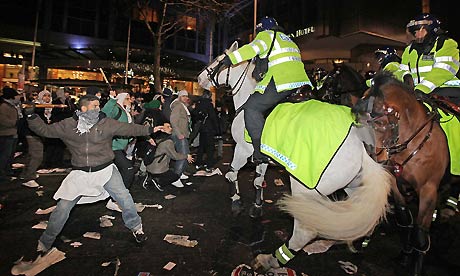
Over several days, flash mobs all over sprang into action faster than they could be controlled. The systemic machinery was caught flatfooted. Violence became contagious with diverse groups joining in on muggings, robbings, lootings, arson and pitched battles with police.

 Addley writes:

… familiar and well-loved streets were turned, for a time, into alien, frightening battle zones … shocking because of their speed and unpredictability, but also because of their geographical and socioeconomic scope.

The British Prime Minister opinioned that pockets of society  were sick. The impression might be that criminal gangs were responsible. However, is that the troublemakers were not clearly identifiable as such. Shockingly, they cut across societynot only white, black, Asian, men, women, children, old or young alone, and neither local nor outsiders, but strange combinations of all of these.

Technology was used effectively to organize the rampage, leaving authorities struggling to keep up. Blackberry messenger, facebook, and twitter spread word like wildfire among the rioters. In the context, social mobility took on new meaning.

Lewis and Harkin write:

… territorial markers which would usually delineate young people's residential areas – known as 'endz', 'bits' and 'gates' – appear to have melted away. "On a normal day it wouldn't be allowed – going in to someone else's area. A lot of them, on a normal day, wouldn't know each other and they might be fighting … This is bringing them together."

Some authors identify alienation, anger, boredom and mischief as the common factors in the chaos.  Some say the long police history of heavy-handedness with the underclass has boiled over. Others point to government policies forcing brutal cuts and austerity measures onto populations. The ordinary experience widening social inequalities, while the richest ten percent reportedly become one hundred times better off at their expense.
In the present context, Power comments:
…consumerism predicated on personal debt has been pushed for years as the solution to a faltering economy … Decades of individualism, competition and state-encouraged selfishness – combined with a systematic crushing of unions and the ever-increasing criminalisation of dissent – have made Britain one of the most unequal countries in the developed world.
I should think that the sense of inequality perceived among social groups is more than a recent occurrence - in fact, a legacy of past imperial practices over populations. Essentially, the interpretations of life naturally differ with cultures. In Western philosophies, for instance, goals have traditionally based on the idea that people have but one lifetime to make an impact.  Since survival is of the fittest, individualism must be favoured. Through centuries, the outlook broke new ground, but it also broke moral and ethical boundaries. 

Western explorers have sailed boldly into unchartered waters to discover the ends of the world driven by the spirit of adventure. The self-reliance and openness to new experiences allowed finding new frontiers. They pushed gathering of new knowledge beyond existing limits.

Tales of wealthy foreign cultures by numerous travellers spawned expeditions to unknown regions also in search of gold, spices, silks, and so on, initially for simple trade in oriental goods. However, economic depressions, internal stresses and market protectionism changed the Western outlook to territorial takeovers. In relentless pursuit of the capture and control of treasured resources, traders became political extensions of their monarchies abroad.

Political fractures within and between communities were exploited to divide and rule.  Ultimately continents were successfully colonized. The English, for instance, were able to boast that the sun never set on their empire. The people they assumed power over were perceived livestock that could be used and abused in slave and labour trades.

Western expansionism flourished also because the foreign lands were peopled by deferent, inward-looking cultures. The Eastern philosophies upheld collectivism, and the ideal of community before self. They tended towards peace of mind, harmonious reciprocity and cosmic karma. However, they were manipulated to lose even national identity for several centuries.


Globalization has most benefited the corporate world, and mostly those located in the West. It enables companies become multinational, to employ skills from a global workforce. But at the same time, rapid changes in reality have been far more than most people could cope with. Despite new markets, local availability of jobs for the underprivileged is rendered uncertain, because outsourcing is common. This cements cross-cultural animosities, although the divisive practice is an indigenous product honed over centuries.

Technology has indeed transformed reality. However, economic and political power games have resisted change. The informational networks have also juxtaposed social issues of past and present in people's minds. They have enabled greater awareness of differences against similarities between diverse people. 

Issues of the present reactivate memories of past racial and cultural inequalities among minority groups. Although demographic migrations post-globalization turned societies heterogeneous, interrelationships between social fractions are ambiguous at best. Distinct cultures coexist in society, but have hardly reconciled with the values of others, especially the majority. Habitual thought and practice remains entrenched in ethnic perspectives. Thus, social divides harboured in the mind never really close. 

The historical wounds of inequalities among minority groups and other social have-nots  also carry forward, mounting tensions generation to generationTheir collective rage might even make the past indignities feel real in the environment here and now. It seems a shame that the rioters turned to destruction as the only way to communication.  It is perhaps more shameful that despite claims of celebrating diversity, Western powers-that-be are yet to get over selfish consumerism, and to harmonize relations with all others that share the same universe, including those within their own societies.


References for this post:

  1. Addley, Esther. “London riots: 'A generation who don't respect their parents or police'guardian.co.uk The Guardian. Tuesday 9 August 2011. 
  2. Lewis, Paul and Harkin, James. “Who are the rioters? Young men from poor areas ... but that's not the full storyguardian.co.uk The Guardian. 10 August 2011. 
  3. "Imperialism in Asia" wikipedia.org. Wikipedia the free encyclopedia. 25 July 2011. 
  4. The story behind the mugging that shocked the world” Reuters report. stuff.co.nz.  Stuff.co.nz. 11/08/2011. 

Sunday, July 3, 2011

Social: 5. The spirit of recovery


In March this year, Japan reeled under devastating blows from the environment. The country’s economic ascendency seemed to dissolve away in an instant before Nature’s fury, causing widespread trauma. Some authors say, however, that Japan’s economic decline began much earlier.

Familiar surroundings disappeared in the earthquake and tsunami.  The toll was at least 5,000 lives along with major infrastructure, leaving people lost and literally cold in the pre-spring weather.  Survivors of the destruction were left to grapple with shock and sudden adversity. Everywhere, writes a friend, almost no electivity, no water, no gas nor gasoline.

The worst environmental calamity in 140 years of that nation’s history has wiped out all traces of development. Even months later, the emotional distress persists, the friend writes:

It passed 3 months since that terrible earthquake attacked us. Since then until now I have been, somehow lethargic and do not want to do anything. But it was beginning of March and still cold and after March, April and May, now we are in June … and seems no changes happen … Northern Part of Japan, focus of the earthquake are still desert. So many people died and still so many missing, so many suffered a lot. On the other hand we are alive and so we have to live, exist…

Lethargy
is but a natural reaction, a defence against trauma most unexpected. Many wonder why they have been left alive at all when all they hold dear in life is gone. In addition, looms the threat of a nuclear fallout that could affect generations. But not everything should be blamed on Nature – the lacks of foresight and openness to change are the human contributions to disaster.


Japan became the Asian superpower on the shoulders of its manufacturing prowess over the later half of the twentieth century, while China and India still grappled with burgeoning populations and poverty. Since globalization, however, these other countries appear to have picked up their pace of development, and they are being termed ‘the new economic frontier’.

Globalization showed up the cultural stagnation. The reason for it, as Japanese retail business leader Yanai perceives, is the people’s getting stuck into change-resistant ways. Ethnocentric preferences turn them inwards celebrating sameness, and in the process, gradually they lose adaptability to the outside world that is meanwhile changing differently.  

The business practices, Yanai writes, have also become introspective:
One problem is that we look down on developing countries… we lack the willingness to learn because we have been so successful before…  we are under the illusion that we are rich and superior … in Japan, income has stagnated for many people for a decade or more. Japan is still very comfortable to live in, if you are Japanese. But there’s a difference between being comfortable and being viable.
In the global forum, crucial business decisions rest on cultural awareness. Yet many Japanese company representatives are unwilling to accept that they can and do make mistakes. Similar people issues may have underlain Toyota’s automobile debacle overseas. Their chairman, summoned before a US Congressional hearing last year on the accident involvements of their cars, hung his attribution on employee confusion between sales and quality. Disgruntled consumers however, complained that repeated problem feedbacks to the company fell on deaf ears. 

The general organizational pattern is bureaucratic, built upon traditional ideals of the Japanese culture including dignity, honour, discipline, and strength.  But expectations of social respect in the collectivistic society, often prevents bottom-up feedback and the sharing of information.  The need to preserve hierarchy may then encourage cover-ups, and thus face-saving of the decision-making structure becomes paramount.  The attenuation of creativity may naturally follow, as may the corruption of power and resources. 

Yanai points out:

Most ordinary Japanese industries are bound up by government regulation, or by agreements (tacit or explicit) within the industry. The idea is to create a union or association or something and then use it to start imposing regulation and preventing competition.

In the recent nuclear crisis at Fukushima, the country’s prime minister himself received news about reactor explosions from media reports! In truth, the reactors were able to withstand the earthquake. Against the tsunami however, the safety measures were inadequate, since a deluge of its proportions had never been experienced or even considered before. The plant authorities did not admit the shortcomings, they chose instead to play down the nuclear threat.

Garthwaite writes:
[International agencies] criticized Japanese authorities for "working from a standard nuclear industry playbook” …  calling for "a frank appraisal of what is known and not known and the potential range of damage and consequences … verbal reassurances about low radiation levels stand in stark contrast to repeated increases in the radius of evacuations."
Post-catastrophe, big firms have become pessimistic about Japan’s business conditions. Economic recovery is not expected to be broad-based and household spending has decreased. The country may also face labour shortage because of its social imbalance - the biggest demographic age group being the oldest. In a nation largely of of retirees and disconnected youth, the effects of trauma may well tend to hopelessness.

Back decades in time, in the aftermath of World War II, a proud nation was brought to its knees, with the atomic bomb explosions at Hiroshima and Nagasaki destroying Japan socially and economically.  The people’s indomitable spirit of recovery raised the levels of creativity and industry to achieve new heights of economic glory. 


Clearly, the present ‘traditions’ of closedness and ethnocentricity are not part of the cultural inheritance. Perhaps these later additions to social learning were adopted to secure the preeminence of the manufacturing industry against foreign invasions.

Beech writes that imminent labour shortage has forced open to change the most traditional doors – in sumo wrestling. This sport, totally associated with Japanese culture, has been practiced for at least 1,500 years.  Its traditional secrets can be expected to remain within the ethnic fold. And yet, the top spots of the sport in Japan itself have been taken over by gaijans – foreign athletes from Mongolia, Bulgaria, and Estonia. 

Economics again has been responsible for the dearth of local talent. In earlier ages, families sent their children to the sumo “stables” to ensure that they were at least fed. In an affluent nation, hard labour is a thing of the past. The goal becomes college education, and thereby a comfortable life.  With few indigenous aspirants, the ancient sport faced extinction. 

The training schools set higher and more stringent standards for the outsiders. But they found that international wrestlers take all in stride – discrimination, indignities, language, diet, isolation, and socio-cultural hierarchy. The rigours they were subjected to in fact enabled them to come out on top. Sumo wrestling adapted to globalisation, and now enjoys a global following.

Beech writes:
After all, if this quintessentially Japanese sport can accept—and even celebrate—foreigners, perhaps the rest of the nation can do the same in other fields.

Indeed, change is a necessary part of evolution. The world has changed, and today in the global forums, people skills are required to survive and flourish.  Sharing does not diminish knowledge, it expands it. In new millennial businesses, collaboration and partnership are replacing merger and acquisition

Perhaps the cultural need of the devastated nation is to revisit the forgotten past, and resurrect the spirit of recovery that once brought the people up from absolutely nothing.  Although their emotional minds are now burdened, the people of Japan need to realize that the opportunity arises to once more resurge from devastation.  And little by little, as my Japanese friend mentions, time and nature heal the sorrow.


References for this post:

1.      Beech, Hannah. “Sumo wrestles with globalizationmckinseyquarterly.com. McKinsey Quarterly. McKinsey & Company. JUNE 2011.   
2.      Garthwaite, Josie. “How Is Japan’s Nuclear Disaster Different?news.nationalgeographic.com. NATIONAL GEOGRAPHIC Daily News. March 16, 2011. 
  1. Kihara, Leika and Ishiguro, Rie. “WRAPUP 2-Japan business mood to recover from post-quake slump-tankanreuters.com. REUTERS. Jul 1, 2011. 
  2.  Yanai, Tadashi. “Dare to errmckinseyquarterly.com. McKinsey Quarterly. McKinsey&Company. JUNE 2011.