Showing posts with label process. Show all posts

Monday, August 13, 2012

The bureaucratic inheritance

It often seems to me that, whether or not they are related by blood, people living together begin to resemble one another over time. Perhaps in eating the same foods and breathing the same air, sameness pervades. We might assume that people unconnected by blood or proximity, differ widely. And yet, in similar organizational structures, members begin to look alike, think alike and behave alike although separated geographically. Those that go before must leave behind something lasting in the structure to anchor time, because the sameness prevails over generations.

The bureaucratic structure, for instance, is our colonial legacy. In organizational shape, it is pyramidal, a hierarchy of levels. The flow of authority and information is top down, and bottom up, obedience is norm. The bureaucratic structure is meant to be impersonal, and the process theoretically, is to be rational, logical and impartial in governance. It was introduced into India by British colonizers. But the very nature of colonization superimposes the concept of the alpha male onto the organizational pyramid. In tune with the ascent of man on the evolutionary chart, the higher echelons of the hierarchical structure are considered superior to people on the rungs below.


The colonial bureaucracies overlaid superiority of race onto the caste hierarchy already prevalent in the region. The Indians realized that despite their knowledge and experience, their organizational aspirations were limited because even junior officers of the British civil service would lord it over the local populace.

The bureaucracies enabled imperialism keep a tight rein on their empire spreading overseas. Educated Indians were inducted to clerk for the colonizers, and to liaison between cultures in the sub-continent. They were called the ‘Baboos’ that looked and dressed Indian, but protected the Crown, furthering the imperialistic goals. Rather like the ‘trusties’ of the prison system, wherein certain prisoners elevated fractionally above others, serve to keep them in line. The Baboo culture was likewise despised by either side.

The colonizers used the Baboos to do their dirty work but hardly respected their racial differences, while the rest of the country hated them as stooges of the foreign establishments. The Baboos responded to the negativity by creating their own fiefdoms within the structure. They became the backbone of the system, indispensable to its functioning. On the one hand, they could interpret and translate communications as they wish, and on the other, withhold information and benefits to the public at large.

Indians are good with cultural traditions; we are loath to disturb the continuity with the past. Customs, practices, norms and habits handed down generation to generation are perceived sacrosanct. Despite the complete change in the social environment, bureaucracies in India meticulously preserve their 200-year old colonial traditions. They thus socialize into disrespect for subordinates, while the ordinary public is the common enemy to protect against.

Consequent to the colonial influence, the character of the pyramidal structure transforms to unfriendly, intimidating and prohibitive. Up and down the bureaucratic hierarchy, countenances are as grim and unbending today as they have been during the British Raj. Especially in the public interface, mistrust and impatience radiate. Communications base on anger management - that is, the lack of self-control characterize the hierarchy. Imagine a blend of parent-child behaviours, rigid and willful at the same time. Obviously, manners get lost in the upward mobility, and often also the work ethics.

Fact is technology thrives, but the traditional mindsets remain entrenched. The change with democracy and independence of the nation, is simply that nobody wants to be the low man on the totem pole anymore. As noted Indian entrepreneur Narayan Murti observes:

In India, we tend to look down on people who do jobs that require physical work or involve disciplined execution and accountability.

As a result, the first impression of any bureaucratic setup in India is poor. The ambience carries a general air of neglect. Governmental or government-related organizations in India may have expensive machinery or other goods strewn carelessly along the corridors. They may have the financial resources to fund other organizations. And yet, black cobwebs sway from the ceilings in the buildings, dust settles on every surface, and the stench of bathrooms hangs thick. Heaps of files, spill their contents onto desks, shelves and floor. Spatters of betel nut juice stain wall corners in the stairwell, while potted plants serve as ashtrays.

The dirty, unkempt look is likely also a façade to put off the public. The disorganization may be intentional, because almost hidden from view behind the mountains of paper files, the Baboos of today continue to protect their territory. Emotions otherwise denied, flow down and out in angry outbursts as individuals seek to assert themselves in the new India by demeaning others. The beat postmen express their angst by delaying or losing mail. The staffs in government offices pretend to be too busy to entertain queries or move files along. Railways employees mess with reservations, even on complimentary passes awarded to the elderly freedom fighters of India’s independence.

The lateral relationships within the pyramid are tight, however. These informal connections are assiduously cultivated to form the social buffer zones, safe to download in. Large numbers of employees unionize together. By themselves the unions may be weak, but they forge outside political affiliations, whose patronage strongly back their workplace confrontations. The attraction to employment in the bureaucracy is job permanence. Employees are confident they cannot be fired because of swift retaliatory union strikes; hence irrespective of actual work done, their wages shall be paid at fixed intervals. Further, the lack of conflict on the lateral plane ensures that the organizational boat remains on an even keel, with little competition between peers.

The Diva writes elsewhere:

For many organizations, conflict is bad - by definition - and they go out of their way to prevent it. The word ‘challenge’ itself becomes sensitive because it may question premises and upset comfort zones. However, the elimination of all discord has consequences. The organization may rarely or even never question its assumptions. It may turn off and lose its creative sparks … The ultimate danger is the rise of the mediocre, rewarded for lacking the ‘superstar quality’ to rock the boat.

The point is this carried forward in time existence tends to atrophy faculties of effective decision-making. The bureaucratic runaround is thus born as indecision is passed around, desk to desk. Members of the organization become champions at dithering. With sudden, unexpected changes in the global scenario, they are invariably caught on the wrong foot. Thus, the most recent downslide in the Indian markets has been attributed to faulty decisions and planning. India's much touted economic ascendancy is now falling behind.  

Bureaucratic structures in India need to wake up to the reality of their increasing incompetence with competition. Their people need to challenge outdated assumptions of leadership styles, philosophies and value systems that have become the unquestioned organizational traditions over the last couple of centuries. Unless the dependence on these outmoded systems and processes is changed, the colonial inheritance will ensure that bureaucracies in India remain locked in the mindsets of a different age.

Monday, August 29, 2011

End of India’s democratic system?

Unrest is sweeping around the world rather like mass hysteria. After authoritarian regimes, democracies now face the heat. The question arises whether here the attempts of social groups are to uphold democratic freedoms, or to holdup systems to ransom.

The tidal wave of protests has now hit India. A section of civil society has chosen to confront the Union Government on it executive functioning. The social group, led by Anna Hazare and dubbed Team Anna in the media, demand the Parliament should make into law the anti-corruption bill they have drafted.

The practice in law making to date has been that civil servants draft bills at the behest of the ruling party. That bill is presented to Parliament and should it receive the majority vote of its members, it becomes law.

Writing in Time, Thottam comments:

It's not clear that the Lokpal bill would be much of an improvement. It's also hard to imagine how the world's largest democracy would function if it gave way every time a prominent protestor demanded a new piece of legislation.

Over 42 years, and despite eight bill presentations, however, successive Parliaments have failed to create a comprehensive anti-corruption law. Hence, Team Anna take it upon themselves to draft the Jan Lokpal Bill that seeks to appoint an ombudsman, and empower them to investigate corruptions charges at all levels of the bureaucracy.

Earlier, the civil society group did manage to compel the forming of a special panel of 5 ministers and 5 activists to discuss their bill draft. The aim is to arrive at a consensus on the bill to be presented to Parliament. But the talks stall over six sticking points. The Government then goes ahead to table before the House their own version, the Lokpal Bill, which effectively protects key positions from the investigative scrutiny.

Team Anna turns to street politics in the effort to garner support for their bill. They accuse the Administration of lacking the political will to tackle rampant corruption and protecting it, in fact. To protest the ineptitude, they announce a hunger strike to be launched publicly.

That earns a crackdown; perhaps the fear in accommodating them is of setting a dangerous precedent. Police swoop in with preemptive arrests of the protest leaders. About twelve hundred others are also detained to stamp out the imminent agitation.  Perhaps the Administration’s strategy is also influenced by events in London, where lawlessness ruled rife for several days. 

However, the move backfires, and is seen by the nation as heavy-handed stifling of dissent.  Two hours later, their release is offered on condition they eschew the agitation. Undaunted, the activists refuse to leave until their demands are met – of the right to conduct public dissent, and of the right to draft the legislation to be made law. Lodged in the Tihar Prison, they kick off their fast on the premises itself.

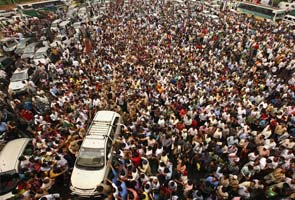
Meanwhile, news of the arrests sparks demonstrations all over the country. Thousands join in very vocal processions across states demanding their release. People in Delhi congregate around the jail as well, holding placards that read, please arrest me.


Unprecedented media coverage publicizes the events. Constant information feeds from private news channels add fillip to the cause. Tech savvy activists make the most use of the tools of Internet – twitter, facebook and youtube to ensure messages from prison reach the world. Their strategy seems to a step ahead, with the authorities having to play catch up.

74-year-old Anna Hazare, the man at the centre of the storm, was virtually unknown outside his home state earlier. He is now a national icon, and his supporters project him as the second Gandhi, leading the second freedom struggle of India through Satyagraha, the path of non-violence.

Reuters’ reporter de Bendern sees the makings of a revolt in the unrest, similar to elsewhere. He writes:
… a galvanised and frustrated middle class and the mushrooming of social networking sites combined with an aggressive private media may be transforming India's political landscape … "The new corporate middle class has little patience with the politics of dignity and identity that are -- for better or worse -- central to Indian politics"…
Perhaps the ruling coalition assumes that the stir will soon die down, as middle-class resolve tends to be tenuous.  They thus try initially to wait out the agitators’ fervour. But as passions whip up instead, party members resort to character assassinations of the social group’s leaders. They also claim them to be media creations set up to blackmail the Administration.

The unrest is branded a subversion of democracy, fronting the attack on the supremacy of the Indian Parliament by outsiders – including foreign powers. The Prime Minister labours to defend the matter in the House. He states:
The question is, who drafts the law and who makes the law? I submit that the time-honoured practice is that the Executive drafts a Bill and places it before Parliament and that Parliament debates and adopts the Bill with amendments if necessary. ... As far as I am able to gather, Shri Anna Hazare questions these principles and claims a right to impose his Jan Lok Pal Bill upon Parliament.
Opposition parties had earlier been kept out of the draft panel formed with the civil society. They now revel in the opportunity to take the Union Government to task over their mishandlings of the case. The use of force to deal with political issues earns flak as arrogance of power reminiscent of colonial times.

Satirists pounce gleefully to proclaim that in India today, people are free to graft or feed on bribes, but to fight corruption or even to not eat, they get no permission at all! In the public perception, the Government is elitist, disconnected with the masses they represent.

The erstwhile silent majority gravitates to displays of people’s power in metropolitan cities and smaller towns. In several parts of the country, entire villages, men, women and children take up the fast in solidarity with that at Delhi. Mumbai’s famed six-sigma food delivery organization, the Dabbawalas, strike work for the first time in 120 years to lend their support.

Before the ground swell of humanity, the system is forced to back down. The Delhi police withdraw all the 22 conditions they had earlier imposed, release the detainees, grant space for the protest gathering, and also assist in managing the crowds. The hunger strike now assumes the proportions of a populist movement. Politicians across the board begin to feel the pinch of adverse public opinion.

The activists further remind their audiences that the preamble of the Indian Constitution states that:
WE, THE PEOPLE OF INDIA … do HEREBY ADOPT, ENACT AND GIVE TO OURSELVES THIS CONSTITUTION.
That is, mention of the people comes first, precedes both parliamentarians and ministers in the Constitution. Essentially, the people are the supreme body, since their votes put the elected representatives in office. This perspective finds resonance with a population fed-up with political kickbacks, scams, and rampant corruption within the bureaucracy.  Social networks are abuzz with millions of supportive opinions and tweets, non-resident Indians joining in as well.


As the crowds grow mammoth rather than dwindle, ministers are caught in an unpleasant bind. They are as averse to decentralizing legislative control as they are to making Anna a martyr. The concern is the longer it takes to resolve the stalemate, the more the septuagenarian’s health weakens, and the more volatile becomes the situation.

They choose to extend an olive branch and invite dialogue. The talks begin, but the two sides are gulfed by enormous trust deficits between the governors and the governed. In the atmosphere of win-lose competitiveness, neither side is ready to unfreeze maximally polarized positions. They battle over democratic rights in the system, of the people versus elected office. Negotiations lurch from breakthrough to breakdown, to another breakthrough, another breakdown and again breakthrough…

Public statements are sometimes intractable, sometimes conciliatory, but furious activities continue behind the scenes. Mediators rush in from around the country to assist each side to keep back channels open and to unfreeze deadlocks. The former chief minister from Maharashtra, experienced in handling previous agitations in Anna’s home state, is called in as the Government’s special emissary to link directly with him.

Newscasters stationed at vantage points around the clock update reports with every new detail. Experts are called from all walks of life to analyze the nuances of move and explain their significances on the private news channels. Constitutionalists, lawyers, corporate stalwarts, authors, editors, social activists, spiritual leaders, politicians, and other celebrities - supporters, detractors and voices of moderation all share views from the same platform.

The entire country appears riveted by the drama playing out on tv. The game of brinkmanship is more thrilling than any soap opera – who will blink first? (The joke here is that Team India is hugely relieved that their disastrous performances on the cricket field in England is, for once, not the focus of public attention. They might hope their entire tour thus flies under the radar!)

During the negotiations, team compositions also change from hawkish to moderate, as the talks seem to progress at the pace of two steps forward and one back. With the forward motion, positions previously thought intractable peg down a notch. The general realization dawns that political issues do indeed require political solutions. Veteran troubleshooters are inducted, as the Prime Minister seeks out-of-box solutions.

Eventually only 3 sticking points remain to threaten compromise: the prime minister’s inclusion in the ombudsman’s (lokpal) purview, similar ombudsmen (lokayukta) for the states, and a citizen’s charter. Team Anna hinges breaking his fast on the Parliament’s vote on resolution of the three points. The Administration, averse to civil society groups dictating to Parliament, cites objections by the Opposition.

The activists appeal to the principle Opposition party to spell out their stand, and receive their support on the 3 points. Opposition parties of the right and left come together, and promise flexibility to help break the impasse. In final compromise, the Sense of Parliament resolution is introduced in both Houses, naming the three sticking points. Seven hours of intense debate on the resolution occurs in Parliament while the nation watches proceedings with bated breath. 


No individual votes follow, but members on both sides of the aisle thump their desks  to adopt it unanimously - a rare sight indeed in Parliament! A relieved Prime Minister tells newsmen: The Parliament’s will is the people’s will. Thereafter, Government’s special emissary and his group rush to the protest site, to reach Anna Hazare a copy of the resolution. He in turn, pledges to break his 12-day fast. The two sides share stage in visual confirmation that accord has been reached.

The perceptions in regions abroad appear to be that the world’s largest democracy has been brought to its knees or that India faces its own Arab Spring. After 13 days of high-voltage drama unfolding the nature of the nation’s functional democracy, we may safely disagree.

It is true that in over six decades of India’s independence, the middle-class has takes to the streets on an issue for the first time ever. Activists term it the outpouring of angst, not new political aspirations. They make no calls for anarchy, regime change, or challenge to the parliamentary system. Fact is this country’s democracy was never targeted; however, the cynical lack of accountability in political and bureaucratic circles has been impaled.

Traditionally, the middle-class remains aloof from political processes; they rarely vote, or may do so negatively. The stereotypical parliamentarian hobnobs in corporate and wealthy circles, appeases the poor before elections with sops for votes, and virtually disregards the middle groups. Their contact with constituents dissolve once the election process is over. Poll promises are forgotten, because elected members toe party lines thereafter, and focus on preserving political allegiances. Thence, their sensitivity to the wishes of the people electing them hardly exists.

The social movement may have triggered a paradigm shift in the political arena,  orientating towards participatory governance.  The surprise result of the exercise has been the dramatic rise of young India.

It is significant that the youth, educated and articulate, carry the fight against corruption on their shoulders. Inspired by the notion of nation building they volunteer services to ensure the movement’s smooth progress. Despite thousands of people congregating, sloganeering, waving the national flag, and holding candlelight vigils, there are no reports of the anticipated mass violence. The trademark Gandhi cap becomes a statement of purpose rather than of fashion, as they identify with the inscribed catchphrase, I am Anna. 


It is just as significant that ways to resolve the standoffs seem to emerge after the young members of Parliament jump into the fray. Many of this youth brigade also choose to defy tradition. They dare to speak their minds in support of social change. They grasp initiative to understand the thrust of the movement, and to acquaint senior leaders with the seriousness of the issue.

We see no losers in this Indian unrest. A people culturally grounded in moral values are unlikely to invest in the dissolution of revered institutions of State. They are however, determined to evolve with the times, in tune with the present age of global partnerships and collaborations. We may have been witness instead, to the restoration of roles and boundaries between the people, the Parliament and the Government. It perhaps bodes well for the future that the citizens of India have been awakened to their rights in the democratic system, and to the more crucial realization that rights include responsibilities.


References for this post:

  1. Thottam, Jyoti. "Anna Hazare: How One Activist Brought the World's Largest Democracy to Its Knees" time.com. Time. August 17, 2011. 
  2. de Bendern, Paul. “India faces risk of its own Arab Spring over anti-graft protests” reuters.com. Reuters. Aug 17, 2011. 

Sunday, July 3, 2011

Social: 5. The spirit of recovery


In March this year, Japan reeled under devastating blows from the environment. The country’s economic ascendency seemed to dissolve away in an instant before Nature’s fury, causing widespread trauma. Some authors say, however, that Japan’s economic decline began much earlier.

Familiar surroundings disappeared in the earthquake and tsunami.  The toll was at least 5,000 lives along with major infrastructure, leaving people lost and literally cold in the pre-spring weather.  Survivors of the destruction were left to grapple with shock and sudden adversity. Everywhere, writes a friend, almost no electivity, no water, no gas nor gasoline.

The worst environmental calamity in 140 years of that nation’s history has wiped out all traces of development. Even months later, the emotional distress persists, the friend writes:

It passed 3 months since that terrible earthquake attacked us. Since then until now I have been, somehow lethargic and do not want to do anything. But it was beginning of March and still cold and after March, April and May, now we are in June … and seems no changes happen … Northern Part of Japan, focus of the earthquake are still desert. So many people died and still so many missing, so many suffered a lot. On the other hand we are alive and so we have to live, exist…

Lethargy
is but a natural reaction, a defence against trauma most unexpected. Many wonder why they have been left alive at all when all they hold dear in life is gone. In addition, looms the threat of a nuclear fallout that could affect generations. But not everything should be blamed on Nature – the lacks of foresight and openness to change are the human contributions to disaster.


Japan became the Asian superpower on the shoulders of its manufacturing prowess over the later half of the twentieth century, while China and India still grappled with burgeoning populations and poverty. Since globalization, however, these other countries appear to have picked up their pace of development, and they are being termed ‘the new economic frontier’.

Globalization showed up the cultural stagnation. The reason for it, as Japanese retail business leader Yanai perceives, is the people’s getting stuck into change-resistant ways. Ethnocentric preferences turn them inwards celebrating sameness, and in the process, gradually they lose adaptability to the outside world that is meanwhile changing differently.  

The business practices, Yanai writes, have also become introspective:
One problem is that we look down on developing countries… we lack the willingness to learn because we have been so successful before…  we are under the illusion that we are rich and superior … in Japan, income has stagnated for many people for a decade or more. Japan is still very comfortable to live in, if you are Japanese. But there’s a difference between being comfortable and being viable.
In the global forum, crucial business decisions rest on cultural awareness. Yet many Japanese company representatives are unwilling to accept that they can and do make mistakes. Similar people issues may have underlain Toyota’s automobile debacle overseas. Their chairman, summoned before a US Congressional hearing last year on the accident involvements of their cars, hung his attribution on employee confusion between sales and quality. Disgruntled consumers however, complained that repeated problem feedbacks to the company fell on deaf ears. 

The general organizational pattern is bureaucratic, built upon traditional ideals of the Japanese culture including dignity, honour, discipline, and strength.  But expectations of social respect in the collectivistic society, often prevents bottom-up feedback and the sharing of information.  The need to preserve hierarchy may then encourage cover-ups, and thus face-saving of the decision-making structure becomes paramount.  The attenuation of creativity may naturally follow, as may the corruption of power and resources. 

Yanai points out:

Most ordinary Japanese industries are bound up by government regulation, or by agreements (tacit or explicit) within the industry. The idea is to create a union or association or something and then use it to start imposing regulation and preventing competition.

In the recent nuclear crisis at Fukushima, the country’s prime minister himself received news about reactor explosions from media reports! In truth, the reactors were able to withstand the earthquake. Against the tsunami however, the safety measures were inadequate, since a deluge of its proportions had never been experienced or even considered before. The plant authorities did not admit the shortcomings, they chose instead to play down the nuclear threat.

Garthwaite writes:
[International agencies] criticized Japanese authorities for "working from a standard nuclear industry playbook” …  calling for "a frank appraisal of what is known and not known and the potential range of damage and consequences … verbal reassurances about low radiation levels stand in stark contrast to repeated increases in the radius of evacuations."
Post-catastrophe, big firms have become pessimistic about Japan’s business conditions. Economic recovery is not expected to be broad-based and household spending has decreased. The country may also face labour shortage because of its social imbalance - the biggest demographic age group being the oldest. In a nation largely of of retirees and disconnected youth, the effects of trauma may well tend to hopelessness.

Back decades in time, in the aftermath of World War II, a proud nation was brought to its knees, with the atomic bomb explosions at Hiroshima and Nagasaki destroying Japan socially and economically.  The people’s indomitable spirit of recovery raised the levels of creativity and industry to achieve new heights of economic glory. 


Clearly, the present ‘traditions’ of closedness and ethnocentricity are not part of the cultural inheritance. Perhaps these later additions to social learning were adopted to secure the preeminence of the manufacturing industry against foreign invasions.

Beech writes that imminent labour shortage has forced open to change the most traditional doors – in sumo wrestling. This sport, totally associated with Japanese culture, has been practiced for at least 1,500 years.  Its traditional secrets can be expected to remain within the ethnic fold. And yet, the top spots of the sport in Japan itself have been taken over by gaijans – foreign athletes from Mongolia, Bulgaria, and Estonia. 

Economics again has been responsible for the dearth of local talent. In earlier ages, families sent their children to the sumo “stables” to ensure that they were at least fed. In an affluent nation, hard labour is a thing of the past. The goal becomes college education, and thereby a comfortable life.  With few indigenous aspirants, the ancient sport faced extinction. 

The training schools set higher and more stringent standards for the outsiders. But they found that international wrestlers take all in stride – discrimination, indignities, language, diet, isolation, and socio-cultural hierarchy. The rigours they were subjected to in fact enabled them to come out on top. Sumo wrestling adapted to globalisation, and now enjoys a global following.

Beech writes:
After all, if this quintessentially Japanese sport can accept—and even celebrate—foreigners, perhaps the rest of the nation can do the same in other fields.

Indeed, change is a necessary part of evolution. The world has changed, and today in the global forums, people skills are required to survive and flourish.  Sharing does not diminish knowledge, it expands it. In new millennial businesses, collaboration and partnership are replacing merger and acquisition. 

Perhaps the cultural need of the devastated nation is to revisit the forgotten past, and resurrect the spirit of recovery that once brought the people up from absolutely nothing.  Although their emotional minds are now burdened, the people of Japan need to realize that the opportunity arises to once more resurge from devastation.  And little by little, as my Japanese friend mentions, time and nature heal the sorrow.


References for this post:

1.      Beech, Hannah. “Sumo wrestles with globalization” mckinseyquarterly.com. McKinsey Quarterly. McKinsey & Company. JUNE 2011.   
2.      Garthwaite, Josie. “How Is Japan’s Nuclear Disaster Different?” news.nationalgeographic.com. NATIONAL GEOGRAPHIC Daily News. March 16, 2011. 
  1. Kihara, Leika and Ishiguro, Rie. “WRAPUP 2-Japan business mood to recover from post-quake slump-tankan” reuters.com. REUTERS. Jul 1, 2011. 
  2.  Yanai, Tadashi. “Dare to err” mckinseyquarterly.com. McKinsey Quarterly. McKinsey&Company. JUNE 2011.  

Tuesday, May 31, 2011

Social: 3. The use of advantage

Ever since I had gained a moderate amount of fame, I’d had women offering themselves to me. I’m not special; the same thing happens to every man who makes his living in sports, music, television or movies.
So says a love rat – although the term used to derogate an unfaithful husband actually insults the rodent. (The real rat merely follows the inherited code of its species, while cheating is definitely a human characteristic.) Upturns in economic and socio-cultural status appear to bring deceit and dysfunction into relationship equations.

With revelations continually appearing on global social networks, it assumes proportions of an emerging trend in celebrity marriages, especially in the West. Elsewhere, women are yet to be empowered to fight for gender equality.

In truth, the “fame” that biker James (quoted above) basked in was not quite his own achievement, but rather glory reflected off his famous wife. His illicit liaisons made a mockery of their marital union. He writes further:
After all, when you take money out of the equation, what’s the point of being famous besides having your pick of attractive partners? 


James is not alone in his proclivities. The Gropegate allegations, and the bombshell of wife and mistress both pregnant at the same time under the same roof reveal the "dark truth" behind the success saga of America's most famous Austrian immigrant. Leigh writes:
… the real Schwarzenegger —  an immoral, arrogantly reckless man with a monstrous  attitude to women and a propensity for having unprotected sex. Schwarzenegger’s rampant womanising has been known to me since 1988, as have his sleazy beginnings in the world of body building, his fondness for sadistic practical jokes, his delight in humiliating women … he often targeted unattractive women because they were more likely to worship him and his muscular physique.
Driven to sexual gratification to prove their own worth, the love rats have few qualms in breaking matrimonial vows, and family values. Men that attain the power of resources tend to assume that being famous puts them beyond the constraints of common social norms. It provides them the licence to unbridled willfulness, reducing the women around them to commodities to be used and abused.

Although gender equality is claimed in the post-feminist era, patriarchal attitudes remain embedded in the social structure. Men count on this organized bias for the tacit understanding that boys will be boys. In France, the cultural view is that affairs of sex are the man’s personal business.  Chrisafis reports:
Nicholas Demorand, editor of the daily Liberation, said his paper would continue to respect politicians' privacy. "It's a democratic principle – hypocritical in some people's eyes, but fundamental ... Ditching this principle would lead to encouraging short-term buzz and trash over quality news."
Despite the faint acknowledgement that “trash” does abound socially, the media defers to power, afraid of being denied access to crucial information. They prefer to focus reporting on more important matters, thus deliberately overlooking the predatory nature of privileged men. 

The French are accused of showing more compassion for Strauss-Kahn than for the alleged victim in the rape case that caused his arrest in New York and also cost him his job as the IMF chief. Some women activists say that had the incident occurred in France, the story may not have surfaced at all.

Politicians strive to grasp the helm of a nation’s leadership and governance. In their speeches, they profess the very highest standards of integrity and ethics, and soundness of judgement. Yet in any country, political heavyweights flouting the same ideals are legion. Their public pronouncements appear to encourage self-control less, and more the assiduous maintenance of a false front.

The wealth and clout of their wives are often pressed into service to defend these public images.  These women, already victims of humiliation, demean themselves further denouncing the charges, perhaps only to preserve the appearance of family in the public spotlight.

The tenacity of investigative journalism has brought to light many of the transgressions over the years. In USA, in the 1980s, Senator Hart had declared his presidential candidature.   Then rumours began to circulate about his philandering on the campaign trail, which he robustly denied.
“Follow me around, I don't care, ” Hart was quoted as saying. “I'm serious. If anybody wants to put a tail on me, go ahead. They'd be very bored. ”
Journalists McGee et al initially had no leads and gave the senator the benefit of doubt. Later they acted on a tip from a woman who said she didn’t want to see another liar elected. Piecing together bits of information about his whereabouts, they discovered his secret hideaway. The journalists conducted round-the-clock surveillance to gather evidence of his feet of clay. In the middle of 1987, they published their scoop. The scandal that broke permanently sank Hart’s presidential aspirations.

A decade after Hart, and, Clinton perjured himself during the trial conducted while he was President.  The crucial evidence of “the dress” eventually demolished his defences, bringing him to the brink of impeachment. One of Clinton’s then harshest critics was Senator Gingrich, a member of the political opposition. The thrice-married Gingrich himself formed relationships with subsequent wives while still married to their predecessor. As a presidential hopeful in 2012 he now admits to have indulged in other flings also.

The men put the most effort into preventing their being outed.  Their advantage of resources and position in the organized hierarchy are used to the hilt to lie, bribe, intimidate, and in the new millennium, to invest in super injunctions to gag their socially unequal mistresses.  

England footballer Giggs had the image of a devoted family man at the time when the sleazy relationships of other players were exposed in the media. His paramour was discreet, and the affair might have remained so too, because she thought they were in love and he genuinely wanted to marry her.

However, his intentions being different, the fear of exposure got to him. He obtained a Court ruling, as he claimed, to forestall possible blackmail.  But in reality, his priority was  self-preservation, as writes Allen:
…to protect his reputation and privacy both personally and professionally. His teammates certainly would not have appreciated the press hovering around the team during workouts. While the legal mandate was in effect it could have helped his team focus and perform well, which gave them a shot at winning the championship. … He was probably also concerned about protecting his sponsorship deal with Reebok and DVD sales for his workout videos.
She was slapped with the order to prevent her ever mentioning him, while no such consideration was accorded her. She could be named and vilified – and indeed it so happened. 

Twitter users, however, refused to be muzzled. On the global platform, many of them were outside the purview of the local Courts.  They took up the challenge to assert rights to freedom of speech in virtual reality. Giggs’ identity was soon splashed across social networks on the Internet.  Hemming, a British parliamentarian then named the player in the House using parliamentary privilege to also bypass the injunction.  He promises that celebrities who have such injunctions face ‘death by a thousand cuts’. 


The drama has sparked power struggles within and between the organized and unorganized social units in UK – the judiciary, the parliament and the global social networks. The social networks have "made the law an ass" and the intrepid tweeters have been threatened legal recourse. Twitter service providers are being pressured to reveal their identities. Parliamentarians insist on their legislative privileges.  Judges, on the other hand, expect laws passed by Parliament to be binding also on its members. 

The question that arises is why, somewhere on their upwardly mobile pathways, men appear to catch the common malady. James gives his reasons for his actions:

Mentally at a loss, desperate for something to make me feel as if I had some freedom, I ran through the list of things I could do to assert my independence. Infidelity, unfortunately, was at the top of the list.

Gringrich explains why in an interview:
There's no question at times of my life, partially driven by how passionately I felt about this country, that I worked far too hard and things happened in my life that were not appropriate…
Excuses for the lack of self-control seek to blame environmental pressures, rather than the individuals concerned. The point is fame and fortune brings into sharp focus the inherent character flaws of the men who so avidly pursue wealth and power. They are motivated by private logic that leads them to believe that thereby - one, they are entitled, and two, they are untouchable.  Perhaps by repeating cheating behaviours they hope to gain a sense of worth, and raise self-esteem enough to convince themselves more than others that they have indeed arrived. 


 References for this post:

  1. Allen, Amber. “Imogen Thomas’s Married Lover Finally Exposed – Footballer Ryan Giggs” wakeywakeynews.com.  Wakey Wakey News. com. 12 May 2011.  
  2. Bowcott, Owen, and Halliday, Josh. “Twitter users and the courts go to war over footballer’s injunction” guardian.co.uk. The Guardian. 20 May 2011. 
  3. Chrisafis, Angelique.“Strauss-Kahn case sparks debate about French media's deference to power” guardian.co.uk. The Guardian. 19 May 2011. 
  4. Devlin, Kate. “Giggs sets courts at war with Parliament” heraldscotland.com The Herald. 24 May 2011. 
  5. “Gingrich: Working 'too hard' led to affair” upi.com. Newsreport. US News. UPI.com. March. 9, 2011. 
  6. James, Jesse. “Tattooed biker Jesse James reveals how fame and his weakness ruined their unlikely love” Newsreport. dailymail.co.uk. Daily Mail. 22nd May 2011. 
  7. Leigh, Wendy. “How many more love children are there, Arnie? Schwarzenegger's biographer says the dark truth about the star is still to emerge...” dailymail.co.uk. The Daily Mail. 23rd May 2011. 
  8. Linder, Douglas “The Stained Blue Dress that Almost Lost a Presidency” umkc.edu. Famous Trials. Clinton  Trial 1999. Dated 2005. 
  9. McGee, Jim; Fiedler, Tom; Savage, James. “THE GARY HART STORY: HOW IT HAPPENED” unc.edu. First published The Miami Herald May 10, 1987.  Reprint undated. 

Tuesday, February 22, 2011

Motive: 7. Violence and objectification

Human beings live and work in groups. Each group develops characteristic behaviour patterns based on implicit theories, which become in time, ‘traditions’ that future generations are exhorted to follow. Differences arise between groups based on race, ethnicity, religion and so on.

Still, on looking closely, one might find that people across the globe are more similar than different, because of similar operative concepts, especially on the gender question. These can transform with new reality, but the basic threads of the ideology, the gender-role belief systems “rooted in the structural relationship between the two sexes” resist change. 

The traditions grow out of a continuum of positive and negative behaviours. Traditional masculinity, for instance, is associated with: personal sacrifice for dependents and calmness in danger. But it is also associated with: coercive behaviour, date-rape attitudes, high-risk behaviour and unemotionality. Thence ‘maleness’ finds expression in a collection of behaviours adapted to the needs of the specific cultural group.

A study in USA on the differential patterns identifies 5 endorsements types of the masculine ideology:

·        traditional
·        high violence/moderately traditional
·        moderately traditional
·        high status /low violence
·        non-traditional

These five endorsements were then related to the men’s gender-role beliefs in terms of:
·        Status/rationality
·        Anti-femininity
·        Tough image
·        Violent toughness
·        Gender-role egalitarianism

In the study, the non-traditional group of men was found less overtly masculine. They scored lower in the four variables of status, image, violence, and anti-femininity and higher than the rest in gender-role egalitarianism.

Each of the other masculine clusters identified – traditional, moderately traditional, high violence/moderately traditional and high status/low violence - were found to be moderate to high on ‘tough image’, ‘status’, and ‘anti-femininity’. To these groups, the presentation of an appropriate public image was the point.

Fischer and Good write:

… being perceived by others as tough, self-sufficient, and confident was at least moderately important… as a “ritualized form of masculinity that entails behaviors, scripts, physical posturing, impression management, and carefully crafted performances that deliver a single, critical message: pride, strength, and control… 


However, a difference was perceived in the mix regarding “violent toughness”. As the researchers explain their findings:

… men in both the High Violence/Moderately Traditional and Traditional clusters reported relatively strong endorsement of Violent Toughness as part of their masculinity ideologies … men who endorsed rather traditional-to-moderate beliefs regarding Status/Rationality, Antifemininity, and Tough Image also held quite nontraditional beliefs regarding Violent Toughness as important to masculinity (i.e., those in the High Status/Low Violence cluster).

In other words, they are divided on the display of machismo. Some wear the badge of violence; others emulate the minority ‘non-traditional’ group. Why the change? Considering their strong ‘anti-femininity’ responses, that ‘low violence’ men could be distancing altogether from gender domination and control is in doubt. Perhaps this group of status-seekers make tactical changes in the gender interface for impression management!

In many modern dual-income families, men may be uncomfortable with their wives choosing career development over part time jobs. Despite education and economics, the masculine devaluation and distrust of women is universally ingrained. At home and at work, women’s advancement may pose threats to their individual high status. In India, for instance, divorce rates and single-mother-households are both on the rise. 

Now, the high status/low violence group may be eschewing physical violence only to project in public the egalitarian image. To keep the progressives from unsettling the status quo, the subtle mode of gender discriminations may be applied instead, like objectification. Men of all cultures may ensure this feminine preoccupation with body issues with constant social reinforcements of the ‘standards’ to be achieved for their acceptance. 


What about the feminine ideology? In the patriarchal social structure, gender inequality is built in. “Female domesticity “ has been idealized throughout its history. Following the social learning in “subordination”, women eventually collaborate with men to carry forward the inequality. 

Jackson opinions that:

…women accepted male power outside the household in return for "rule in their own place."… they received "secondary gains" of social status, leisure, freedom from responsibility to earn an income, and the freedom "to devote a major portion of her time to personal adornment and attention to herself" through marriage.

In the last two centuries of organized social life, any change in women’s status has revolved around the basic tenet. More recent economic, political and legislative changes attempt to counter women’s subordination and gender inequality. But the outlook that arose from implicit beliefs and practices of male supremacy is yet to be eradicated worldwide.

Social norms targeting women cut across the divides of culture and race. For instance, women in Asia and Africa have over centuries, suffered torture to meet ‘standards’ of traditional beauty and sexuality. In the Asian Far East, the feet of female children were bound from birth to keep them small. On the African continent, young girls were forced to undergo genital mutilations to be acceptable for marriage.

Impett et al write:

Girls experience immense pressures to behave in feminine ways, both in their relationships with other people (i.e., by suppressing their own authentic thoughts and feelings) and in their relationships with their own bodies (i.e., by suppressing bodily hungers and desires to conform to prevailing images of beauty and attractiveness).

The objectification theory Fredrickson & Roberts formulated in 1997, suggests that women tend to internalize the socio-cultural values and “become their own first surveyors”. Researchers say:

… women learn to view themselves primarily through an observer’s perspective. According to objectification theory, society places more emphasis on attractiveness for women than men, such that women are constantly subject to appraisal of their appearance. Sexual objectification occurs when a person is treated as a body valued for its use by others.

Women have been taught over the ages that their personal sense of self and value in personhood rests almost entirely on others, especially the male gender, responding positively to their appearance – size, shape, colour, dress and what-have-you.

African American women may be more concerned about being judged on “skin tone, hair texture, and facial features”. Research has also found a strong link between skin tone and hypertension among this cultural group. Buchanan et al report:
…educational level, occupational level, and family income each were stratified by skin tone; higher mean educational attainment, greater participation in professional and technical careers, and higher income were associated with lighter skin tone.
In India, fairness of skin, a legacy of cultural invasions, has long been an index of beauty in the country. Fairness creams are the fastest moving consumer goods for women and men. Product advertisements suggesting associations between skin colour and upward mobility thus blatantly fill corporate coffers.

Celebrity endorsements are revered in this country, which the manufacturers utilizes to push their products. Film and TV stars gain fame leading the pack in fashion sense, and with globalization, the hot pursuit of the Western-influenced size zero dress measure. The obsession with body weight amongst the ‘white’ European and American women’s groups has often pointed to. Another emerging new trend noticed among young girls in UK is the following of porn stars. 

Buchanan et al write that:


Theoretically, this continual evaluation of the self in terms of internalized societal ideals may result in negative psychological consequences such as increased shame and anxiety. These psychological consequences of self-objectification may lead, in turn, to increased risks for mental health concerns such as depression, eating disorders, and sexual dysfunction.


Women in India and elsewhere, of the educated and employed circles as well, do little to improve their objectified status, and their debased self-esteem. The social learning has been to avoid conflict; hence the idea of confrontation is itself too stressful to contemplate. 


They would prefer to tune out of their present unequal circumstances, immerse in serialized soap operas suspending judgement and reflection on their subtle sexist messaging, or even fantasize that in individual suffering they contribute to the greater good. Implicit theories of gender inequality continue to flourish because women are yet to unite voices against second-class citizenship.


References for this post:
  1. Bidisha “Pubic hair removal: The naked truth” Article guardian.co.uk The Guardian, Friday 11 February 2011 http://www.guardian.co.uk/lifeandstyle/2011/feb/11/womens-pubic-hair-removal-porn
2.      Buchanan, Taneisha S. Fischer, Ann R. Tokar, David M. and Yoder, Janice D. “Testing a Culture-Specific Extension of Objectification Theory Regarding African American Women's Body Image” The Counseling Psychologist Volume 36 Number 5, September 2008 697-718 originally published online 8 July 2008.
  1. Fischer, Ann R. and Glenn, E. Good. “New Directions for the Study of Gender Role Attitudes: A Cluster Analytic Investigation of Masculinity Ideologies”. Psychology of Women Quarterly 22 (1998), 371-384
  2. Impett, Emily A, Schooler, Deborah, Tolman, Deborah L. “To Be Seen and Not Heard: Femininity Ideology and Adolescent Girls’ Sexual Health”. ARCHIVES OF SEXUAL BEHAVIOUR, Volume 35, Number 2, 129-142. 
  3. Jackson, Robert Max “Chapter 8. Disputed Ideals: Ideologies of Domesticity and Feminist Rebellion” nyu.edu Working Draft of DOWN SO LONG . . . Undated.