
The sight of naked figures on temple architecture is
disconcerting for a foreign traveler to India. She asks, in her blog, why
these compromising positions should display at a temple. Obviously, at
Western places of worship, nothing unprepossessing like them exists. The
apparent social indiscipline upsets her organized mind, and the expectation of
what should be. Clearly, there is a clash of cultures.
Organization gives meaning to everyday life
in the West, a social control apparently missing in more organic
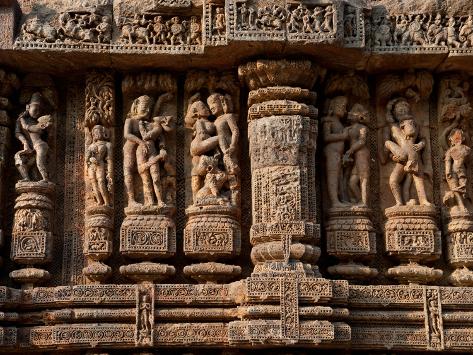
cultures on the other side of the world. In the temple arts of India, erotic
compositions in full view are usual. Male and female figures may be bejeweled,
bedecked with flowers, but otherwise naked.
Why? One thing for sure, the social context differs – certain
artworks are dated around 6-2 millennium BCE. However, since paper trails
documenting this remote past are inadequate, the conceptual reasons for the
artworks must be left to conjecture. Numerous include have arisen in attempts
to explain the practice.
These include:
These include:
- Sign of happiness, auspiciousness and prosperity: that the figures are motifs to bring good fortune.
- Mock the ascetics: that the intent is to ridicule the esoteric practices of the extreme sects.
- Code language: that the compositions carry a deeper spiritual meaning. The figures are not about the humans but symbolic representations of attributes of Nature.
- Conceal the magico-propitiory yantra: that the figures are a distraction, used to conceal the important points of specific ritualistic designs.
- Non-duality: that the male and female elements are opposing forces that complement each other, and ultimately become One.
It is known, however, that there were restrictions on the dissemination of knowledge. It was strictly on need to know basis, in the sense that only worthy receptacles could receive knowledge. Not segregation by birth, but by ability. Truth to be revealed to a person depended upon their level of spiritual preparedness for it. Seats of education were the gurukul, the ashram or temple home of the teachers, who were priests and also householders. Knowledge was not open to the uninitiated, neither was entry to the temples.

For instance, the Rig Veda, the oldest of the written scriptures, which dates around six millennia BCE, is an epic poem with over ten thousand verses. The verses can be chanted in three different meters that change their interpretation of divine truths. Students would be allowed a particular meter only after they were deemed fit and ready for it. Else, the hidden meanings would be kept secret.
The Hindu temple arts of India were created over several millennia, from ancient to medieval times. They are often carved or painted in intricate designs on solid rock. In some places, they are within caves in the mountainside. Unknown artists laboured over them, with rudimentary chisels and hammers, and organic colours of the time, to create sculptures and murals that have survived the ages. Their models were not live humans, but products of their imagination.
Objectification of gender is not the purpose in temple art. The lack of clothing on the figures signifies divinity, when the light of complete self-awareness renders external coverings redundant. The gods and goddesses depicted are meant to be numerous forms of One Supreme Being - the one that becomes many. The figures and their relationships are heavy with symbolism; male and female elements complement each other in their representative powers.
Stephen Knapp writes:
In the Vedic tradition it is common to see the pairing of the Vedic male Gods with a female counterpart, thus combining both sets of powers and qualities that each would have. We can easily see this in Radha-Krishna, Sita-Rama, Lakshmi-Vishnu, Durga-Shiva, Sarasvati-Brahma, Indrani-Indra, etc. Thus, we have the combination of male and female Divinities that make the complete balance in the divine spiritual powers.

Fact is Hinduism started out as a philosophy, not as a religion. Neither in ancient society was a woman barred from intellectual pursuits. Women as a group held high positions in society. The verses of the Rig Veda (the oldest of the scriptures written down about six millennia BCE, but likely composed far earlier) extol the prowess of over thirty women sages that were held in the highest esteem.
The temple compositions retell stories from the mythology, the scriptures and other ancient texts. The multiply arms, heads, or animal parts in the portrayals also have symbolic meaning. The female elements in the compositions are not subordinate to the gods. The goddesses ache instead for victory in battles against male elements! In their pose, prototype and expression, they exude power.
For instance, the image of Durga, the warrior goddess is shown to have eight arms. This means that she is able to combat in eight directions simultaneously that the male gods cannot! The ‘battle’ signifies the conflict of good and evil. Actually, ‘gods’ and ‘demons’ represent the strengths and weaknesses of a person, and the conflicts between them, rife moral dilemmas.

In subsequent ages, Hinduism transformed to an orthodox religion with deity worship and ritualistic practices. Changes wrought by invasions, conquests, annexations and colonization of the country buried the gender equality of ancient India deep into the sands of time. The roles of sages, apostles, prophets and avatars became the prerogative of men in subsequent ages of patriarchy. The feminine gender was made to believe that they are the secondary sex, and thus their objectification justified.
The point is the ancient temple arts communicate imagery of a bygone social context different from that today. Artefacts still standing, are possible testimony to the different reality. There and then, the female was at least equal to the male. Walls and architecture bear proof of the pride and power of female sexuality. Over time thereafter, women's groups appear to have lost sight of their identity, their social power, and, in the words of present day thinkers, their erotic territory. The pilgrimage for the modern woman should be to rediscover their social worth and value through relevant lessons from the past. They need to find power within their self, to chart for the future, the culture of enlightened gender roles.


