Showing posts with label governance. Show all posts

Thursday, September 4, 2014

Heed the homily, sir


As the one of India’s very ordinary citizens, the intricacies of governance is a little beyond me, as it must be amongst the vast population of the country. The Supreme Court’s response last week to a petition against tainted ministers caused a stir in political circles, and some lawyers termed it overstepping jurisdiction.  I hoped it was a ruling dramatic enough to shake the country out of its stupor.
 

In the Indian Parliamentary system, the Constitution clearly and ingeniously separates the powers of the legislature, the executive and the judiciary. Like an equilateral triangle of power, each has pole position, and is a counter to the others. Their equidistance is a democratic necessity, maintained by check-and-balance to prevent the usurpation of power by any one, or connivance of two against the third. Nobody guards turf better than the members of the tripartite. They do not have to agree, and so, with metronomic regularity, they flex muscles to prove they do not. But in this case, certain politicians applauded the Court’s stand, which is a bit unusual. 

A public interest litigation was filed some ten years ago (against ministers of the last coalition government actually), asking the Court to disqualify ministers involved in cases. As it happens, thirteen ministers, almost a third of the present Administration, have lawsuits pending against them; some named the accused in criminal cases. Granted that at times, these may be frivolous, filed to create trouble, and that none of the charges have yet been proven. And, that this stalemate may continue for years, because delays in Court are easy to obtain by filing appeal after appeal. The point is we, of the almost silent majority, are tired of political sins, real or imaginary, being swept under the carpet of expediency.

On the campaign trail several months ago, news channels reported statements the Prime Ministerial candidate purportedly made, and I quote: 

Just give me one chance to clean the system. I will set up special courts under the supervision of the supreme court to try all the tainted MPs and MLAs, that too within [a] one-year time limit. After one year, those who are guilty will go to jail. 
 
These impressive words must have contributed at least a smidgen to his attaining office with sweeping majority a short time later. We are now well into the “one-year time limit” delineated. However, in the months that have passed since then, there has been a profound executive silence on the matter. 


The question often raised is that should the country meanwhile be deprived of the talents of the ministers in governance? In this there are no global cultural differences! The identical equation of worth is brought up whenever an incumbent is caught out or indicted for corruption of one type or another anywhere in the world. The standard of personal integrity should be held high and uncompromising, because the public arena is such a minefield of temptation. Power corrupts, said Hobbs so many decades ago, and absolute power corrupts absolutely. The executive body knows, as does each member of the judiciary and the legislature, that thence, they are called to be above reproach.

The flawed character is prone to deviousness to cover up their lacks of honour, merit and commitment. Neither is there the moral centering and self-control needed in the job; they repeatedly falter, or take the easy way out, and then expect protection of the Institution. Its veil of immunity is probably what they count on, because surely they are well aware of the outcomes of indiscreet or corrupt activities.  

That quality of person has no business being there in the first place, and should indeed be kept out. This nation has survived more than five thousand years without their inputs and certainly can manage further. Yes, some have been falsely accused. They should have the grit to ride out the storm, and return exonerated, elevated to spotless in the eyes of the nation. Few though, can resist the lure of the kursi (chair)! 

I couldn’t figure where the Bench had overstepped its bounds in this particular case of public interest. Fact is they actually declined disqualification, and no surprise then that the politicians applauded! The Court claimed no Constitutional provision for it; it would tantamount to crossing the boundaries of judicial review. However, there was a sop for the many, many in the country that had hoped for a definitive directive.  Politicians convicted and sentenced are disqualified from elections, even if they are in the midst of filing appeals. Miniscule though it is, perhaps it is a wiggle of change in the right direction.

The 5-member Supreme Court Bench left the task of dealing with tainted ministers up to the discretion of the Prime Minister, the executive head of government. As reported in the news, and I quote, they said:
 
The Prime Minister, while living up to the trust reposed in him, would consider not choosing a person with criminal antecedents against whom charges have been framed for heinous or serious criminal offences or charges of corruption to become a minister of the council of ministers… This is what the Constitution suggests and that is the constitutional expectation from the Prime Minister. Rest has to be left to the wisdom of the Prime Minister. We say nothing more, nothing less.

Well, there we have it, the old and trusted check-and-balance at work! One body on the power triangle can go only so far. May be their hands are tied and they cannot issue directive to the Chief Ministers of states, and the Prime Minister of the Union. May be the “homily” was all that they are able deliver under the circumstances. But to the ordinary citizen, it could look like the suave passing of the buck characteristic of democracy – everybody’s business is nobody’s business.


It may also be that the Bench decided to serve a subtle reminder to the Prime Minister of his own words to the electorate in the run-up to the elections. They put the ball squarely in his court. Many of us remember that on several occasions before and after assuming office, swacch (clean) is the word he emphasized. On the national stage, he promised to prioritize clean rivers, clean environment and clean government. Even those that did not vote him to power were impressed with his forward-looking speeches. The hope being that acche din (good days) are really here, rather than merely in a catchy slogan.

It is owed to the country. For decades we have waited for our political leaders to lead the country into the light, and almost every time, we have be left with disillusionment. But still we believe that change is right around the corner. Lest he forget, they have taken oath to bear true faith and allegiance to the Constitution of India and to discharge their duties faithfully and conscientiously. The time for talk is over; it is now time to execute. That is why he is in office - to do in letter and spirit of the Constitution. The country must now await the outcome of the executive decision. Will the homily be heeded? Or will political expedience trump personal integrity?

Wednesday, August 20, 2014

Swacch is the key


Independent India turns sixty-eight years, and we are proud to be us, its democratic people! In keeping with the tradition set with “India’s tryst with destiny” so many decades ago, today is the Prime Minister’s day. To the strains of the national anthem he unfurls the national tricolour, he takes the inter-services guard of honour, and he gives the speech to set the tone of things to come in governance. 


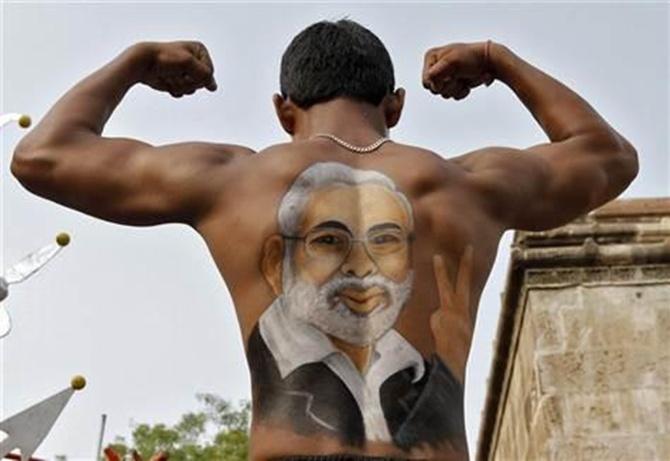
We witness Narendra Modi, resplendent in a pagri (turban), take the stand for his first shout out to the nation from the historic rampart of the Red Fort. This Union administration has been at work for a couple of months and it is about time they have a handle on things. We hope that they will now begin to deliver results that are actually good for the country.

I’m sure there is an army of speechwriters to help with the message, but on this day he decides to speak extempore. It is a brave move, and I hope he will not ruin it with political rhetoric. We are tired of politicians devaluing occasions by sniping at one another, blaming previous administrations for failures that continue, and wooing vote blocks with an eye on the next elections.

As he speaks, his grasp of matters is compelling. We are reminded that, although he is often derogated as a chaiwala (tea-seller), Narendra Modi is an educated man. Before this, he has been the Chief Minister of Gujarat for four terms. Part of this state of western India, was devastated by a massive earthquake.  Visitors to the regions since that decimation are impressed with the recovery he led. With the Hindu-Muslim riots however, Modi was tainted with the communal tag. The USA went so far as to cancel his visa to that country.

I wonder if that was the result of the “vilification campaign”, many at its receiving end are accusing Western media of conducting! The point is, Narendra Modi was cleared of culpability by the Supreme Court, the highest judiciary body of India, and hence was able to contest national elections successfully. Today, the US Administration is forced to back-pedal fast to establish diplomatic ties with the new Head of the Union Government of India!

I had the impression that he was a force to be reckoned within the Gujarati community, an icon within a certain religion and caste. When election results were announced, and the party projecting Modi as the Prime Ministerial candidate won a landslide victory, I texted “The Guju has landed!” to my non-resident extended family that had been rooting for him, while thinking to myself “God help us now!” My point is that when India is secular according to its Constitution, there should be no place for sectarianism in the Union Administration.

It is perhaps a discourteous thing to do, but when unimpressive politicians deliver uninspiring speeches, I tend to switch off the set or change channels. I am probably not the only one in this country to do so. I tuned into the live telecast of his acceptance speech with some trepidation. Although the trappings of the victory celebrations were distinctly Hindu rituals, it was a relief to hear the speech devoid of religious overtones. It was surprisingly sensible speaking without a written script to keep message on track. The man is gracious to the opponents he has drubbed at the hustings. It is his duty, he said, as the prime servant of the country, to also carry along with him the hundreds of thousands that did not vote for him.


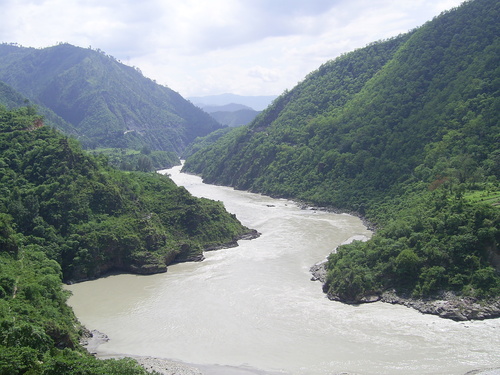
Modi strikes a chord when he points out that despite the traditional reverence, the Ganges is dreadfully polluted. The River Ganges, one of the most prominent in the country, has sustained civilizations on her banks over several millennia. Hindus especially, worship her as Mother Ganga. Why then, he asks, do we tolerate our mother remaining unclean?  He pledges to prioritize the cleanup of rivers. The environmental consciousness is unexpected, since Indian politicians allegedly kowtow to the creators of much of the pollutants, the big business houses. 

In his first Independence Day address to the nation, Modi harps on the same swacch (clean) theme as in his acceptance speech. He calls on industry to utilize India's vast human and knowledge resources, to make in India various good with zero defect and zero effect (on the environment). He draws attention to unsanitary living conditions that have become characteristic of rural and slum areas. People still continue the habit of using the great outdoors, in the absence of toilets.  In growing populations, women have to wait for the cover of darkness before they may do the same. Modi questions – why this disrespectful disregard for our mothers and sisters? He exhorted corporate social responsibility in corporate houses and NGOs to prioritize toilet construction.

But to my mind, this would address only half the issue. Amongst the majority of Indians, the attitude to swacch (clean) must change. At present, it is a contradiction. People are very particular about personal hygiene and will bathe several times a day to emphasize it. However, there is a cavalier disregard for environmental cleanliness. Boys and men relieving themselves at any convenient street corner is a common sight even within the city. And it is not just the poor that do so; the habit is rife amongst those more privileged. Women, with nowhere to go, tend to avoid fluid intake to 'control' bodily functions, which leads to eventual health complications.

Most definitely, public toilets for men and women and garbage vats are urgently required at every street corner. But those that are there are so badly maintained, they are unhygienic, unsanitary, and the sources of disease. Government installations - offices, schools, colleges, universities, hospitals, trains, are the worst imaginable. They are improperly used as well, as if the people are still in the great outdoors! The plumbing is blocked, choking and often overflowing. Nobody seems to complain or even notice. Garbage disposal is simple too; just toss them out on to the street, as though to a kitchen garden compost heap! These habits persist even in the foreign returned, those that should know better. 

If cleanliness is next to godliness, we have fallen far indeed! We hear Modi is a man of action, and he likes getting things done. He has begun a new trend of issuing “report cards” to parliamentarians on the work they do for their constituents. He has called upon them to create model villages. So far he has sounded no-nonsense. And if India’s new Prime Minister is able to unfreeze the mindset of the country’s teeming populations, to make swacch the key to change, he will have done the world a great service.

Monday, August 13, 2012

The bureaucratic inheritance

It often seems to me that, whether or not they are related by blood, people living together begin to resemble one another over time. Perhaps in eating the same foods and breathing the same air, sameness pervades. We might assume that people unconnected by blood or proximity, differ widely. And yet, in similar organizational structures, members begin to look alike, think alike and behave alike although separated geographically. Those that go before must leave behind something lasting in the structure to anchor time, because the sameness prevails over generations.

The bureaucratic structure, for instance, is our colonial legacy. In organizational shape, it is pyramidal, a hierarchy of levels. The flow of authority and information is top down, and bottom up, obedience is norm. The bureaucratic structure is meant to be impersonal, and the process theoretically, is to be rational, logical and impartial in governance. It was introduced into India by British colonizers. But the very nature of colonization superimposes the concept of the alpha male onto the organizational pyramid. In tune with the ascent of man on the evolutionary chart, the higher echelons of the hierarchical structure are considered superior to people on the rungs below.


The colonial bureaucracies overlaid superiority of race onto the caste hierarchy already prevalent in the region. The Indians realized that despite their knowledge and experience, their organizational aspirations were limited because even junior officers of the British civil service would lord it over the local populace.

The bureaucracies enabled imperialism keep a tight rein on their empire spreading overseas. Educated Indians were inducted to clerk for the colonizers, and to liaison between cultures in the sub-continent. They were called the ‘Baboos’ that looked and dressed Indian, but protected the Crown, furthering the imperialistic goals. Rather like the ‘trusties’ of the prison system, wherein certain prisoners elevated fractionally above others, serve to keep them in line. The Baboo culture was likewise despised by either side.

The colonizers used the Baboos to do their dirty work but hardly respected their racial differences, while the rest of the country hated them as stooges of the foreign establishments. The Baboos responded to the negativity by creating their own fiefdoms within the structure. They became the backbone of the system, indispensable to its functioning. On the one hand, they could interpret and translate communications as they wish, and on the other, withhold information and benefits to the public at large.

Indians are good with cultural traditions; we are loath to disturb the continuity with the past. Customs, practices, norms and habits handed down generation to generation are perceived sacrosanct. Despite the complete change in the social environment, bureaucracies in India meticulously preserve their 200-year old colonial traditions. They thus socialize into disrespect for subordinates, while the ordinary public is the common enemy to protect against.

Consequent to the colonial influence, the character of the pyramidal structure transforms to unfriendly, intimidating and prohibitive. Up and down the bureaucratic hierarchy, countenances are as grim and unbending today as they have been during the British Raj. Especially in the public interface, mistrust and impatience radiate. Communications base on anger management - that is, the lack of self-control characterize the hierarchy. Imagine a blend of parent-child behaviours, rigid and willful at the same time. Obviously, manners get lost in the upward mobility, and often also the work ethics.

Fact is technology thrives, but the traditional mindsets remain entrenched. The change with democracy and independence of the nation, is simply that nobody wants to be the low man on the totem pole anymore. As noted Indian entrepreneur Narayan Murti observes:

In India, we tend to look down on people who do jobs that require physical work or involve disciplined execution and accountability.

As a result, the first impression of any bureaucratic setup in India is poor. The ambience carries a general air of neglect. Governmental or government-related organizations in India may have expensive machinery or other goods strewn carelessly along the corridors. They may have the financial resources to fund other organizations. And yet, black cobwebs sway from the ceilings in the buildings, dust settles on every surface, and the stench of bathrooms hangs thick. Heaps of files, spill their contents onto desks, shelves and floor. Spatters of betel nut juice stain wall corners in the stairwell, while potted plants serve as ashtrays.

The dirty, unkempt look is likely also a façade to put off the public. The disorganization may be intentional, because almost hidden from view behind the mountains of paper files, the Baboos of today continue to protect their territory. Emotions otherwise denied, flow down and out in angry outbursts as individuals seek to assert themselves in the new India by demeaning others. The beat postmen express their angst by delaying or losing mail. The staffs in government offices pretend to be too busy to entertain queries or move files along. Railways employees mess with reservations, even on complimentary passes awarded to the elderly freedom fighters of India’s independence.

The lateral relationships within the pyramid are tight, however. These informal connections are assiduously cultivated to form the social buffer zones, safe to download in. Large numbers of employees unionize together. By themselves the unions may be weak, but they forge outside political affiliations, whose patronage strongly back their workplace confrontations. The attraction to employment in the bureaucracy is job permanence. Employees are confident they cannot be fired because of swift retaliatory union strikes; hence irrespective of actual work done, their wages shall be paid at fixed intervals. Further, the lack of conflict on the lateral plane ensures that the organizational boat remains on an even keel, with little competition between peers.

The Diva writes elsewhere:

For many organizations, conflict is bad - by definition - and they go out of their way to prevent it. The word ‘challenge’ itself becomes sensitive because it may question premises and upset comfort zones. However, the elimination of all discord has consequences. The organization may rarely or even never question its assumptions. It may turn off and lose its creative sparks … The ultimate danger is the rise of the mediocre, rewarded for lacking the ‘superstar quality’ to rock the boat.

The point is this carried forward in time existence tends to atrophy faculties of effective decision-making. The bureaucratic runaround is thus born as indecision is passed around, desk to desk. Members of the organization become champions at dithering. With sudden, unexpected changes in the global scenario, they are invariably caught on the wrong foot. Thus, the most recent downslide in the Indian markets has been attributed to faulty decisions and planning. India's much touted economic ascendancy is now falling behind.  

Bureaucratic structures in India need to wake up to the reality of their increasing incompetence with competition. Their people need to challenge outdated assumptions of leadership styles, philosophies and value systems that have become the unquestioned organizational traditions over the last couple of centuries. Unless the dependence on these outmoded systems and processes is changed, the colonial inheritance will ensure that bureaucracies in India remain locked in the mindsets of a different age.

Monday, August 29, 2011

End of India’s democratic system?

Unrest is sweeping around the world rather like mass hysteria. After authoritarian regimes, democracies now face the heat. The question arises whether here the attempts of social groups are to uphold democratic freedoms, or to holdup systems to ransom.

The tidal wave of protests has now hit India. A section of civil society has chosen to confront the Union Government on it executive functioning. The social group, led by Anna Hazare and dubbed Team Anna in the media, demand the Parliament should make into law the anti-corruption bill they have drafted.

The practice in law making to date has been that civil servants draft bills at the behest of the ruling party. That bill is presented to Parliament and should it receive the majority vote of its members, it becomes law.

Writing in Time, Thottam comments:

It's not clear that the Lokpal bill would be much of an improvement. It's also hard to imagine how the world's largest democracy would function if it gave way every time a prominent protestor demanded a new piece of legislation.

Over 42 years, and despite eight bill presentations, however, successive Parliaments have failed to create a comprehensive anti-corruption law. Hence, Team Anna take it upon themselves to draft the Jan Lokpal Bill that seeks to appoint an ombudsman, and empower them to investigate corruptions charges at all levels of the bureaucracy.

Earlier, the civil society group did manage to compel the forming of a special panel of 5 ministers and 5 activists to discuss their bill draft. The aim is to arrive at a consensus on the bill to be presented to Parliament. But the talks stall over six sticking points. The Government then goes ahead to table before the House their own version, the Lokpal Bill, which effectively protects key positions from the investigative scrutiny.

Team Anna turns to street politics in the effort to garner support for their bill. They accuse the Administration of lacking the political will to tackle rampant corruption and protecting it, in fact. To protest the ineptitude, they announce a hunger strike to be launched publicly.

That earns a crackdown; perhaps the fear in accommodating them is of setting a dangerous precedent. Police swoop in with preemptive arrests of the protest leaders. About twelve hundred others are also detained to stamp out the imminent agitation.  Perhaps the Administration’s strategy is also influenced by events in London, where lawlessness ruled rife for several days. 

However, the move backfires, and is seen by the nation as heavy-handed stifling of dissent.  Two hours later, their release is offered on condition they eschew the agitation. Undaunted, the activists refuse to leave until their demands are met – of the right to conduct public dissent, and of the right to draft the legislation to be made law. Lodged in the Tihar Prison, they kick off their fast on the premises itself.

Meanwhile, news of the arrests sparks demonstrations all over the country. Thousands join in very vocal processions across states demanding their release. People in Delhi congregate around the jail as well, holding placards that read, please arrest me.


Unprecedented media coverage publicizes the events. Constant information feeds from private news channels add fillip to the cause. Tech savvy activists make the most use of the tools of Internet – twitter, facebook and youtube to ensure messages from prison reach the world. Their strategy seems to a step ahead, with the authorities having to play catch up.

74-year-old Anna Hazare, the man at the centre of the storm, was virtually unknown outside his home state earlier. He is now a national icon, and his supporters project him as the second Gandhi, leading the second freedom struggle of India through Satyagraha, the path of non-violence.

Reuters’ reporter de Bendern sees the makings of a revolt in the unrest, similar to elsewhere. He writes:
… a galvanised and frustrated middle class and the mushrooming of social networking sites combined with an aggressive private media may be transforming India's political landscape … "The new corporate middle class has little patience with the politics of dignity and identity that are -- for better or worse -- central to Indian politics"…
Perhaps the ruling coalition assumes that the stir will soon die down, as middle-class resolve tends to be tenuous.  They thus try initially to wait out the agitators’ fervour. But as passions whip up instead, party members resort to character assassinations of the social group’s leaders. They also claim them to be media creations set up to blackmail the Administration.

The unrest is branded a subversion of democracy, fronting the attack on the supremacy of the Indian Parliament by outsidersincluding foreign powers. The Prime Minister labours to defend the matter in the House. He states:
The question is, who drafts the law and who makes the law? I submit that the time-honoured practice is that the Executive drafts a Bill and places it before Parliament and that Parliament debates and adopts the Bill with amendments if necessary. ... As far as I am able to gather, Shri Anna Hazare questions these principles and claims a right to impose his Jan Lok Pal Bill upon Parliament.
Opposition parties had earlier been kept out of the draft panel formed with the civil society. They now revel in the opportunity to take the Union Government to task over their mishandlings of the case. The use of force to deal with political issues earns flak as arrogance of power reminiscent of colonial times.

Satirists pounce gleefully to proclaim that in India today, people are free to graft or feed on bribes, but to fight corruption or even to not eat, they get no permission at all! In the public perception, the Government is elitist, disconnected with the masses they represent.

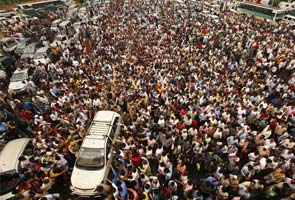
The erstwhile silent majority gravitates to displays of people’s power in metropolitan cities and smaller towns. In several parts of the country, entire villages, men, women and children take up the fast in solidarity with that at Delhi. Mumbai’s famed six-sigma food delivery organization, the Dabbawalas, strike work for the first time in 120 years to lend their support.

Before the ground swell of humanity, the system is forced to back down. The Delhi police withdraw all the 22 conditions they had earlier imposed, release the detainees, grant space for the protest gathering, and also assist in managing the crowds. The hunger strike now assumes the proportions of a populist movement. Politicians across the board begin to feel the pinch of adverse public opinion.

The activists further remind their audiences that the preamble of the Indian Constitution states that:
WE, THE PEOPLE OF INDIA … do HEREBY ADOPT, ENACT AND GIVE TO OURSELVES THIS CONSTITUTION.
That is, mention of the people comes first, precedes both parliamentarians and ministers in the Constitution. Essentially, the people are the supreme body, since their votes put the elected representatives in office. This perspective finds resonance with a population fed-up with political kickbacks, scams, and rampant corruption within the bureaucracy.  Social networks are abuzz with millions of supportive opinions and tweets, non-resident Indians joining in as well.


As the crowds grow mammoth rather than dwindle, ministers are caught in an unpleasant bind. They are as averse to decentralizing legislative control as they are to making Anna a martyr. The concern is the longer it takes to resolve the stalemate, the more the septuagenarian’s health weakens, and the more volatile becomes the situation.

They choose to extend an olive branch and invite dialogue. The talks begin, but the two sides are gulfed by enormous trust deficits between the governors and the governed. In the atmosphere of win-lose competitiveness, neither side is ready to unfreeze maximally polarized positions. They battle over democratic rights in the system, of the people versus elected office. Negotiations lurch from breakthrough to breakdown, to another breakthrough, another breakdown and again breakthrough

Public statements are sometimes intractable, sometimes conciliatory, but furious activities continue behind the scenes. Mediators rush in from around the country to assist each side to keep back channels open and to unfreeze deadlocks. The former chief minister from Maharashtra, experienced in handling previous agitations in Anna’s home state, is called in as the Government’s special emissary to link directly with him.

Newscasters stationed at vantage points around the clock update reports with every new detail. Experts are called from all walks of life to analyze the nuances of move and explain their significances on the private news channels. Constitutionalists, lawyers, corporate stalwarts, authors, editors, social activists, spiritual leaders, politicians, and other celebrities - supporters, detractors and voices of moderation all share views from the same platform.

The entire country appears riveted by the drama playing out on tv. The game of brinkmanship is more thrilling than any soap opera – who will blink first? (The joke here is that Team India is hugely relieved that their disastrous performances on the cricket field in England is, for once, not the focus of public attention. They might hope their entire tour thus flies under the radar!)

During the negotiations, team compositions also change from hawkish to moderate, as the talks seem to progress at the pace of two steps forward and one back. With the forward motion, positions previously thought intractable peg down a notch. The general realization dawns that political issues do indeed require political solutions. Veteran troubleshooters are inducted, as the Prime Minister seeks out-of-box solutions.

Eventually only 3 sticking points remain to threaten compromise: the prime minister’s inclusion in the ombudsman’s (lokpal) purview, similar ombudsmen (lokayukta) for the states, and a citizen’s charter. Team Anna hinges breaking his fast on the Parliament’s vote on resolution of the three points. The Administration, averse to civil society groups dictating to Parliament, cites objections by the Opposition.

The activists appeal to the principle Opposition party to spell out their stand, and receive their support on the 3 points. Opposition parties of the right and left come together, and promise flexibility to help break the impasse. In final compromise, the Sense of Parliament resolution is introduced in both Houses, naming the three sticking points. Seven hours of intense debate on the resolution occurs in Parliament while the nation watches proceedings with bated breath. 


No individual votes follow, but members on both sides of the aisle thump their desks  to adopt it unanimously - a rare sight indeed in Parliament! A relieved Prime Minister tells newsmen: The Parliament’s will is the people’s will. Thereafter, Government’s special emissary and his group rush to the protest site, to reach Anna Hazare a copy of the resolution. He in turn, pledges to break his 12-day fast. The two sides share stage in visual confirmation that accord has been reached.

The perceptions in regions abroad appear to be that the world’s largest democracy has been brought to its knees or that India faces its own Arab Spring. After 13 days of high-voltage drama unfolding the nature of the nation’s functional democracy, we may safely disagree.

It is true that in over six decades of India’s independence, the middle-class has takes to the streets on an issue for the first time ever. Activists term it the outpouring of angst, not new political aspirations. They make no calls for anarchy, regime change, or challenge to the parliamentary system. Fact is this country’s democracy was never targeted; however, the cynical lack of accountability in political and bureaucratic circles has been impaled.

Traditionally, the middle-class remains aloof from political processes; they rarely vote, or may do so negatively. The stereotypical parliamentarian hobnobs in corporate and wealthy circles, appeases the poor before elections with sops for votes, and virtually disregards the middle groups. Their contact with constituents dissolve once the election process is over. Poll promises are forgotten, because elected members toe party lines thereafter, and focus on preserving political allegiances. Thence, their sensitivity to the wishes of the people electing them hardly exists.

The social movement may have triggered a paradigm shift in the political arena,  orientating towards participatory governance.  The surprise result of the exercise has been the dramatic rise of young India.

It is significant that the youth, educated and articulate, carry the fight against corruption on their shoulders. Inspired by the notion of nation building they volunteer services to ensure the movement’s smooth progress. Despite thousands of people congregating, sloganeering, waving the national flag, and holding candlelight vigils, there are no reports of the anticipated mass violence. The trademark Gandhi cap becomes a statement of purpose rather than of fashion, as they identify with the inscribed catchphrase, I am Anna


It is just as significant that ways to resolve the standoffs seem to emerge after the young members of Parliament jump into the fray. Many of this youth brigade also choose to defy tradition. They dare to speak their minds in support of social change. They grasp initiative to understand the thrust of the movement, and to acquaint senior leaders with the seriousness of the issue.

We see no losers in this Indian unrest. A people culturally grounded in moral values are unlikely to invest in the dissolution of revered institutions of State. They are however, determined to evolve with the times, in tune with the present age of global partnerships and collaborations. We may have been witness instead, to the restoration of roles and boundaries between the people, the Parliament and the Government. It perhaps bodes well for the future that the citizens of India have been awakened to their rights in the democratic system, and to the more crucial realization that rights include responsibilities.


References for this post:

  1. Thottam, Jyoti. "Anna Hazare: How One Activist Brought the World's Largest Democracy to Its Knees" time.com. Time. August 17, 2011. 
  2. de Bendern, Paul. “India faces risk of its own Arab Spring over anti-graft protestsreuters.com. Reuters. Aug 17, 2011. 

Thursday, August 25, 2011

Endangered species, the super-rich!

Democratic freedoms seem to mean different things to different people, as events in different countries show. On the recent riots in London, we posted the thought that, among the socially disadvantaged, long-term frustrations with systemic inequality, may have finally boiled over into displays of violent dissent.The taxpaying public affected by the unrest has had little sympathy for it; the super-rich has remained cocooned. 

To sections of society, the sudden budget cuts could have felt like the last straw in the suspension of civil rightsHowever, reader from UK argues that benefits have been the actual source of the problem, having largely nurtured grifters seeking to appropriate what they do not earn. Their freebies threatened, these people planned the criminal activities.

He shares with us his indignation:
In Britain we are faced with reducing a huge debt and everyone is paying the price… benefits are one of the causes of the debt in the first place … Here even those with nothing can achieve a better standard of living IF THEY CHOOSE TO WORK HARD but many don't [and] they choose to take money and do nothing. There are some who cannot achieve anything and need help but there are also many who just can't be bothered.
The perception there is not so much of spontaneity in the protests, as of deliberately orchestrated lawlessness. Organized groups of criminal elements fanned out to stretch police resources thin, so that the looting could continue without inference. 


Our incensed reader adds:
… it's a good thing I'm not mayor of London otherwise I think I may have used Chinese or Syrian tactics and issued machine guns to the police and told them to fire at the knees and then arrested those people in hospital.
The palpable disgust of the salaried class probably stems from the economic pressures placed on them. In the dodgy economy, they are asked to share sacrifices with austerity measures. They carry the brunt of the tax burden, and as they see it, it is their contributions that ensure survival of the non-payers.

Powers-that-be perceive broken sections in society. They do not however, perceive the sustained political and corporate contributions to the moral collapse. The general solution resolved seems to be to stamp out the gangs with stiff sentencing of the looters caught on camera, and further cuts in their benefits.

But these stern measures would do nothing to address the searing sense of deprivation. Rather, the administration’s iron hand would underscore their disconnect with the ordinary population - pejoratively, the underclass. The social alienation that already exists may even be compounded as criminality in the targeted groups.

Meanwhile political establishments tend to coddle their super-rich. The tax payments of the moneyed class are minimal, which bloats their returns on investments. This tacit political support of the social hierarchy has widens its divides, with the rich simply getting richer. Billionaires in fact, are protected as if they are endangered species.

Warren Buffet comments:
OUR leaders have asked for “shared sacrifice.” But when they did the asking, they spared me. I checked with my mega-rich friends to learn what pain they were expecting. They, too, were left untouched. While the poor and middle class fight for us in Afghanistan, and while most Americans struggle to make ends meet, we mega-rich continue to get our extraordinary tax breaks … 

The Western perspective generally is pro-business, and the prevailing social climate relentlessly projects consumerism. Media entertainment and advertising tend to portray acquisitions as the most important goal in life, at the expense of honest human achievement.  

Booker points out:
Today, whenever my world-weary eyes alight on a "youth show" it merely resembles a glossily edited advert for celebrity lifestyles, co-starring a jet-ski and a tower of gold. And regardless of the time slot, every other commercial shrieks that I deserve the best of everything. I and I alone.
When sensation and consumption pervades the environment around them, few can escape the social learning. Consumerism burns in the hearts of the have-nots, especially the youth, although they have not the ready means to fulfill wants. It needed but a slight push to tip over the building dissatisfaction - and so it happened in the mass looting of consumer goods.

Severe punishments hardly come across as the best way to fix what seems broken in the emotional mind. Ordinary residents in parts of the city are instead applying a much more novel balm to social wounds – they continue to adorn walls with post-it notes. Placed on damaged buildings by the community’s silent majority, the messages form a mosaic of human feelings. Social psychologists consider the visual impact of the daubs of colour the critical, public counteraction to aggression.

Barford reports:
"Charming, sentimental, concerned, non-destructive, clever, responsible and recyclable, these Post-it messages represent very different values to those so atrociously revealed last week … human beings use visual markings to claim areas - so people are partly reclaiming their streets by putting down a territorial element" …

The completely non-threatening message boards not only invite participation, they also spread comfort and solidarity among the people, healing the trauma. During the riots, many individuals lost touch with themselves, as violence became their only way to communicate. The walls of love, with their reminders of eternal human values, may serve to relocate communities.

The super-rich of the land also need reminding that citizenship is an important social responsibility. In place of selfish self-interest and extraordinary breaks, they need to exercise their democratic freedoms to sacrifice and share with the less fortunate others of society. Perhaps then the pains of social divides may cease, and us-and-them groupings be rendered obsolete in Diversity. 


References for this post:

  1. England riots: What are the Post-it note 'love walls' all about?bbc.co.uk. BBC News. 17 August 2011. 
  2. Booker, Charlie. “How to prevent more riotsguardian.co.uk. The Guardian. 14 August 2011. 
  3. Buffet, Warren E. “Stop Coddling the Super-Richnytimes.com. The New York Times. August 14, 2011. 
  4. England riots: Broken society is top priority – Cameronbbc.co.uk. BBC News. 15 August 2011. 
  5. Gilligan, Andrew. “London riots were orchestrated by outsiders” telegraph.co.uk. The Telegraph. 21 Aug 2011. 
  6. Power, Nina. “There is a context to London's riots that can't be ignoredguardian.co.uk. The Guardian. 8 August 2011.

Sunday, August 14, 2011

A parody of social unity

The global village concept has relied on technological advancements to unite the world. The informational networks become crucial to keep people connected. They are considered the routes to celebrate diversity in societies growing increasingly multicultural. However, as the London riots demonstrate, the spread of dysfunctional attitudes make a parody of social unity. 

Globalization opened up markets beyond national borders. The Internet was meant to bring together diverse cultures. Economic development was expected on one hand, and spirituality on the other. The assumption has been that the new knowledge facilitates the ready acceptance of differences. And yet, London burned...!


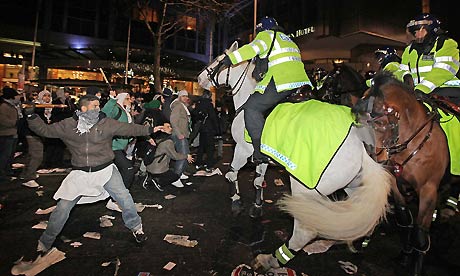
Over several days, flash mobs all over sprang into action faster than they could be controlled. The systemic machinery was caught flatfooted. Violence became contagious with diverse groups joining in on muggings, robbings, lootings, arson and pitched battles with police.

 Addley writes:

… familiar and well-loved streets were turned, for a time, into alien, frightening battle zones … shocking because of their speed and unpredictability, but also because of their geographical and socioeconomic scope.

The British Prime Minister opinioned that pockets of society  were sick. The impression might be that criminal gangs were responsible. However, is that the troublemakers were not clearly identifiable as such. Shockingly, they cut across societynot only white, black, Asian, men, women, children, old or young alone, and neither local nor outsiders, but strange combinations of all of these.

Technology was used effectively to organize the rampage, leaving authorities struggling to keep up. Blackberry messenger, facebook, and twitter spread word like wildfire among the rioters. In the context, social mobility took on new meaning.

Lewis and Harkin write:

… territorial markers which would usually delineate young people's residential areas – known as 'endz', 'bits' and 'gates' – appear to have melted away. "On a normal day it wouldn't be allowed – going in to someone else's area. A lot of them, on a normal day, wouldn't know each other and they might be fighting … This is bringing them together."

Some authors identify alienation, anger, boredom and mischief as the common factors in the chaos.  Some say the long police history of heavy-handedness with the underclass has boiled over. Others point to government policies forcing brutal cuts and austerity measures onto populations. The ordinary experience widening social inequalities, while the richest ten percent reportedly become one hundred times better off at their expense.
In the present context, Power comments:
…consumerism predicated on personal debt has been pushed for years as the solution to a faltering economy … Decades of individualism, competition and state-encouraged selfishness – combined with a systematic crushing of unions and the ever-increasing criminalisation of dissent – have made Britain one of the most unequal countries in the developed world.
I should think that the sense of inequality perceived among social groups is more than a recent occurrence - in fact, a legacy of past imperial practices over populations. Essentially, the interpretations of life naturally differ with cultures. In Western philosophies, for instance, goals have traditionally based on the idea that people have but one lifetime to make an impact.  Since survival is of the fittest, individualism must be favoured. Through centuries, the outlook broke new ground, but it also broke moral and ethical boundaries. 

Western explorers have sailed boldly into unchartered waters to discover the ends of the world driven by the spirit of adventure. The self-reliance and openness to new experiences allowed finding new frontiers. They pushed gathering of new knowledge beyond existing limits.

Tales of wealthy foreign cultures by numerous travellers spawned expeditions to unknown regions also in search of gold, spices, silks, and so on, initially for simple trade in oriental goods. However, economic depressions, internal stresses and market protectionism changed the Western outlook to territorial takeovers. In relentless pursuit of the capture and control of treasured resources, traders became political extensions of their monarchies abroad.

Political fractures within and between communities were exploited to divide and rule.  Ultimately continents were successfully colonized. The English, for instance, were able to boast that the sun never set on their empire. The people they assumed power over were perceived livestock that could be used and abused in slave and labour trades.

Western expansionism flourished also because the foreign lands were peopled by deferent, inward-looking cultures. The Eastern philosophies upheld collectivism, and the ideal of community before self. They tended towards peace of mind, harmonious reciprocity and cosmic karma. However, they were manipulated to lose even national identity for several centuries.


Globalization has most benefited the corporate world, and mostly those located in the West. It enables companies become multinational, to employ skills from a global workforce. But at the same time, rapid changes in reality have been far more than most people could cope with. Despite new markets, local availability of jobs for the underprivileged is rendered uncertain, because outsourcing is common. This cements cross-cultural animosities, although the divisive practice is an indigenous product honed over centuries.

Technology has indeed transformed reality. However, economic and political power games have resisted change. The informational networks have also juxtaposed social issues of past and present in people's minds. They have enabled greater awareness of differences against similarities between diverse people. 

Issues of the present reactivate memories of past racial and cultural inequalities among minority groups. Although demographic migrations post-globalization turned societies heterogeneous, interrelationships between social fractions are ambiguous at best. Distinct cultures coexist in society, but have hardly reconciled with the values of others, especially the majority. Habitual thought and practice remains entrenched in ethnic perspectives. Thus, social divides harboured in the mind never really close. 

The historical wounds of inequalities among minority groups and other social have-nots  also carry forward, mounting tensions generation to generationTheir collective rage might even make the past indignities feel real in the environment here and now. It seems a shame that the rioters turned to destruction as the only way to communication.  It is perhaps more shameful that despite claims of celebrating diversity, Western powers-that-be are yet to get over selfish consumerism, and to harmonize relations with all others that share the same universe, including those within their own societies.


References for this post:

  1. Addley, Esther. “London riots: 'A generation who don't respect their parents or police'guardian.co.uk The Guardian. Tuesday 9 August 2011. 
  2. Lewis, Paul and Harkin, James. “Who are the rioters? Young men from poor areas ... but that's not the full storyguardian.co.uk The Guardian. 10 August 2011. 
  3. "Imperialism in Asia" wikipedia.org. Wikipedia the free encyclopedia. 25 July 2011. 
  4. The story behind the mugging that shocked the world” Reuters report. stuff.co.nz.  Stuff.co.nz. 11/08/2011.