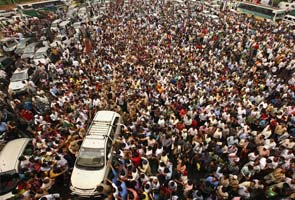
Unrest is sweeping around the world rather like mass hysteria. After authoritarian regimes, democracies now face the heat. The question arises whether here the attempts of social groups are to uphold democratic freedoms, or to holdup systems to ransom.
The tidal wave of protests has now hit India. A section of civil society has chosen to confront the Union Government on it executive functioning. The social group, led by Anna Hazare and dubbed Team Anna in the media, demand the Parliament should make into law the anti-corruption bill they have drafted.
The practice in law making to date has been that civil servants draft bills at the behest of the ruling party. That bill is presented to Parliament and should it receive the majority vote of its members, it becomes law.
Writing in Time, Thottam comments:
It's not clear that the Lokpal bill would be much of an improvement. It's also hard to imagine how the world's largest democracy would function if it gave way every time a prominent protestor demanded a new piece of legislation.
Over 42 years, and despite eight bill presentations, however, successive Parliaments have failed to create a comprehensive anti-corruption law. Hence, Team Anna take it upon themselves to draft the Jan Lokpal Bill that seeks to appoint an ombudsman, and empower them to investigate corruptions charges at all levels of the bureaucracy.
Earlier, the civil society group did manage to compel the forming of a special panel of 5 ministers and 5 activists to discuss their bill draft. The aim is to arrive at a consensus on the bill to be presented to Parliament. But the talks stall over six sticking points. The Government then goes ahead to table before the House their own version, the Lokpal Bill, which effectively protects key positions from the investigative scrutiny.
Team Anna turns to street politics in the effort to garner support for their bill. They accuse the Administration of lacking the political will to tackle rampant corruption and protecting it, in fact. To protest the ineptitude, they announce a hunger strike to be launched publicly.
That earns a crackdown; perhaps the fear in accommodating them is of setting a dangerous precedent. Police swoop in with preemptive arrests of the protest leaders. About twelve hundred others are also detained to stamp out the imminent agitation. Perhaps the Administration’s strategy is also influenced by events in London, where lawlessness ruled rife for several days.
However, the move backfires, and is seen by the nation as heavy-handed stifling of dissent. Two hours later, their release is offered on condition they eschew the agitation. Undaunted, the activists refuse to leave until their demands are met – of the right to conduct public dissent, and of the right to draft the legislation to be made law. Lodged in the Tihar Prison, they kick off their fast on the premises itself.
Meanwhile, news of the arrests sparks demonstrations all over the country. Thousands join in very vocal processions across states demanding their release. People in Delhi congregate around the jail as well, holding placards that read, please arrest me.

Unprecedented media coverage publicizes the events. Constant information feeds from private news channels add fillip to the cause. Tech savvy activists make the most use of the tools of Internet – twitter, facebook and youtube to ensure messages from prison reach the world. Their strategy seems to a step ahead, with the authorities having to play catch up.
74-year-old Anna Hazare, the man at the centre of the storm, was virtually unknown outside his home state earlier. He is now a national icon, and his supporters project him as the second Gandhi, leading the second freedom struggle of India through Satyagraha, the path of non-violence.
Reuters’ reporter de Bendern sees the makings of a revolt in the unrest, similar to elsewhere. He writes:
… a galvanised and frustrated middle class and the mushrooming of social networking sites combined with an aggressive private media may be transforming India's political landscape … "The new corporate middle class has little patience with the politics of dignity and identity that are -- for better or worse -- central to Indian politics"…
Perhaps the ruling coalition assumes that the stir will soon die down, as middle-class resolve tends to be tenuous. They thus try initially to wait out the agitators’ fervour. But as passions whip up instead, party members resort to character assassinations of the social group’s leaders. They also claim them to be media creations set up to blackmail the Administration.
The unrest is branded a subversion of democracy, fronting the attack on the supremacy of the Indian Parliament by outsiders – including foreign powers. The Prime Minister labours to defend the matter in the House. He states:
The question is, who drafts the law and who makes the law? I submit that the time-honoured practice is that the Executive drafts a Bill and places it before Parliament and that Parliament debates and adopts the Bill with amendments if necessary. ... As far as I am able to gather, Shri Anna Hazare questions these principles and claims a right to impose his Jan Lok Pal Bill upon Parliament.
Opposition parties had earlier been kept out of the draft panel formed with the civil society. They now revel in the opportunity to take the Union Government to task over their mishandlings of the case. The use of force to deal with political issues earns flak as arrogance of power reminiscent of colonial times.
Satirists pounce gleefully to proclaim that in India today, people are free to graft or feed on bribes, but to fight corruption or even to not eat, they get no permission at all! In the public perception, the Government is elitist, disconnected with the masses they represent.
The erstwhile silent majority gravitates to displays of people’s power in metropolitan cities and smaller towns. In several parts of the country, entire villages, men, women and children take up the fast in solidarity with that at Delhi. Mumbai’s famed six-sigma food delivery organization, the Dabbawalas, strike work for the first time in 120 years to lend their support.
Before the ground swell of humanity, the system is forced to back down. The Delhi police withdraw all the 22 conditions they had earlier imposed, release the detainees, grant space for the protest gathering, and also assist in managing the crowds. The hunger strike now assumes the proportions of a populist movement. Politicians across the board begin to feel the pinch of adverse public opinion.
The activists further remind their audiences that the preamble of the Indian Constitution states that:
WE, THE PEOPLE OF INDIA … do HEREBY ADOPT, ENACT AND GIVE TO OURSELVES THIS CONSTITUTION.
That is, mention of the people comes first, precedes both parliamentarians and ministers in the Constitution. Essentially, the people are the supreme body, since their votes put the elected representatives in office. This perspective finds resonance with a population fed-up with political kickbacks, scams, and rampant corruption within the bureaucracy. Social networks are abuzz with millions of supportive opinions and tweets, non-resident Indians joining in as well.
As the crowds grow mammoth rather than dwindle, ministers are caught in an unpleasant bind. They are as averse to decentralizing legislative control as they are to making Anna a martyr. The concern is the longer it takes to resolve the stalemate, the more the septuagenarian’s health weakens, and the more volatile becomes the situation.
They choose to extend an olive branch and invite dialogue. The talks begin, but the two sides are gulfed by enormous trust deficits between the governors and the governed. In the atmosphere of win-lose competitiveness, neither side is ready to unfreeze maximally polarized positions. They battle over democratic rights in the system, of the people versus elected office. Negotiations lurch from breakthrough to breakdown, to another breakthrough, another breakdown and again breakthrough…
Public statements are sometimes intractable, sometimes conciliatory, but furious activities continue behind the scenes. Mediators rush in from around the country to assist each side to keep back channels open and to unfreeze deadlocks. The former chief minister from Maharashtra, experienced in handling previous agitations in Anna’s home state, is called in as the Government’s special emissary to link directly with him.
Newscasters stationed at vantage points around the clock update reports with every new detail. Experts are called from all walks of life to analyze the nuances of move and explain their significances on the private news channels. Constitutionalists, lawyers, corporate stalwarts, authors, editors, social activists, spiritual leaders, politicians, and other celebrities - supporters, detractors and voices of moderation all share views from the same platform.
The entire country appears riveted by the drama playing out on tv. The game of brinkmanship is more thrilling than any soap opera – who will blink first? (The joke here is that Team India is hugely relieved that their disastrous performances on the cricket field in England is, for once, not the focus of public attention. They might hope their entire tour thus flies under the radar!)
During the negotiations, team compositions also change from hawkish to moderate, as the talks seem to progress at the pace of two steps forward and one back. With the forward motion, positions previously thought intractable peg down a notch. The general realization dawns that political issues do indeed require political solutions. Veteran troubleshooters are inducted, as the Prime Minister seeks out-of-box solutions.
Eventually only 3 sticking points remain to threaten compromise: the prime minister’s inclusion in the ombudsman’s (lokpal) purview, similar ombudsmen (lokayukta) for the states, and a citizen’s charter. Team Anna hinges breaking his fast on the Parliament’s vote on resolution of the three points. The Administration, averse to civil society groups dictating to Parliament, cites objections by the Opposition.
The activists appeal to the principle Opposition party to spell out their stand, and receive their support on the 3 points. Opposition parties of the right and left come together, and promise flexibility to help break the impasse. In final compromise, the Sense of Parliament resolution is introduced in both Houses, naming the three sticking points. Seven hours of intense debate on the resolution occurs in Parliament while the nation watches proceedings with bated breath.

No individual votes follow, but members on both sides of the aisle thump their desks to adopt it unanimously - a rare sight indeed in Parliament! A relieved Prime Minister tells newsmen: The Parliament’s will is the people’s will. Thereafter, Government’s special emissary and his group rush to the protest site, to reach Anna Hazare a copy of the resolution. He in turn, pledges to break his 12-day fast. The two sides share stage in visual confirmation that accord has been reached.
The perceptions in regions abroad appear to be that the world’s largest democracy has been brought to its knees or that India faces its own Arab Spring. After 13 days of high-voltage drama unfolding the nature of the nation’s functional democracy, we may safely disagree.
It is true that in over six decades of India’s independence, the middle-class has takes to the streets on an issue for the first time ever. Activists term it the outpouring of angst, not new political aspirations. They make no calls for anarchy, regime change, or challenge to the parliamentary system. Fact is this country’s democracy was never targeted; however, the cynical lack of accountability in political and bureaucratic circles has been impaled.
Traditionally, the middle-class remains aloof from political processes; they rarely vote, or may do so negatively. The stereotypical parliamentarian hobnobs in corporate and wealthy circles, appeases the poor before elections with sops for votes, and virtually disregards the middle groups. Their contact with constituents dissolve once the election process is over. Poll promises are forgotten, because elected members toe party lines thereafter, and focus on preserving political allegiances. Thence, their sensitivity to the wishes of the people electing them hardly exists.
The social movement may have triggered a paradigm shift in the political arena, orientating towards participatory governance. The surprise result of the exercise has been the dramatic rise of young India.
It is significant that the youth, educated and articulate, carry the fight against corruption on their shoulders. Inspired by the notion of nation building they volunteer services to ensure the movement’s smooth progress. Despite thousands of people congregating, sloganeering, waving the national flag, and holding candlelight vigils, there are no reports of the anticipated mass violence. The trademark Gandhi cap becomes a statement of purpose rather than of fashion, as they identify with the inscribed catchphrase, I am Anna.
It is just as significant that ways to resolve the standoffs seem to emerge after the young members of Parliament jump into the fray. Many of this youth brigade also choose to defy tradition. They dare to speak their minds in support of social change. They grasp initiative to understand the thrust of the movement, and to acquaint senior leaders with the seriousness of the issue.
We see no losers in this Indian unrest. A people culturally grounded in moral values are unlikely to invest in the dissolution of revered institutions of State. They are however, determined to evolve with the times, in tune with the present age of global partnerships and collaborations. We may have been witness instead, to the restoration of roles and boundaries between the people, the Parliament and the Government. It perhaps bodes well for the future that the citizens of India have been awakened to their rights in the democratic system, and to the more crucial realization that rights include responsibilities.