Friday, August 22, 2014

Lost in translation


Can you realize how difficult for me if even Indians is not able to understand each other [sic]. His head in a whirl, the guy’s exasperation with life itself is palpable. On his own in a new country, he cannot fathom what is going on! For the first time ever, I suppose, he really is up against India’s formidable diversity! 

Lenny, as I shall call him, is a member of the global workforce, a foreigner in India, and here on assignment.  Blessed with the characteristic zeal and drive of generation next, he is able with technology, and unafraid of diversity. He hasn’t the comfort of a compatriot group at his back, but surely, with his skills and temperament, he can take on anything!

He is the new tenant in the building. But he insists he is not new to India – he has lived in Gurgaon off-and-on for about a year for his last assignment. Now, that is an affluent complex outside Delhi that caters to non-residents Indians accustomed to the lands of plenty. It is a home away from home for expats too, with exclusive highrise buildings, and airtight windows that preserve interiors. If you live in Gurgaon, you live in a bubble. Like at an idyllic oasis in the desert, there’s no need to get down and dirty! I think I should warn him, now that he has transferred to an ordinary metropolitan city, that Gurgaon is very atypical India. Of course, of course, he agrees at once that every place will be different.

  
I ask the most pertinent question, do you have Hindi? No, he smiles. Well then, I think wryly, the culture shock awaits! Lenny may manage fine at a hotel, but running his own household may be a different proposition altogether.  I hope somebody mentioned to him before that English is only one of the 22 official languages spoken here, not to mention some six thousand dialects. These may differ widely in grammar and syntax, and hence, so do the thinking processes their people learn growing up. Even in a “common” spoken language, what is said, and what is understood, may be two very different things. Simple matters may then become complicated.

Lenny has an impressive work ethic and puts mind and heart into whatever he does. Within a day, however, he looks drawn. He tells me he was up all night cleaning the flat he thought was left dirty. It was cleaned before you came, I tell him. This is everyday dust, and it collects all time. Cleaning has to be done once or twice daily. Even locked flats soon cake with dust in this region, as you will see. He stares, and I see the wheels turning in his brain – when will he get to work then? I advise hiring help, but without a translator to back him, how can he?   

The problems pile up - there is no water in the flat. In the heat of the Indian summer, Lenny is wilting. I call the plumber, and stay to translate. I notice the flat has almost no furniture at all. I wonder if he expected to be moving into a furnished home. If so, the letdown of bare walls must be immense! It begins to dawn on Lenny that managing work and home alonein this country is daunting. He comes from a wintry country, so the weather here must really saps out his energy. And by not having the language he is lost, like never before! 


His driver arrives to transport him to work, and is instead drafted into the water project alongside the plumber. He has Hindi and passable English picked up in his line of work, and seems to relish the new role of go-between. Lenny quickly delegates the home issues to his new Man Friday. I’m relieved! It had became clear that Lenny, a fit young man who bounds up and down the stairways hardly losing breath, was quite unaware that other age-groups might struggle to do the same. In politely trying to keep up with his pace, my knees are killing me!

Some pipes and valves are changed and eventually, there is running water in the taps of the flat, everybody is happy! By the evening, however, it is all gone again. The plumber is surprised at the news. He had filled the tank to last a day or two and can’t imagine what they did with all the water. Well, I say, the sahib couldn’t shower properly for a couple of days, so he must be making up for it! 500 litres, the man mutters incredulously! But actually it is a new issue - the tank is unable to retain water, and they would have to map the entire pipeline to locate the problem points. 

That would take quite a while, and Lenny has to be at home for it to happen. Schedules would then need to be coordinated. The driver in his enhanced role, wants to protect his boss from these small matters, and tells me all communications should pass through him instead! I hand over the relevant telephone numbers, and decide that now they can help themselves, I am done. But by next evening, their octogenarian landlady is in a tizzy over another plumber on the scene! She cannot reach the tenant or his driver, so she frantically calls me to intervene. I’m mystified as to how she has suddenly become involved.

She tells me the first plumber was working elsewhere in the morning and was unresponsive to phonecalls. New Man Friday then decided to exercise initiative. He phoned her to point out the persistent problem and the plumber’s failure to respond, and asked for a replacement. Late in the evening, when they will be back from office, would be the best time for the work to be done. Too helpfully, she engaged an alternative person to work on the water system that same evening. Notably, there is no further communication between her and the driver thereafter. This second plumber arrives in time to find the flat locked, and complains. She feels left holding the bag - and the second plumber’s bill! 

Lenny, happy to have delegated, is still at work miles away, and blissfully unaware of these new developments. Immersed in a totally different world, he falls from the skies when I call to ask him what is going on. He has no knowledge whatsoever of a second plumber being engaged. He cannot understand how the issue arose, because his information is that the first plumber has been reached and his time booked for the next day. Bewildered, he points me to his driver for answers.  I accost Man Friday next to explain the mess-up. He distances from it forthwith, denies any such conversation with the landlady, and sticks to the information of the first plumber’s next visit.


I begin to get the classic picture of blocked communications. The first plumber resurfaced at the end of the day. At that time, the work schedule was re-fixed with him. Caught up in his regular duties through the day, the driver clean forgot about the other plumber being engaged by the landlady at his (Man Friday) word. His own initiative taking exercise of the morning had slipped his mind, and since then it has turned too embarrassing! Lenny, in being ‘protected’, was kept out of the loop altogether, as was I until it snowballed. 

I suggest to the old lady she involve no further for her own wellbeing, and send Lenny a cryptic text message: Lost in translation. He responds in utter confusion: Can you realize how difficult for me…

Wednesday, August 20, 2014

Swacch is the key


Independent India turns sixty-eight years, and we are proud to be us, its democratic people! In keeping with the tradition set with “India’s tryst with destiny” so many decades ago, today is the Prime Minister’s day. To the strains of the national anthem he unfurls the national tricolour, he takes the inter-services guard of honour, and he gives the speech to set the tone of things to come in governance. 


We witness Narendra Modi, resplendent in a pagri (turban), take the stand for his first shout out to the nation from the historic rampart of the Red Fort. This Union administration has been at work for a couple of months and it is about time they have a handle on things. We hope that they will now begin to deliver results that are actually good for the country.

I’m sure there is an army of speechwriters to help with the message, but on this day he decides to speak extempore. It is a brave move, and I hope he will not ruin it with political rhetoric. We are tired of politicians devaluing occasions by sniping at one another, blaming previous administrations for failures that continue, and wooing vote blocks with an eye on the next elections.

As he speaks, his grasp of matters is compelling. We are reminded that, although he is often derogated as a chaiwala (tea-seller), Narendra Modi is an educated man. Before this, he has been the Chief Minister of Gujarat for four terms. Part of this state of western India, was devastated by a massive earthquake.  Visitors to the regions since that decimation are impressed with the recovery he led. With the Hindu-Muslim riots however, Modi was tainted with the communal tag. The USA went so far as to cancel his visa to that country.

I wonder if that was the result of the “vilification campaign”, many at its receiving end are accusing Western media of conducting! The point is, Narendra Modi was cleared of culpability by the Supreme Court, the highest judiciary body of India, and hence was able to contest national elections successfully. Today, the US Administration is forced to back-pedal fast to establish diplomatic ties with the new Head of the Union Government of India!

I had the impression that he was a force to be reckoned within the Gujarati community, an icon within a certain religion and caste. When election results were announced, and the party projecting Modi as the Prime Ministerial candidate won a landslide victory, I texted “The Guju has landed!” to my non-resident extended family that had been rooting for him, while thinking to myself “God help us now!” My point is that when India is secular according to its Constitution, there should be no place for sectarianism in the Union Administration.

It is perhaps a discourteous thing to do, but when unimpressive politicians deliver uninspiring speeches, I tend to switch off the set or change channels. I am probably not the only one in this country to do so. I tuned into the live telecast of his acceptance speech with some trepidation. Although the trappings of the victory celebrations were distinctly Hindu rituals, it was a relief to hear the speech devoid of religious overtones. It was surprisingly sensible speaking without a written script to keep message on track. The man is gracious to the opponents he has drubbed at the hustings. It is his duty, he said, as the prime servant of the country, to also carry along with him the hundreds of thousands that did not vote for him.


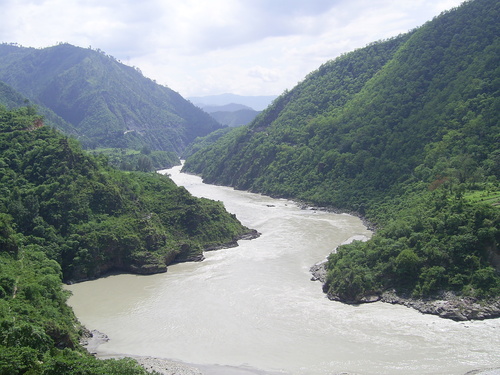
Modi strikes a chord when he points out that despite the traditional reverence, the Ganges is dreadfully polluted. The River Ganges, one of the most prominent in the country, has sustained civilizations on her banks over several millennia. Hindus especially, worship her as Mother Ganga. Why then, he asks, do we tolerate our mother remaining unclean?  He pledges to prioritize the cleanup of rivers. The environmental consciousness is unexpected, since Indian politicians allegedly kowtow to the creators of much of the pollutants, the big business houses. 

In his first Independence Day address to the nation, Modi harps on the same swacch (clean) theme as in his acceptance speech. He calls on industry to utilize India's vast human and knowledge resources, to make in India various good with zero defect and zero effect (on the environment). He draws attention to unsanitary living conditions that have become characteristic of rural and slum areas. People still continue the habit of using the great outdoors, in the absence of toilets.  In growing populations, women have to wait for the cover of darkness before they may do the same. Modi questions – why this disrespectful disregard for our mothers and sisters? He exhorted corporate social responsibility in corporate houses and NGOs to prioritize toilet construction.

But to my mind, this would address only half the issue. Amongst the majority of Indians, the attitude to swacch (clean) must change. At present, it is a contradiction. People are very particular about personal hygiene and will bathe several times a day to emphasize it. However, there is a cavalier disregard for environmental cleanliness. Boys and men relieving themselves at any convenient street corner is a common sight even within the city. And it is not just the poor that do so; the habit is rife amongst those more privileged. Women, with nowhere to go, tend to avoid fluid intake to 'control' bodily functions, which leads to eventual health complications.

Most definitely, public toilets for men and women and garbage vats are urgently required at every street corner. But those that are there are so badly maintained, they are unhygienic, unsanitary, and the sources of disease. Government installations - offices, schools, colleges, universities, hospitals, trains, are the worst imaginable. They are improperly used as well, as if the people are still in the great outdoors! The plumbing is blocked, choking and often overflowing. Nobody seems to complain or even notice. Garbage disposal is simple too; just toss them out on to the street, as though to a kitchen garden compost heap! These habits persist even in the foreign returned, those that should know better. 

If cleanliness is next to godliness, we have fallen far indeed! We hear Modi is a man of action, and he likes getting things done. He has begun a new trend of issuing “report cards” to parliamentarians on the work they do for their constituents. He has called upon them to create model villages. So far he has sounded no-nonsense. And if India’s new Prime Minister is able to unfreeze the mindset of the country’s teeming populations, to make swacch the key to change, he will have done the world a great service.

Friday, August 15, 2014

Wedge of Western media


The Russian expat bristles with righteous indignation. He is all fired up in defence of his country over the Ukraine conflict. Vilifying Russia is the campaign of Western media, he reiterates to his fully Indian audience. Now, I don’t know the person or the facts of the case well enough to counter, but what immediately pops into mind is: What about Crimea?   

We look on in fascination as he expounds on his conspiracy theory. It takes courage, as the outsider in a group, to stand up for one’s convictions. I wonder how many Indians abroad would be as vehement regarding India’s reported actions. I suspect, intimidated by the environment, most would much rather focus on their jobs there, than make waves. Not that any of us here had questioned Russia’s role. He brought it up himself, and approached the topic head on – the very image of a young, impassioned Putin! (Well, he does mention his father’s name is Vladimir; but perhaps I read too much into obvious ethnic characters!) 


On this day, we hear that it is an internal matter of Ukraine, that three Russian-speaking - not pro-Russian – districts express disgruntlement over certain issues. The unrest is not of Russia’s doing. Its projection as the evil force, however, is political motivation for vested interests. It is like the situation in the subcontinent, we are told. The India-Pakistan conflict is never allowed to be resolved. India is blamed for whatever adverse happens in the other country. And ultimately, through the media hype, Western powers retain control.

Frankly, we know little in India about the crime or the antecedents of the conflict, other than what the news channels report, and the various speculations on the 'Net. It is true, though, that “proof” is pretty thin - not conclusive, it merely suggests. The world has been treated to an isolated picture of an antiaircraft gun on the back of a truck with Russian markings. We are informed that this is the culprit, the one that rolled into Ukrainian soil, shot down commercial airliner MH 17 and its passenger load of civilian men, women and children, and then slunk back across the border. That it was suddenly photographed in the process appears suspicious.

Besides, would the Russians, if they were indeed behind the attack, be so stupid as to allow any implicative evidence to exist? The KGB of yore may not remain, but surely its operative methods of ruthless efficiency live on. The Western media also presented phone transcripts that purportedly caught the perpetrators acknowledging the ‘mistake’. Now, if there are recordings of conversation after the fact, something must exist from before, from the planning to its execution stages. It seems quite improbable that only these transcripts were detected, and that too randomly. Somebody must have been monitoring that particular frequency over time. A news leak might have stopped the tragedy from happening, unless, horror of horrors, it was allowed to happen to protect snooping sources.  

They are afraid of Russia’s influence, the expat declares in full spate. He relates to us an aspect of the World Wars little known to us: the contributions of Russia. The media spotlight is on glorious exploits of Britain or America only, as if they did it all. There is never any mention of Russia, which fought a lone hand for three years before these others came into the picture. The cold war is being revived, he says. The Western media is calculative. Its intent is to drive a wedge between friendly countries, or those not at war with each other, and destabilize regions. We do not want their democracy, either, he says. The Western misadventure in Iraq and its aftermath of present crises, is his case in point.

India and Russia are natural friends, connected by culture, he emphasizes. Those people don’t want them to get close. The claim of a "cultural connection" is a stretch to far for me. How is that even possible? I ask. Russia is a European nation, and India is in Asia. They follow the Russian Orthodox Church, while the majority religion here is Hinduism.


It seems Christianity - the Greek Orthodox Church - is a Western imposition on Russia. Before that, there was an indigenous culture that went underground. That ancient culture, is similar in philosophy to Hinduism, and believes as they do, in the swastika as a sacred religious symbol. He shows a tattoo to prove his beliefs. (I recall that many groups, including the White Supremacists also utilize swastik symbolism. Who knows, he just could be one of them!) Logically, however, if India and Germany can claim Aryan origins from around the Caspian Sea, surely Russia can too? This Indo-Ruski cultural commonality is news to me, but maybe we do share roots from ‘way back in time.

The Russian explains that the Church demands a slavish mentality, and there are many like him that believes differently. We do not need their religion, when we have our own. We are not slaves of a cruel God. We are descended from the gods. We have the gods within us. Indeed, it does sound a lot like Hindu philosophy! This face of young Russia seems quite different from the supercilious, goose-stepping regimental prototype we have so far carried in mind!

But I must own that in India, we are biased towards UK and USA, accustomed as we are to thinking by their rules. This probably follows from centuries of colonization by the British Empire. We would easily visualize ‘Michael’ or ‘Alexander’ as conditioned to. We clean forget or are unaware that ‘Mikhael’ and ‘Aleksandr’ may also exist!

Earlier, the migratory pathway of the skilled Indian workforce pointed in one direction only, towards the West. Because an adequate inflow was missing, we called it the brain drain. But in more recent times, other nationalities are winging their way into the country, bringing in with them their own unique heritage. Diversity, hopefully, gains as a result. With open interactions nurtured by India’s customary collectivistic hospitality, it may become easier for people of different cultures to get to know and understand one another’s perspective.

Tuesday, August 12, 2014

The pull of Indian leather


On my way out of Kolkata the other day, I got talking with a co-passenger I shall call Eric. He is from Belgium. Conversation is a bit of a feat over the general noise, and our diverse accents. I’m curious about why he is in India, because he doesn’t behave touristy. Social worker? I enquire, with only a touch of sarcasm. Truth is, I’m more than a little bugged that foreigners need to come save our souls, as if our own people cannot. But no, he is a businessman, and has been coming to India for a long time. 


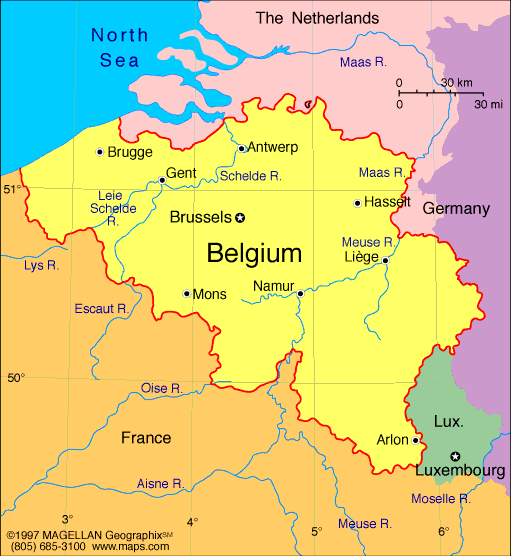
I rack my brains for ‘Belgium’ but nothing surfaces from school geography. It is probably landlocked in the middle of the continent. Budapest? I hazard. No, Brussels, Antwerp… It turns out Belgium isn’t all that landlocked. Though surrounded by land on three sides, it is open on one side to the waters of the North Sea. I probably confused it with Switzerland or Luxembourg in my mind!

I tried to name to myself five Belgians of note. Hercule Poirot, but he was a figment of somebody’s imagination, so didn’t count. Mother Teresa was…Albanian. Ah, the football team, dark horses in FIFA World Cup 2014. They came unstuck against Messi magic, I think. I remember a young nun, who played the violin at assembly every morning in my elementary school, but her name was lost to me. Van Damme, the Hollywood action hero. And a former colleague, a British national had once mentioned that his mother’s ancestors were from the Belgian city of Gent… It seems a pitiful list!

I have to accept that my general knowledge is pretty poor. I didn’t know for instance, that Belgium does not have a distinct national language. Eric said that Belgium was made a buffer state, between Germany and other countries of Europe. I began to imagine a nation of human shields, but it seems to me now that something was lost in translation! He probably meant that it was neutral, like Switzerland.

Belgium also does not have an indigenous people apparently. Rather, migrants of other nations people it, and even now a language boundary runs through it. So they speak only French in the south, and Flemish in the north. I finally understand after all these years of wondering, why Agatha Cristie’s Poirot, said to be Belgian, would mutter to himself in French! Diversity somewhat like India, I nod knowingly. This country too has no single national language. However, there are twenty-two official languages and over six thousand dialects. Still, with English and Hindi, it is possible to communicate in almost all of India.

Eric says he has of French origins, and that he does not have much formal education. I ask how come then he speaks English, since he never had it at school? I learn it in India, he says. He must have been coming to this country for many, many years indeed! Nevertheless, I’m impressed with the teaching skills of the Indian business community! I notice he is carrying a book by Noam Chomsky for travel reading, so the education obviously continues. 
 

Eric is in the leather industry. It is not a family business, just something he has personally been interested in.  He started designing handbags on his own and somehow his passion grew, as did the business. Now he has aged, but he just can’t stop working, which upsets his family. In Kolkata, he buys the leather hides to be further processed and used in the manufacture of the bags back in Belgium. Why not Italy leather? I ask, wouldn’t that be cheaper to import? Leather in Kolkata, he tells me, is good. It is good, he reiterates.

If this means that the tanneries of India are able to export in bulk to another continent, then the quality of the leather must be not just good, but excellent. The next time I pass Tangra, and want to hold my nose and mutter under my breath on being overwhelmed by the stench of the raw hides, I shall remind myself that they too contribute to the nation’s economy. In fact, if more young Indians became interested in the industry, India would benefit. Designer bags that celebrities tote around seem to each cost a fortune! 

Eric must have been exhausted by my many questions about his country and his business. Eventually he confides that he is old. And old-fashioned. He says that it is easy for women to ask questions, but men are constrained by courtesy from doing so. I’m surprised. If women may interrogate, it’s only fair that men may do so too, no? I suppose he comes from a generation that lives by a code. Have you never ever asked any question of any woman in this country in all these decades? I ask incredulously. He shakes his head a touch ruefully. I could never, he says. Well, if you could, what would you have liked to ask? Eric thinks a moment, smiles and says: Are you married?

Saturday, August 9, 2014

Owning Indian roads


That we are rather inconsiderate of people perceived as outsiders is, I think, the fallout of the social allegiances adhered to in India’s collectivism. These relationships of ‘us’ and ‘them’ groups are high-maintenance. In attempts to preserve their intra-group integrity, and areas of control, they are unkind to those perceived parayas (outsiders) despite the traditional culture of hospitality to all. Gender segregation is at work too. In the minds of the majority of Indian men, the external world is their preserve. They own the roads, and they may be sexist about it. It is surprising how much resentment is generated against women drivers, the outsiders. Common jibes are that these sisters-in-law should stay home and cook!

Pedestrians, however, are relieved to see women drivers coming along. They stick out an arm as a stop sign just about anywhere and begin to cross the road, confident that the women’s maternal instincts will take over, and they will stop to let them through. This happens even when the traffic signal has turned green. Men are far less accommodating; many actually speed up seeing their movement, and pedestrians, the elderly, women and children, are forced to scurry back. 
 

The common assumption is that men are born better drivers, although the evidence for it may not be particularly strong. I was in Delhi recently, and happened to be a passenger in a large sedan. I expressed the wish to drive this more powerful vehicle sometime, since my car in Kolkata is amongst the smallest on the road. The driver I shall call Prem, smiled patronizing, and I could almost see his ego inflate. Benevolently, he said he would teach me how to drive. Women, you see, just cannot drive! 

On Indian roads, size seems to matter in road hierarchy. Men at the wheels of bigger, more expensive cars, expect right of way over everybody else. As we went along, I noticed Prem didn’t much bother to watch his rear-view and wing mirrors. His trajectory seemed premeditated - he would go as he wished, and others could (or should!) drive around him. At one point, he took a turn too sharply, and sideswiped another car parked on the side of the road. Lucky for him nobody seemed to notice, and he quickly drove off in another direction.

A safe distance away, he began to boast about the long distances he drives every day without mishap. So what happened back there, I enquired. Immediately he faulted the other car for blocking the passage. We got off easy, he chortled. I was irked at his suddenly drafting me as the co-conspirator of his error. You didn’t get off easy, I emphasized, you just ran, but my disgust was lost on him. It was clear that he learned nothing from the experience, because sometime later, he left the car idling on the road and dashed into a shop nearby for supplies. Wanting to save on parking fees, he was oblivious to the fact that the car was now an impediment for other vehicles, not to mention the wastage of fuel and environmental pollution happening at the same time!

Bad driving is common and so are incidents of hit-and-run. Driving licences may be purchased under the table - without knowledge either of cars, or the traffic rules. Bystanders get het up if there is injury to people or loss of life, otherwise they gather around just to watch the drama of altercations unfold. Sometime ago, one such a rookie driver, showing off to his mates whilst his boss was away, rammed a roadside stall. He tried to flee, of course, and in his hurry, rear-ended my stationary small car. Alert locals nabbed one of the boys out that car before it sped away. The terrified youth quickly spilled the beans; the group was rounded up and hauled into the police station. Their families showed up as well. Mothers especially, wept buckets, beating their chests, begging the police and anybody else who might listen, for mercy. Because they were poor, it would naturally be cruel to book their sons. The poverty card is easily played in this country, and no compensation is ever forthcoming for the damage these ‘poor’ inflicted on others’ property! 


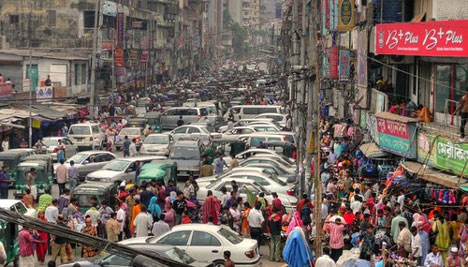
In majority, male drivers let loose on Indian roads, drive to get there first. However, they have no real answer to the question “and where to exactly?” As it is the roads rarely have lane-markings, and even if they do, few bother to keep to them. Driving is taken to mean to constantly overtake somebody else, although more often, they cause or intensify traffic jams. Sudden maneuvers are usual, and without sound or signal, an adjoining vehicle noses out diagonally, intending to force another to give way.  This when there is traffic at standstill ahead, behind and on every other side! Other vehicles, magnetically attracted by movement, invariably follow the leader to jam up the roads even more.

It sometimes feels a violation of personal space, but it makes “road sense” here to creep close to the vehicle ahead, almost bumper-to-bumper, to plug any ‘openings’! One has to be on guard against lateral encroachments, because some ambitious overtaker will soon insert his vehicle, and unceremoniously sideline the giver of space. I’ve learnt that being polite does not pay, and hoot insistently and gesticulate wildly to draw attention to the infractions that might happen relating to me. That seems to back them down. Men in India don’t want their misdeeds held up to public scrutiny, especially by brazen outsider women!

Saturday, July 26, 2014

Loudness is in the genes


The teenager I started to speak with, turned his head to stare at me. You’re too loud, he said, I don’t like loudness. Fair enough, I responded, dropping my voice to a stage whisper, does this work better for you? This was a family counselling session, and it seemed to me that the boy was habituated to pushing buttons. His intent may have been only to embarrass the adults, but his statement gave me food for thought. Perhaps, culturally we are indeed rather loud in this country. ‘Privacy’ hardly exists; even personal conversations tend to be broadcast to all and sundry.
 
 
It must be the result of social learning. But surely it didn’t happen in a day, and has been ingrained in us over generations. It shows up our cultural roots - the agrarian background, the traditional collectivism, and the societal divisions based on birth that has been the practice of our ancestors. Sharing everything within the biraderie (one’s own kind, family or caste) was common within these social groups. Their information pool grew as a result; it nurtured interpersonal ties, and gave the group the strength of unity. Social allegiances were inward, and the wellbeing of the community trumped that of individuals.

These bonds were routinely reinforced through various activities, especially those of religious festivals, whereby the entire community was able to come together. To be loud was to feel at home, included in the crowd. Entire villages grew around this biraderie of strong intra-group ties. People didn’t need to whisper; it was safe to holler across cultivation fields and large ponds. Where everybody was somehow related to everybody else, there were no secrets. 

Mostly for economic reasons, this scenario has changed today. Many village people migrate to the towns in search of work, and their own kind therein is minority, like small fish in big ponds. Still, the loud communicative patterns are carried forward from village to city. They may now own mobile phones, but they still holler in answer to phone-calls, unconsciously attempting to bridge distance between members, as in the past.

Loudness many also be a technique meant to establish some level of interpersonal positional authority. Parents and teachers do it to ensure compliance in children.  Age, in Indian traditions, is hugely respected, even if the difference is only of a few years. The form of address tends to change, in response to social perceptions. For instance, in Hindi, there are three distinct forms of address. Anybody a little older assumes the right to address younger people as ‘tum’ rather than ‘aap’. Amongst peers, the form is generally ‘tu’, which testifies to their mutual familiarity.

Although in cities, many diverse families house in close proximity, the loudness continues - albeit here, it is for a different reason. More people, more establishments and more vehicles lead to rising levels of white noise.  As a matter of course, people go up the scale to compensate for the hustle and bustle of everyday living. The loud to drown out ubiquitous external sounds. And, because we forget to adjust in more confined spaces, raised voices in ordinary conversations become normal, not an obvious sign of conflict.


Thus, loudness must be embedded in our genes. For women in a patriarchal society, however, loudness is new learned behaviour of social assertiveness, a measure to protect their comparatively new self-dependence. Through generations, men have had tacit social sanction to shout at their mothers, wives, sisters and daughters. Women, perceived as second-class citizens, are thus dominated verbally, and sometimes much more. Any man on the street, unwilling to change with the times, and considering himself superior to women, would expect similar subservience from them. Women now need to be loud to ensure that boundaries are kept, and they are not aggressed upon. Being shouted at by a woman in public is extremely shaming for the Indian male! 

Culturally, we are loud, but our communications are faulty, since the collectivistic element of our heritage is almost lost. A new togetherness has not been built with the diverse city elements; rather the traditional concept of the biraderie diminishes. The extended ‘family’ of yore has been left by the wayside. The social universe grows smaller, and we hardly know who lives next door. We routinely become members of various social groups, but our allegiances to them are tenuous. 

The outcomes of public arguments may depend on the vocal strength of each side, as is often clearly proved with our state and union parliament representatives - members rush into the well of the House, shout slogans, and so on, to crank up the decibels. They need to understand that mere loudness is hardly the substance of good, communicative governance! Similarly, our inherited speech patterns need reexamination too, if we want others to actively listen to our words of wisdom.

Saturday, May 10, 2014

The pace of rural Bengal


It is our second year of collaboration with the school at Kolaghat. We plan to meet the new batch of children of Class IX and their families, and also intend to catch up with the group whose education we “adopted” last year, and who will be facing their Board Examinations at the end of the session. 

 The speed of activities in this part of the world could rival a snail! We had thought that it would help the children if they were sponsored at the start of their academic session, now in January. But with one thing or another considered unavoidable, our scheduling keeps getting disrupted, pushed back to nearly the middle of the session. School and Board exams, paper corrections, election duties and government directives of school holidays, all take precedence. I begin to wonder whether there is a need at all for our kind of inputs in society. Perhaps we just fool ourselves that we make a difference in wanting to sponsor kids through high school!
  
 
When we finally set off for the school, the weather is hot, hot, hot. The fact that the weather seems to change so, must be due to global warming.  It is temperatures in the forties degrees Celsius, but we are not drenched in sweat as before. The weather patterns have changed noticeably. Humidity has come down; however, the thunder-squalls that we expect at this time to bring us relief from the heat, are no shows. The national highway on our route has a few diversions because of men at work on the asphalt. Still, without the continual traffic signal stops that are major impediments in the city, we make good progress. We thank our stars that it is the weekend and traffic is comparatively thin.


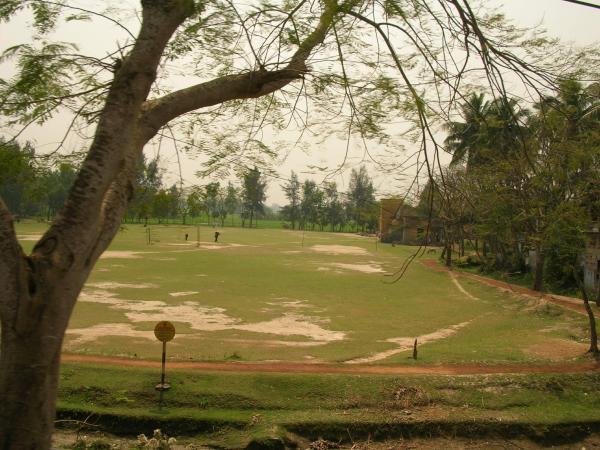
As we arrive in rural Bengal, it becomes easier to breathe. We leave behind the asphalt, but ‘roads’ become progressively narrower. The dirt roads of Kolaghat look bright red in the glorious sunshine. We slow down drastically, sometimes at speed no more than 2 Kmph and it takes us nearly an hour to travel about 15 Kms. We have to pass through the fish and vegetable marketplace that springs up every morning along the roadside.  Shoppers plant themselves on the road, and bend over to examine the merchandise. They are oblivious to traffic. We are greeted by this array of ‘hairpin bends’ that refuse to straighten up or move to let us through. Our persistent honking irritates, and some yell out that we go too fast, although we are literally standing on the brakes to avoid anything untoward.

A couple of times we have to back up to allow another vehicle to get by. Since the car obviously does not belong to the area, the locals want to make sure we do the reversing out of the way. A young man trying to get onto the wooden bridge first is distracted and topples over. He stares when he sees us and picks himself and his bicycle up quickly. Nevertheless, a crowd gathers around the car to shout insults.  They are a little nonplussed to see women in the car. The traditional respect for the sari kicks in and the usual aggressiveness towards outsiders peters out pretty quickly. It is good to see girls and women venturing out, riding bicycles. They jump in to tell off the men and our passage is immediately smoother! In two hours we are at our destination about 82 Kms away, in the Headmaster’s office, eager to get to work and do some good for the community with our perspective of educational support. 


Wednesday, January 22, 2014

Women, the elderly, privilege and responsibility


They seem willing to wear the cap of ignominy – many Indian women at work, I mean. Men roll their eyes when asked about these colleagues not without reason. If the personal preferences of these representatives in the workplace are the traditional gender roles, how can the women’s group as a whole even hope to have a viable organizational presence?


They project vibes of martyrdom, as if as good women, they wouldn’t step outside the home, except for the economics. They tend to take no pride in their work, and to treat the workplace as an extension of the home, oblivious to the fact that the organizational position is not meant to confer privilege or power, but responsibility first and foremost. By avoiding job responsibilities, these women hold the total group up to ridicule. 

The public comes to the organization with issues that need redressal, and organizational employees are designated to address them – this is the job they are paid for. No, it is not their fault that work-related issues arise. But surely they must be faulted when, although they can help resolve the issues, they do not. An incident report illustrates the point: 
My mother is in her eighties, and she receives a family pension through a national Bank. They have a rule, which she has quite diligently followed for the last two decades. It is to present herself at the local branch before the end of the calendar year to furnish life certificates to keep alive her pension accounts. Despite this, the pension payments have been withheld on occasion and her accounts sealed, for no reason other than that the life certificates submitted to them have been lost or misplaced.  Now she has been told to furnish her pension pay order (PPO) book to verify her authenticity. There should be at least two copies of the book – one at the Bank that collects pension on her behalf and one with the pensioner. These are created when the order is first received from the disbursing government authority. Now, although so directed to do so by the disbursing authority at the start of the family pension nearly twenty years ago, the Bank is yet to forward her copy of the PPO book. So how is the octogenarian pensioner to produce something she has not received in the first place? Whilst attempting to resurrect her pension, we found a new omission. According to the latest government circular about pension revisions, she is being underpaid - receiving each month several thousand rupees less than is her due.
With the hope of settling the issues at local level, we make our way to the pension cell at the local head office of this prominent national Bank. The women there, both the young and the middle-aged, are grim and unsmiling. I presume their presence is intended to reassure the pensioners, and help them over the sticky points, but they neither greet people, nor respond to greetings. Rather, they seem resentful to be called upon to do their jobs. We are directed to a particular desk. The incumbent’s chair is empty, and we are told we can get ourselves cups of tea whilst we wait. Eventually, the lady appears. She walks into the room with a mobile phone clasped to her ear, in earnest conversation with somebody about exchanging gift calendars for the New Year. Her joviality ends with the call, and she settles herself on the chair, and fiddles with some papers on the desk. Finally, ‘What?’ she asks abruptly without looking up. We begin our story, but her interest disengages. It is clear that she is not about to help in any way. She declares the government circulars of no consequence, and says the Bank will not change what they were already paying unless the pensioner brings a fresh order in her name from the original disbursing authority. And by the way, she is not there to receive letters/complaints from the public. 
Imagine for a moment the Government having to send out millions of individual letters every time there is a revision of pay and pension income scales at any level!  National Banks were given mandates for the convenience of reaching the monies to retirees and pensioners through their networks. Theirs is no charity; they are paid for the service. Pension cells, somebody said, are punishment assignments. It seems the people transferred there are those the organization would rather not have handle more important tasks!

However, it is disheartening to think that as a result, hundreds upon hundreds of hapless pensioners may be thus harassed. In a blogpost sometime ago, I pointed out that an important factor in the rise of multinational organizations in investment banking was the failure of national organizations to value their retirees and family pension holders. National Banks are still playing catch up in this industry, and the lack of customer-relationship skills within the system is evident. 


Some women in organizations strive for equality, but many others actually retard the group progress. Perhaps because job security tends to be high in Indian organizations, to many employees, the job means only what they can take home for themselves. Plagued by low self-esteem, they yearn for the privilege and power of the chair, and then actively avoid the associated responsibility.  Managements and unions should come together to ensure that those in service actually serve.  Quality of work should be the criterion in organizations, not reservations, even of gender. Especially in the pension cells, the incompetence foist upon elderly pensioners delays, even deprives them of their just rewards. They certainly deserve better for their years of dedicated service.

Sunday, January 19, 2014

Drives on Kolkata roads


For the past so many months, my focus has been the roads of Kolkata, and driving on them myself. The need to improve spatial orientation was the motivation. What better way to know directions than actually discover the routes to different places myself? Bad idea, said family and friends, no sane person drives in this city. Well, then, I reasoned, since my sanity is so often questioned, perhaps I am indeed appropriately equipped to do so! Moreover, they told me frankly and kindly, an old dog can’t learn new tricks. So of course I felt goaded to try my hand at it! Truth is, the learning has been intense.    

 
In Kolkata, value is on size. The hierarchy on the roads is based on this parameter – from the pedestrian to two-, three-, four-wheelers and so on. Within each category of vehicle then, class matters. A luxury SUV, for example, scores over a small economical car. Yes, big assumes ascendancy, and their association with masculinity is strong. The car model I choose is for a minimal carbon footprint, and to better maneuver the narrow lanes and bylanes of the city, with their problems of parking space. However, it automatically relegates me to the low end of the scale, and raises social expectations of my giving way to those hierarchically superior.

It is common knowledge in this region that women have no affinity for things mechanical. Most believe that they cannot drive because of gender, and men have learnt to patronize them when they do. Women that want to get behind the wheel must expect to be put down or intimidated by the majority on the roads. They must take in stride the standard received wisdom yelled out to them: like, get a driver, or go home and cook, sister-in-law!


Random males I have encountered around the city, whether casual bystanders or themselves drivers, have presumed this ‘natural’ gender superiority. Many modern husbands are unsupportive of their wives driving, unable, they say, to bear the tension of them being out on the road. Many women in turn, prefer to remain within the bounds of their gilded cages. Those that can drive rarely venture out at peak traffic hours, or to areas unknown, and never drive heavier vehicles. Perhaps all this is to keep away from any public confrontation with men.

I put it down to family traditions being carried forward. It is customary for families to await the coming of sons rather than daughters. The production of an heir makes it easier on the mother. Else, her childbearing days do not end; the husband feels less of a man, and she is blamed for it. Mothers that suffer extreme low self-esteem, are hard on their daughters, but pamper their sons. From early childhood itself, girls are taught to wait on their brothers or any male visitor that happens along. They pick up after the little emperors that grow up expecting right of way and gender deference from all women. But, due to changing times and the disobedience of modern women, wishes are left unfulfilled and anxiety becomes generic.


Seems to me that the point is performance anxiety, rather than insanity on Kolkata roads. The women fear being judged in public, and Indian men are stricken with the irrational drive to get there first. The mad rush is to be on and off before anybody else. On trains and airplanes, they will block the aisles simply to prevent others from getting ahead of them. Even in a queue, it is usual to cut in before any woman that happens to be there, as she is unlikely to protest. They must impose, though ask them why and they probably have no answer. 

The same prevails while driving. The men driving bigger cars, taxis, trucks or even passenger buses, are in too much of a hurry getting to destinations they know not where to mind the traffic rules. Cutting past as the lights turn red or before they are green is rife. My car has been bumped and scraped several times just for being in the way. They hit and they run. If unable to escape, they invoke the ineptitude of women as the obvious cause of the accident. The police are seldom around and when they are on hand, they seem too preoccupied to notice or take action against them. The victim must find the nearest police station to report the matter, file a case to fight out in court, and deal with the insurance claims thereafter. In terms of time, money and effort, getting redressal is a Herculean task. Hence, it is futile to argue; the perpetrators get away scot-free, which they count on. 

It is true that driving in Kolkata is dicey. Roads are frequently wide enough for only one lane of cars to pass either way. Often cars parked on the sides have to be negotiated around, whilst being hounded by some impatient tailgater. Initially, it is scary to be on the road, because other vehicles pass so close. They are just inches away - sometimes deliberately, to force the less experienced off track, and women out of this assumed male bastion of roads.


However, as a wise veteran driver told me, everybody is afraid of failure, not just women behind the wheel. Socially at the receiving end, women have traditionally tended forge special bonds with their sons in private. This has been their investment for their future - to dominate their sons’ lives from behind the scenes, backseat driving

This behaviour pattern needs to change, and they need to self-actualize with their own abilities. In fact, on these roads, women drivers are forced out of their shells of social inhibition. This is the positive outcome, I experience. One gradually discovers method in the madness, and learns patterns of intent.


Women need to realize their adaptability to fluid situations through mastering two-, three- and four-wheelers. They need to get in the driver’s seat, to rely on their strengths of purpose to raise their self-esteem. They need to break the traditional mould and storm the male stronghold as it were, and drive themselves forward rather than be driven backseat. The process would enable them to increase visibility, to step out in numbers to create a stronger, more confident group presence in public.

Friday, May 31, 2013

Values in work culture


As a counselor, I envy Kasuo Ishiguro. I mean we struggle professionally to establish empathy and rapport with individuals and groups. Walk in their shoes, as it were, to understand their issues. But for Ishiguro, to weave plausibility across country and culture seems to come naturally. He has the amazing ability to imagine people and situations, and write fiction into reality. 

He says in The Remains of the Day:
Now, naturally, like many of us, I have a reluctance to change too much of the old ways. But there is no virtue at all in clinging as some do to tradition merely for its own sake.
I would imagine that he refers to the orthodox traditions of Japan that he was born into, and spent early childhood in. With his experience of then and now, he perhaps perceives his origins as entrenched in the past when compared to the liberal West. But no, he puts the words in the mouth of Stevens the butler, English in every inch. This character, the protagonist of the book, is in charge of staff at an English manor in England around the time of World War II, a setting perhaps previous by a couple of decades to the birth of the book’s author.

It is true that Ishiguro has been immersed in Western culture from the age of five, but as an immigrant. Hence, to not only visualize a cultural context different from roots, but also to fit it into a bygone era has to be a feat. The author says he gleans much knowledge about the cultural distinctiveness from books. He probably also has a prodigious memory for detail to be able to capture their characteristic quirks – and for this book, the Booker prize.


Despite the enlightenment he projects against clinging to traditions, Englishman Stevens himself appears to find it difficult to break out of the standard received mould of a manservant in the England of the ‘forties. A story he mentions, and one that his father would frequently recount admiringly, is of the exploits of a British butler overseas. At the employer’s residence in colonial India, this man had suddenly discovered a tiger hiding under the dining table: 
The butler had left the dining room quietly, taking care to close the doors behind him, and proceeded calmly to the drawing room where his employer was taking tea with a number of visitors. There he attracted his employer’s attention with a polite cough, then whispered in the latter’s year: ‘I’m very sorry, sir, but there appears to be a tiger in the dining room. Perhaps you will permit the twelve-bores to be used?’ And according to legend, a few minutes later, the employer and his guests heard three gun shots. When the butler reappeared in the drawing room some time afterwards to refresh the teapots, the employer had enquired if all was well. ‘Perfectly fine, thank you, sir’, had come the reply. ‘Dinner will be served at the usual time and I am pleased to say there will be no discernible traces left of the recent occurrence by that time.’

In the Stevens perspective, the onus is on the butler worth his salt to choose his employer intelligently. First, he must make a careful study of the employer and the work conditions. He must then make an informed choice for the best fit of employer-employee relations. Thereafter, the choice is binding. The highest work aspiration is to provide unquestioning service in all circumstances throughout employment. Stevens strongly disapproves of critical servants; they neither commit to tasks or stick with the job.

He muses:
For it is, in practice, simply not possible to adopt such a critical attitude towards an employer and at the same time provide good service. It is not simply that one is unlikely to be able to meet the many demands of service at the higher levels while one’s attention is being diverted by such matters; more fundamentally, a butler who is forever attempting to formulate his own ‘strong opinions’ on his employer’s affairs is bound to lack one quality essential in all good professionals: namely, loyalty.


The pronouncement probably resonates with Japanese traditions. But there is a distinct cultural difference. Honour and obedience to elders, especially family members, is paramount in the Asian cultures. In the England of the time, thoughts about the wellbeing the employer appears to trump familial bonds, as happens with Stevens.


The values of service mentioned in the book are hardly in evidence any more in the different regions of the globe. Is globalization to blame for this? Seems to me that we might point to the rise of professional management in organizations. As a result, the operational control of the concern has generally been separated from its ownership.

In the multinational corporation, for instance, commercial holdings of the company in various countries ensure that business transcends borders. Their management style and culture, knowledge and skill-based, is the same across continents. It drives the migration of the global workforce to different parts of the world, irrespective of individual nationality and culture. Their emergence has been welcomed as the process of unifying the world into one global village.  The exploitation of employees, a legacy of the industrial age where owners looked for ‘hands’ not ‘brains’, has thus been curtailed. 

Normally, the fear in the immigrant community would be of losing their cultural identity on foreign soil. Minor issues of discomfort in the new country may then appear magnified – the unfamiliar religious affiliations, food habits, currency calculations, traffic rules and even the inability to vent in the vernacular! These become emotional stressors. To keep from being assimilated, the people would find safety in like numbers, building around them an ethnic shield. A Chandni Chowk, a China Town, a Latin Quarter, and so on, develop in pockets to preserve continuity with ethnic origins.

The trouble is, the immigrant community very often clings to the past they have carried with them overseas. Unbeknownst to them, the social order may itself have evolved beyond back home. The traditions they swear by may in fact, be on the way to extinction in the parent nation, and they thus find themselves caught between cultures, with their adaptability in any case, suspect. 

The workplace, on the other hand, builds a structure and culture unlike society. They base almost solely on the rational numbers of business. This organizational sameness, whether in Asia or America, may appear familiar, reassuring to the individual immigrant.They immerse in work to stave off their angst. They tend to work harder than others to blend into the work culture, which serves the needs of the organization best. Should the culture call for an unwavering focus on the bottom-line, so be it, they live to serve its needs. 

However, there is a downside. The change of process causes the traditional attitudes to service to also change. Money has, instead, become the strongest motivator in the workplace.  In more recent times the pendulum seems to swing in the opposite direction.  Top management in many professionally managed companies resort to paying themselves obscene bonuses at the expense of the system and thousands of laid-off workers. The traditional values of service – commitment, honour, loyalty, and sacrifice, are casualty with the advancement of greed. We might shrug and call it collateral damage.  


Reference: 

Ishiguro Kazuo, “The Remains of the Day”. ISBN 978-0-571-25824-6. Faber and Faber Limited. Great Britain. 1989.