Sunday, March 31, 2013

Must they be ugly?


I never really considered a social context to art before.  Artists idealize gods or royalty, create something incomprehensible or objectify sexuality. At least, it so seemed in my experience. A friend recently passed on to me Linda Nochlin’s collection of essays that I initially looked at only to be polite. But then some insights caught attention - the social power of gender portrayed in and through art.

Nochlin’s focus is the social status of women - or rather the lack of it - depicted in the structure and theme of the artworks. She investigates images painted by both male and female artists in the West, between 18-20th centuries. It is interesting to note that in the art world as in any other organization, for female workers, the glass ceiling is imminent, among other things. Their being out of sight, so to speak, makes no difference!

In the essay Women, Art and Power, Nochlin writes:

representations of women in art are founded upon and serve to reproduce indisputably accepted assumptions held by society in general, artists in particular and some artists more than others about men’s power over, superiority to, difference from, and necessary control of women, assumptions which are manifested in the visual structures as well as the thematic choices of the pictures in question.

Her sentences sometimes feel a sea of words, and I cannot claim to have understood all pronouncements of the book, but some perceptions make absolute sense. She points out how prevailing social contexts have strongly influenced the artists. Their works reflect the thought and guidelines of behaviour in the society of the times. These notions appear as subtext in the pictures about women and by women.
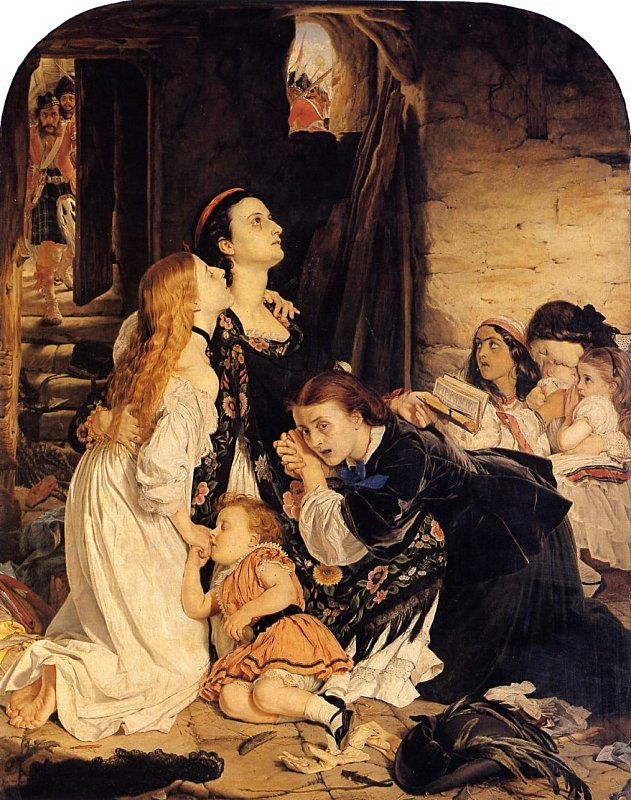
 
 
In the eighteenth century, assumptions about women being the secondary sex were clearly stronger than they are now. Women were conditioned to prefer death to defying conventions. Gender was objectified in art as in all aspects of everyday life, and so was class and race. The hierarchical divisions were rigid, immovable. For instance, a painting of honourable British women in colonial India during the sepoy mutiny, entitled In Memoriam, portrays them heroic in the face of danger. How so? The women do nothing at all to survive, but properly await their fate.

Nochlin explains:

Now there are at least two discourses articulated in this image. One is the overt story of heroic British ladies and their children during the Sepoy mutiny, fortifying themselves with prayer as they are about to be assaulted by savage, and presumably lustful, natives. The other discourse, less obvious, is the patriarchal and class-defined one which stipulates the appropriate behaviour for the lady, and it implies that no lady will ever unsex herself by going so far as to raise a hand in physical violence, even in defense of her children.

She says that the original image, considered too graphic for the delicate sensibilities of the upper crust Victorian society, had to be painted over with the Scottish rescuers appearing at left replacing the “presumably lustful” Indian rebels

For eons, respectability for women has meant the confines of home and family. Women are honourable in the community as long as they are weak, passive, nurturing and domesticated, available for the needs of their husbands, and with no real needs of their own except to be of service to preserve the social order. Women artists have been hard-pressed to find acceptability and self-expression outside the entrenched social rules. They have had to be subtle in their approach; else risk caricature. Case in point, Nameless and Friendless by Emily Mary Osborn in the nineteenth century that describes in more than a thousand words the plight of women in the harsh reality of the time.


The young woman artist/model, stepping outside the home, possibly facing hard times yet unwilling to lose her dignity, is nevertheless subject to keen male scrutiny and condescension, both for her person and her work. It is surprising that, despite this painting of 1857 being created by woman herself, it was described in a 1970 art publication as Gentlewoman reduced to dependence upon her brother’s art. Perhaps the standard received wisdom carried forward is that women are incapable of creativity. The female artist too must adhere to that social norm and deny talent to her female model...but does she?

The slightest aggression amongst women or other signs of being unsexed would banish them from the respectable class, and put them beyond the pale of ‘normal’ or ‘human’. Women social activists have thus been portrayed as poor, ugly, demonic rabble-rousers, destroyers of the social fabric. It would seem that these social have-nots strive, in frustration rage, to reverse proper power equations. Apparently, the mere attempt at being a change agent renders a woman certifiably insane! 

Some women artists of earlier times have adhered to the popular myth in their creations. Perhaps, riding the traditional bandwagon has been the only way for them to survive in the man’s world. Sadly in the process, they do themselves and their own representative group no service, because the association renders capable women untouchable - poor, mad and ugly – and open to derision. 
 

Many closet feminists suffer emotional pain in private at their own public obeisance to gender inequality. Unable to cross the invisible social barrier, they confess cloying the deception to the pages of their personal journals. In an essay on the works of Florine Stettheimer, Nochlin quotes a telling poem written by the artist and poet, but published only after her death:

Occasionally
A human being
Saw my light
Rushed in
Got singed
Got scared
Rushed out
Called fire
Or it happened
He tried to extinguish it
Never did a friend
Enjoy it
The way it was
So I learned to
Turn it low
Turn it out
When I meet a stranger---
Out of courtesy
I turn on a soft
Pink light
Which is found modest
Even charming
It is a protection
Against wear
And tears
And when
I am rid of
The-Always-To-Be-Stranger
I turn on my light
And become myself. 
Ah, yes, on the other side of the world in India as well, feminine initiative is traditionally discouraged. This image of assertive women being dark and disorderly has endured through mythological epics created over two and a half millennia ago. Durga, the sylvan deity, is the epitome of beauty and grace as wife and mother. But in her role as the warrior goddess Kali, she is depicted as so frighteningly bloodthirsty and uncontrollable that few women would want to identify with her fearsome (outcast) image or be inspired to action. Of course, only the intervention of husband Shiva, shames her into remembering her place, and brings the Kali fighting evil outside back home to her senses!

The at best patronizing attitudes to women and women’s work have resisted change in many parts of the world. Women must think, feel and act exactly as males at home or in society decide for them, or else. In social fundamentalism even today, women and girls seeking education or employment have been brutalized, defaced by acid, shot, raped and murdered; punished for transgressing some gender role or dress code dreamed up by men to reiterate authoritarianism. 

It is more than time to rectify this demeaning outlook. Many women artists have used deconstruction techniques to make their point, to expose and deny the standard received concepts of beauty. Hannah Hoch’s Pretty Girl is an intriguing photo-collage from, I believe, the 1920s. This woman artist was earlier considered marginal, but it seems to me that her bold perspective and courageous rejection of the pervasive patriarchal order puts her far ahead of her time.

Nochlin writes:

Pretty Girl is in part a savagely funny attack on mass-produced standards of beauty, the narcissism stimulated by the media to keep women unproblematically self-focused. At the same time, the collage allegorizes the arbitrarily constructed quality of all representations of beauty: the “pretty girl” of the title is clearly a product assembled from products …


I must confess that as a very ordinary spectator, my unconscious search has been for aesthetic harmony in art images. I remember once visiting a photo-art exhibition in USA in the late 1990s. I forget both theme and name of artist, but it seemed an ugly, unabashedly cynical display of larger-than-life male genitalia. Possibly I was both naïve and prudish that I found the pictures off-putting, although other viewers appeared unfazed. I thought it a deliberate intent to elicit reaction, which I found repugnant. Was it necessary to assault the senses to draw attention? I took it as narcissism hidden behind the right to freedom of expression, laziness in actually harnessing creativity, and a banking on gender to carry the work.

Nochlin’s essays push me, the reader, to rethink my own premises. Definitely there are thought-provoking aspects to art I overlooked before. I wonder today if I did that phallic photographer a disservice in my negativity. There might have been a social comment in the work that escaped me. Perhaps the artist attempted to shock viewers into a conscious awareness of the effects of overindulgence. The graphic images might actually have highlighted the increasing social preoccupation with the pursuit of pleasure in developed society. That technology scales new heights, but the minds of men remain entrenched in overt, self-absorbed and even deviant sexuality… I don’t know, maybe…  


Reference for this post:

Nochlin, Linda. "Women, Art, and Power and Other Essays". ISBN 0-06-430183-4 (pbk.) Icon Editions. Westview Press USA & UK. 1989.

Monday, January 14, 2013

Blue helmets: come home


In 2007, the United Nations broke new ground. A contingent of 103 peacekeepers reached the capital of Monrovia in Liberia. Immaculate in blue, these 103 peacekeepers were all women. Indian women. Known as the "Blue Helmets", these women guarded the President office by day and patrolled crime-ridden areas by night. Their presence marked significant change. Trained in sophisticated weaponry and combat tactics amongst other skills, the Blue Helmets' foot patrolling by night reduced armed robbery by as much as 65 per cent. Local women felt safer; children felt safer; and men who were not involved in crime, felt safer. 


In India, we tout traditions of respect and equality for all mankind. In fact, that is how we explain namaste or namashkar, the traditional greeting with folded hands, which impresses the world. But it shames us as a people that, to protect our own women and children at home, the collective in this country fail. As a New Year’s wish, ordinary citizens in India would wish for the blue helmets to come home as soon as possible to work their magic on mounting gender-based crimes.  

Respect and equality for all seems to disappear rapidly in the case of females. Gang rape and murder of innocent women and girls is on the rise, not only in regions in conflict. It has naught to do with genetics, rather the social learning of gender inequality.  Assumptions of the old adage boys will be boys simply gloss over their loutish behaviour. Around the world, men club with the perpetrators to apportion blame onto the victims. Some women rape easy says a senate hopeful in US. In India, men in respectable positions wonder why, if they are “respectable”, the females are out at night with male companions not their relatives


A local politician declares: There's only one word – Limit. If you cross the limit, you face the same treatment that Sita faced in the Ramayan. If you cross the Laxman-rekha (i.e., boundary), Ravan will kidnap you like Sita. A godman advises women to address the predators as “brothers” and beg for their lives. The son of the highest incumbent of the land rubbishes the spontaneous demonstrations in New Delhi over the gang-rape and murder of a young paramedic trainee with: What's basically happening in Delhi is something like the pink revolution, which has very little connection with ground realities. Women who are beautiful, painted, dented, go to discos, give interviews, are not particularly serious about the protests for which they have come out on the streets.
 

The idea of masculine identity is testosterone fueled. Women’s education, women employment that become an affront to male dominance must be put down, and this aggression is rationalized as right. The continued practice of blaming provocation onto victims is shocking to the freedom loving sections. But shock we feel for all of a few minutes before things return to the way they have always been – to the status quo of powerlessness before learned patriarchal dominance.


An opinion in The Hindu explains the point in India:


It has become commonplace to understand certain spaces and institutions (say, the street and Parliament) as public, and others (say, the home) as private. The terms “public” and “private” have, in turn, become linked to ideas about the “proper” realms for men and women. Women are tolerated in public spaces and within public institutions but are expected to behave “properly.” Otherwise they suffer ridicule and violence. The media quite often provides accounts of public women (say parliamentarians) through describing what they wear, or, how many children they have; women’s primary identity continues to be defined through an implicit understanding that public institutions possess (and should possess) a masculine identity.


Fundamentalists point fingers at “decadent” urban culture brought on by the “depraving” influence of the West, which generally refers to women aspiring to equality. Others blame it on the traditions of male dominance formed with usurpation the position of women in an earlier era. Thus creates the legacy of confusion between progressiveness and orthodoxy that fragments society also on gender issues. But no, nothing and no one else is to blame for the ways things are today. The fault is ours; we who are global citizens of the structure that, on the one hand, unquestioningly carry forward ignorance and animosity of the past that festers gender roles, and on the other, takes freedom to the extreme of demolishing the very concept of family.


An opinion on the Daily Mail says of the West:
  
Our generation, who started to grow up ‘between the end of the Chatterley ban and the Beatles first LP’ got it all so horribly wrong. We ignored the obvious fact that moral conventions develop in human societies for a reason. We may have thought it was ‘hypocritical’ to condemn any form of sexual behaviour, and we may have dismissed the undoubted happiness felt by married people as stuffy, repressed and old hat. But we were wrong, wrong, wrong. Two generations have grown up — comprising children of selfish grown-ups who put their own momentary emotional needs and impulses before family stability and the needs of their children. 


We have been unable yet to find common ground between antagonistic perspectives. In the resulting confusion, perhaps the collective stops thinking, as individuals and as groups. Our evolution then is measured on technological advancements and not the minds of people. India and Pakistan for instance are said to be traditional rivals. Not really, since the two were part and parcel of the same nation for thousands of years before the Partition tore them apart. Vested political interests have kept the animosity alive, and even six decades after their separation as two different national identities in the sub-continent, both countries bleed attitude. When their citizens meet in neutral settings, they relate as mature adults. However, there appears to be something in the sub-continent that keeps the same people sprouting vitriol from opposite sides of the fence, whichever that is. 

And thus follows the stress of paranoia, the fear of being overwhelmed by others. These make for self-centredness, pushing the conservation of resources, and protection of identity. The creativity in problem solving is lost, because the intent is to control by any means, rather than adapt to new realities.  It is time to change stagnative structures. Patriarchal hierarchy needs to give way to democratic spheres of influence. It is perhaps more than time for the women peacekeepers to make their presence felt back home.

 
In a blogpost about these warrior women, Kohli says of their effectiveness: 


Far from being "soft" which is what many expected an all women's contingent to be, the Blue Helmets endeared themselves to the local community. Their message was simple - you can trust us. They were perceived as polite and forthcoming in help, and did what they were meant to do - keep the peace.

In India, this we need today: the return of traditions of respect and equality in this new avatar – women in the role of protectors of the sisterhood of mothers, wives and daughters.

Friday, December 21, 2012

Heard of Dark Continent?

The little girl looked carefully at me. Had I ever heard of Dark Continent, she asked softly. I was surprised that she knew enough to quiz about it, considering her background. She was a child of the slums, and hardly ten years old, her clothes worn, frayed at the edges. Perhaps this is the habitual mistake the “educated” make. We look upon the poor as an undifferentiated mass of entrenched illiteracy, impediments to the nation’s economic progress. 
This country does its best to eradicate poverty, but with the population burgeoning, it is difficult to make much headway. I believe a Japan adds on in people numbers each year or so! Illiteracy is the other face of poverty; hence education for all is a part of social development in the socialist, democratic republic of India of the present.  Education is heavily subsidized to make it within the reach of the economically disadvantaged. 
In a bygone era of numerous monarchies, organized community living in the Indian sub-continent had strict social segregations based on birth. These divisions of society were hierarchical. The Brahmins were the academicians, teachers, custodians of the scriptures; the Kshatriyas were the royalty, the warriors; the Vaishyas were the business group; the Shudras were the menial labour, the untouchables. Social discrimination was rife. Males born into a particular family were forced to follow the trade of their fathers. There was no escape; caste was hereditary.  The “upper” castes hoarded wealth and privileges, and imposed upon those “lower”. 

The right to education was restricted to the top of the social ladder, and those born to families low on the totem pole were barred from it. The epic Mahabharata recounts the story of Ekalavya, the talented son of an untouchable. Unable to attend the martial arts academy run by the renowned Dronacharya, guru to the princes, Ekalavya practiced archery on his own before a statue of the teacher he revered. He caused consternation when he dared compete against Prince Arjuna, the guru’s favourite student. Teachers, during that period, were not paid salary, but received guru dakshina (returns in cash or kind) from the students or their families. Although not directly responsible for Ekalavya’s prowess, Dronacharya nevertheless claimed dakshina from him, and demanded his archer’s thumb in reward! 

Women of course, were entitled to a caste only after marriage. Thus the point of their education really did not arise outside of chores learned at home from childhood - cooking, cleaning and rearing children. Although social reformers fought long and hard through the colonization of India to remove the social discriminations, the perception of women being secondary to men continued far into the twentieth century. All that the marriage market required was the minimal ability to read and write; girls hardly needed to become pundits! In fact, the elders feared that prospective grooms would turn away from over-qualified brides, who would never get married and thus dishonour the family name. Even today many believe that investment in the education of boys bring returns in future, but girls are paraya (outsiders), soon to belong to another family. 

In the ‘sixties, my father broke family tradition, as it were, by sending daughters to English-medium schools to get what was then the best education. I remember that during university days, a classmate and I were in heated discussion of a certain project on the tram ride back home. While we argued our points, other passengers were listening in. After I got off the tram, the man that took my seat turned to my companion and inquired where I came from. His eyes popped when he heard that I was a local. Huh, he exclaimed in astonishment, Speaking English! Educated!


At the time, the tuition fees everybody paid were about two hundred rupees a year, that is, less than five dollars annually, even in the science subjects. This was because the political intent post-Partition was to rebuild the dismembered nation. They assumed that the intellectual crop so nurtured would take the country forward. But that idea backfired in the ‘seventies and ‘eighties. Unlike many other nations, India did not have a compulsory service scheme for its citizens. Thousands of top graduates and post-graduates winged their way to the West, lured into serving in the more lucrative workplaces overseas. The expendable patriotism of the already privileged sunk the nation deeper into debt, because there were no legal bonds to hold them back. With the actual cost of the university education for each a few hundred thousand rupees at least, the eventual loss to the national exchequer with the brain drain must have been in the billions. Without the IT boom and the outsourcing industry, the Indian economy might have still wallowed in the doledrums. 

Although scores of private autonomous universities have since mushroomed charging exorbitant amounts for better teaching facilities, the educational subsidy continues in governmental institutions, the university fees being raised minimally over decades.  Furthermore, in and around Kolkata, primary and secondary governmental schools waive tuition fees for the economically disadvantaged sections. After generations of illiteracy on the backs of social segregation and poverty, their offspring are exposed to the R’s, and graduate degrees. One parent told me that they would have been satisfied with their children being allowed to touch the benches of high school; to have a graduate in the family was beyond imagination. 

I visited the students of a governmental primary school recently to get a sense of their ability in the English language. Both boys and girls present were the first school-goers in their family. I looked at one young boy’s exercise book. He had made many mistakes in an earlier spelling test, and in one word, written “dee” instead of “deer”. Just carelessness, I presumed. I pointed to the word, and asked him what it was meant to be. He blinked at it a moment and then whispered to me that it was a very hard word. What is it, I insisted. Elephant, he replied glibly. Clearly the wiggles on the page made no sense to him at all! 

It seems to me that, with the decision to eliminate examinations in the school system, the point of education is being lost. The light of knowledge being spread is dim because the children are not pushed to rehearse, remember, think complex and compete intellectually. They are being uniformly promoted with no quality control of capability, simply pushed up to a new level of incompetence each year. Education to them thus becomes a meaningless trudging back and forth each day, uncomprehending. 

An interesting TV reality show is titled Are you smarter than a fifth-grader? Questions from science, math, history, geography, grammar, etc., are asked of adults locking horns with the academic level of the average American ten-year-old. It proves that the children really do have to study a lot, because most adults trip up in the programme. But sadly, amongst the economically disadvantaged groups in this state today, many children of the same age are stumped by anything to do with academics. 

Education for all is a commendable idea in democracy, but is the process in use the best for the country? The educators might boast of rising literacy numbers, but the quality of education differs widely between the social sections. Eliminating competition in schools for the disadvantaged encourages their students to avoid critical thinking, to seek the easy ways out. Where ability counts most, in the work world, they fail to impress employers.  The degrees they possess may not be worth the paper they are printed on. The joke is, toss a pebble on the street and you might hit such an “educated” unemployed. 

The little girl clued into the Dark Continent is one bright spot of intelligence amongst the general clueless. Surely, there are many more talents like her touched with the light of knowledge, passionate about learning, and waiting for the opportunity to excel.  Education is meant to enlighten minds, to create awareness of the environment for adaptability, and to dispel the darkness of ignorance, superstition and discrimination. The socially disadvantaged groups need out of dole dependency to develop as people. Else, lamp-lighting ceremonies in the educational institutions become mere rituals, while the dark continent of mindsets are preserved across society.


Sunday, December 16, 2012

Women on guard


The research institute I visit on occasion is a massive structure. Its wings stretch out in long corridors to accommodate the rooms after rooms required for research, replete with state-of-the-art machinery each priced at lakhs, if not crores of rupees. At the entrance to the premises a bunch of uniformed sentinels are constantly present. They are the undifferentiated security buffer to the outside world, and few know them as individuals.

The institution was born decades ago, when a small group of doctors mooted the idea of ongoing research and development. The founders had to fund the projects themselves, initially. Today it has grown prestigious, and money is no longer an object. The institution is showered with scholarships, fellowships and grants. New sections are added or renovated at will. But rather like within a beehive, roles are preordained. The building buzzes with activity with hundreds of personnel. Scientists and research scholars scurry about in their lab coats and latex gloves, focused unwaveringly on making new discoveries. Each such member hardly has the time to look around at their surroundings, much less to interact with people unrelated to their technical universe.

The security staff is meant to facilitate the institutional preoccupations, to ensure the safety of the institutional members and their magic machines. A small security complex is built right beside the gates. It has a tiny office for the security supervisor, a chair or two to rest on by turns and little else in terms of facilities. The security cell is not air-conditioned, and one large standing fan is in operation at the height of summer. Ineffectual at keeping out the heat beating down on the low roof of the structure, it serves to merely move the hot air around.

I notice a woman there on guard duty. She is tall, of athletic build, attractive and still young. She looks smart in her uniform of shirt with epaulets and security insignia and starched white sari. Her employment is probably a result of the increasing percentage of women being employed. Yes, she nods; her duty is to interact with the women, so that they do not face handling by men. Since she is the only female in the cell, her services are invaluable. During conventions and other important meets she must be in attendance for all the lady visitors. That means, rain, hail, shine or personal illness, she cannot be absent.

We spend a few moments in girly conversation, about fashion accessories that I might wear but she is not allowed to by the regulations. There does not seem to be any separate facility either for her as a woman although she has been at work for a couple of years. I ask why she took this job. She has a ready smile and pleasant manner. Surely there are other avenues of front-office employment open? She gets many offers, pips up one of her colleagues, but she does not take them up. Everybody wants her and nobody here will let her go. I smile at the extravagant words. The woman blushes pink and shushes him.

She tells me she comes from a police family. Father, brother and sister, are all in the force. That was the life she had wanted too. Her application was being processed, but then marriage happened, and the regulations immediately rendered her ineligible. The touch of vermillion in her hair signals her marital status. I ask how she balances between her work and her home. She looks away momentarily, and shakes her head. Her child is being raised by the extended family, and she barely gets to see them. The job demands her time and all she can do for family is pay the costs. The emotional conflict is tangible.

Walking out from the institution, I spot a policewoman at work on the street. She is on traffic duty dressed in the khaki service shirt of the police force and sari, though, as she tells me later, they must wear trousers too. I stop by the side of the road. She motions me to stand near her as she waves her arms to regulate pedestrian crossings. I shake my head and say I stopped to see her. She looks a little perplexed. I suppose she too is used to being seen as a role rather than a person. She is middle-aged, looks drawn and seems to favour a limp. She is unsmiling, her tone strident as if used to encountering intransigence. And, true to “regulations”, she has never married. She tells me she has been ill for some days, but her leave application was not sanctioned.

It is her duty to serve. I watch her tackle jaywalkers. See, she says, as she points to offenders that can see the lights are green for traffic, yet run across dodging the oncoming vehicles. She stops several and gives them a stern talking to, but the habit is ingrained. It seems a thankless job to speak about public safety because the people she stops argue in return. Unfortunately, she is powerless to issue deterrents like spot fines. She threatens that should an accident occur, she will not book the driver, because it would be the victim’s own fault for getting in the way. 

I wonder how long she has been a traffic cop. She says she is not. She has thirty-one years of police service but the assignment here is only for the day because of shortage of women personnel.  Their job is to follow the orders that come and she was told to report here only two hours before. Earlier, she was engaged in crowd control at the sports stadium. I ask her why she chose the force. What jobs are there for us, she counters, thousands are trying to get this one now. She looks around her, comments that the streetlights are inadequate for such a busy intersection and then limps away to stop a few more defaulters.


I am surprised that to this day and age in India, the archaic service conditions for women carry forward unquestioned. It seems the men in any organization may have family but women in uniform must sacrifice for service. Not all women though - I remember a high-profile female police commissioner portrayed in the media as the ideal, efficiently managing both work and family, so there must be regulations and regulations. Equality, it seems, is for men or else, for those at the top of the heap. Why so? The obvious issue is biological – the bearing and rearing of children. Those remain the woman’s personal works in this region, while elsewhere in the world, campaigns run for paternity benefits!

Under these regulations, the discrimination of gender and class in bureaucratic employment continue, leaving many of these women vulnerable, open to exploitation. It is hard for those ensconced in ivory towers to think beyond themselves. Their tunneled vision of the world makes social conversations with others difficult, or even to relate to them as people. I called on the institutional director some years ago, to suggest people development programmes with personnel across levels. In my perception, many could do with some training of social skills, understanding the reality of others through feedback, especially of those below them in the hierarchy. The man sitting in the plush chair, dwarfed by the massive desk and protective detail, was incensed by the implication. We are an HRD institution, he shouted, it is our job to teach! 

Women are comparatively new to employment and work conditions. Guard duty, for instance, is not a common choice of work for women brought up with marriage as their goal. They seek employment for economic needs. But when required to sacrifice home-life for work-life, they are being force to pay a price for being women. Social activism attacks poverty or corruption, but there seems none to fight for the rights of women putting life and limb on the line to keep others safe. Their work conditions are pathetic, and urgently require revision. It is more than time to address the pervading standard received wisdom of keeping them disadvantaged. The powers-that-be of institutions need to learn a little empathy, a little humility before they teach.

Thursday, December 13, 2012

Flower in the muck

The boy on the bus sat hunched in his seat. He was about ten years of age, but the posture, hiding his face behind the bag of books on his lap, made him appear small and lost. He seemed shy and withdrawn, squashed between buxom passengers on seats reserved for ladies. His uniform, faded from many washes, had an indeterminable emblem embroidered on the breast of the shirt. It may have been a lotus - the flower that blooms alone in muck, its innate splendour unsullied by its environment.


It was clear he travelled unattended. The dusty socks and shoes on his feet testified to rundown conditions. I imagined the family was hard pressed to make ends meet. His father was probably the only earning member, burdened by the costs of supporting an extended family, his mother young and harried. Household chores would take up all her time – cooking, cleaning, washing, hauling water and tending to the elderly in the family as well as the children. In sending to school, the child’s parents must visualize a brighter future for their generation next, as well they should. If the free mid-day meal at school was attraction, so be it. But definitely, escorting them to and from school was out of the question; neither would they have the wherewithal to hire school-bus services for their safety.

The ordinary buses here, both public and private, carry far more passengers than they should. At peak time overcrowding, there is hardly any personal space, as people pack in like sardines. These buses, my sister living in America believes, are a hotbed of deviant behaviour, a living hell for children. She shudders at the mere thought of one. Convinced that predators abound, she has banned her offspring from boarding them. Apparently this thought never occurred to her in our younger proletariat days when she herded us onto them!

It is true that back in the day, far fewer women were out and about pursuing education or employment. Most mothers were too shy to speak about sex, and children, especially girls, were left their clueless about this reality. Public awareness was poor as well, and the young victims either too uncomprehending to protest, or too ashamed to draw attention to themselves. But much has changed since then, mainly in the passenger numbers. With greater social awareness, the bus interiors have clear gender demarcations – women and children on one side, men on the other. Over the intervening years, girls learned to confront, to even hit back at attempts to take undue advantage. As mothers themselves thereafter, many have taught daughters to be assertive. Often other passengers join in to deter unsavory behaviours.

In a country as large as India, with at least a quarter of the billion plus population located below the economic cut-off line, poverty is the affliction. Exposed as they are to the environment with nobody to shield them from harm, children born into this disadvantage have to learn early to fend for themselves. Harsh circumstances force their growing up fast - or perishing.

On this day, the bus conductor ruffled his pack of tickets with his thumb, the sound a distinct reminder of the rite of passage – one had to buy one’s stay on the bus. The boy pressed back as if trying to disappear from view. He could not however, avoid the experienced eye of the conductor. Every now and then the man would look around at him and flick his pack in warning. The boy would feebly feel in his pockets in response. Ticket, ticket, urged the man with his persistent thumb sounding his impatience, his stare unsympathetic. Watching the tension build up, I was touched by the boy’s woeful look. The point to disembark was approaching for me, so I decided to intervene in their byplay and help the child. As I moved forward to resolve the issue, to buy the ticket for him myself, the boy stood up and dug deep into his pockets. He brought out a coin that he placed in the man’s palm, and shrugged his shoulders to imply he had no more. The man glared at him, but turned away. He did not offer a ticket stub, nor was he asked for one. The boy hopped off the bus when it stopped, and behind him, I did too.

He seemed to gain energy as the bus trundled away. As I watched, he casually slung the bag across his shoulder. Then suddenly, he sprinted across the road beating the oncoming traffic. He seemed to be heading in the same direction that I was. I followed at a more sedate pace. On the other side on the road, he skipped along ahead on the sidewalk. I saw him pause a moment before darting in towards a roadside stall.  These are makeshift wooden structures where knickknacks are sold – chocolates, lozenges, potato chips, cigarettes, chewing tobacco, and so on. Their owners set up for business every day, keeping a weather eye open for the police. Because, whenever there is a clean-up drive, they must pack up and leave. 

The boy leaned on the counter, pointing at something in the stall, while holding out something he had clutched in his hand. As I came alongside, the stall-keeper took it and opened out the tight folds of paper money! I could see that the note would easily have covered the actual price of the boy’s bus ride. I shook my head and smiled wryly to myself as I walked on. So much for my expectations of childlike innocence, I thought! Indeed, this child has already learned to fend for himself in an unkind world.  Left to their own devices and exposed to a devious environment, children of disadvantage may practice the art of con, long before mastering the R’s.  The need for survival forces their early adaptation to harsh reality. Can we really fault the lonely flower for being touched by the surrounding muck?

Monday, December 10, 2012

Worthy of the gods

The other day, I noticed a long queue of young men outside the doctor’s chamber. I wondered what could make so many youths collectively sick. It turned out to be a recruitment drive and they awaited medical reviews. I imagined they were in the city chasing their dream job. They seemed to hail from rural areas, a little out of comfort zones in the urban surroundings. One by one they they were called into the room; some stayed there, but more returned outside. The ones returning were the ‘unfit’ group, and disappointment writ large on their faces. In their sheepish looks around, their continuity with tradition seemed imminent – that is, to abandon dreams in the face of failure. 

Indians invest huge effort in pursuing goals. The practice of rituals and identification with mythological characters is quite pronounced in this region, and so is the belief in fate. We presume to be descendants of the gods. Although lacking the requisite supernatural powers of the epic characters, we expect to be like Prince Arjuna, the archer extraordinaire of the epic Mahabharata who never missed a shot. Even through a reflection, he could pierce the eye of the fish revolving high above. Because Arjuna thus won the princess, we expect to be similarly blessed.  


We forget that as mundane humans, we have to contend with the interfering variables that mythology does not. Our talents also are not equivalent, and wins therefore, are dicey. But failure does not sit well with the heritage we claim. And when we do not succeed at the first try, we take it personal. We are shamed by failure, and do not invest in second chances. Should the one try we make hit target, we can continue to greater exploits. Should it not, we give up entirely. It is all or nothing, with no middle path. This is our morphogenetic learning, the song of culture, as it were. 

I remember being fascinated by rhymes in childhood. The cadence of similar sounding words allured me into ambitiously trying my hand at it. Like:

Donkeys can bray
Some houses are gray
Lions can roar
My pretty dress tore
Birds can fly
And I can cry.

Now, considering that English was then learned only in school, it may have been an achievement for a 5-year-old. But as ‘verse’ was probably little more than a few similar-sounding phrases strung together.  Perhaps with a few decades of honing, something impressive might have resulted. But while I quietly admired my handiwork, an English teacher of the school, noticed my childish scrawl. She was a tall, dark, severe-looking woman and we were all afraid of her. She took my little creativity and frowned at it. I awaited her response with trepidation, expecting punishment or at least a public dressing down for my temerity. Instead, she praised my penmanship as worthy of publishing in the school paper. Her intent, I am sure, was only to offer encouragement, and she probably put it out of her mind soon after. But I assumed she would make it soon happen. For days and weeks and months I waited for the word or sign of making the hit. When it never came to pass I my self-esteem so plummeted I never rhymed again.

We are not taught to handle defeat, hence the fear of public humiliation is consuming. In the school I went to as a child, getting exam results was like visiting the dentist. We could not just pick up our scores and leave – pain was inevitable! The entire class assembled, names were called one by one and performances announced. We learned early that being bottom of the class would earn sustained ridicule from peers. Chants of failure, failure would follow the unlucky everywhere, even amongst children that could hardly spell the word. I actually thought the term was ‘fail-year’, to signify unworthiness throughout the year. My anxiety was double because, at home, it was relative to the monies spent. The standard was set at first in class, and no result below that pleased the elders. So, each time, I died many deaths before I learned my fate!

Respect for elders is a strong thread of the Indian/Bengali cultural fabric. Authority figures are viewed too intimidating to question, and we tend to read divinity into their manner. Even half a century later, I recall the unwittingly effect of the Mss Broughton of the sixties that put paid to my poetic proclivity! Similarly, the group of ‘unfit’ young men would probably read one disappointing medical review as absolute rejection of worth. These Arjunas of the twenty-first century would soon pack up their dreams and fade into oblivion.  Do not give up, I exhorted forcefully in the vernacular. The bowed heads jerked up in surprise at my sudden interjection. ‘Unfit’ today does not make you unfit for life, I said. Ask to understand exactly why you fail the test today. Correct it, and make sure nobody finds you unfit the next time. I waggled a forefinger at them to emphasize the role of the social elder I was appropriating. The country wins if you win, I added, which brought reluctant smiles to their faces.

Engrossed in the mythological fantasy, the tendency with every bump on the road, is to quickly sideline opportunity as not fated for us. We need to respect our own efforts enough to change the dismissive social attitude that relegates to nothingness, genuine efforts on the learning path. To enable adaptability to a changing world, our stories must include personal experiences of failure to highlight the resilience we lack. As a people we now need to invest in new human stories from diversity to help us accept failure without shame. The historical tale of King Robert Bruce, for instance, who, inspired by the tenacity of the lowly spider, found the courage to fight again after six crushing defeats, to finally win his throne. The eye of the fish should be a guideline to focusing mind on task. We should not belittle ourselves by taking it as the only acceptable standard of achievement worthy of the gods.

Saturday, December 1, 2012

Disappointing the future


In childhood, the future holds great promise. Images of things perceived novel around us crowd our brains. At one time or other, and with the discovery of new, exciting roles in life, we emulate train-drivers, firemen, stuntmen, superheroes, writers, musicians, dancers, and so on, as our models for life. The want to be is fleeting, to vanish when some other novelty grabs attention. But adults often are impatient with these daydreams taking away from actual goals. With intent to protect them from themselves, they assume control of and direct their children’s lives, in their own image.

It seems to me that the modern habit of sticking children in walkers to ‘protect’ them from injury contributes to dependency - and the fear of falling. Many sheltered young people I hear about voluntarily transfer their life-choice decision-making, almost in throwback to the joint family process of yesteryears wherein the head of the family ruled over all aspects of the extended family members lives. Although families in India had since transformed to nuclear, becoming smaller and independent of traditions, in some areas, the social dynamic appears unchanging.

For instance, the allure of ‘love marriages’ (choosing one's own partner) diminishes, perhaps because divorce rates have climbed four thousand percent in India in recent times. In a growing trend, these children look to having their life-partners secured for them by parents instead. Technology has become a hugely useful tool in the burgeoning market of marriage ads. There are specific websites to meet the demands for community, caste, status, looks, ad infinitum. I see the parents of grown sons and daughters avidly trawl Internet to find suitable matches from around the world. As in the corporate industry, SWOT analyses are conducted of individual and family and, in concessions to democracy, a final ‘shortlist’ of candidates made and presented to generation next.


Following the parental spadework, the prospective brides and grooms then venture out dating down the list to discover mutual chemistry. When The One is found, the parents from both sides then meet to hammer out the nitty-gritty between them - including the covert gives-and-takes of dowry - so that marriage along traditional lines might occur with full pomp and pageantry. In the process, the parents and other authority figures find relevance in their own existence.  Otherwise smart and intelligent young people also cultivate the expedience of this generational symbiosis extending continuity with the past. It is perceived a useful allocation of family resources, to collectively prevent mistakes from happening.

My question is whether the continual spoon-feeding allows the children to grow up at all capable of assuming their adult responsibilities, especially to think outside the box in situations unexpected. The children are taught to avoid making mistakes in life, and learn to have little faith in their own choices. The point missing in the remote control is the practice of falling and getting up again. Neither as parents nor as teachers do the elders pass on this crucial art to those in their charge.

An opinion I found on the ’Net says:
To gain admission or be hired at top-tier universities, we have been on a winning streak, earning awards and top grades with ease. We follow the rules to get ahead. We have often forgotten how to fall, much less how to teach others to fall. If we do fall, we carefully hide those failures from students and colleagues to preserve our reputations. As classroom experts, we rarely venture afield to remember what learning by trial and error feels like. …Much of the time we have become entranced with being experts rather than learners—and thus have distanced ourselves from the students we hope to teach.
 

We assume that disappointments with the adult world were more rife in our time, because in those decades, technology did not wipe away boundaries between people or open global avenues of opportunity. I remember that as the youngest member of a joint family, my reality was constantly looking up to others, wanting to follow in their footsteps. For instance, the dance school where older girls went became my goal in life. I dreamed of becoming light as a fairy, graceful as a swan, just like them. The family elders, on the other hand, were obviously counting the monies; their resources stretching thin. They had no incentive to invest in further training that would probably lead nowhere, since, at that time, there were no reality shows to play out competitions on television, hawking lucrative deals to motivate contestants’ guardians. Education, and only education was then the thing, especially for girls! It was left to my mother to break the news to me. Rather than admit the truth, she opted instead to say that it (dance) would lead to ugly fat in later life! That crashing comedown for me, probably affected my perceptions of self and elders thereafter. I always wanted to be a dancer, but somehow felt constrained. 

The mindsets of parental control have changed little even today, and parental aspirations may replace the children’s aptitudes. Because the social environment continues to support total obedience and respect for elders, the younger members feel powerless to rebel against the family authority. They begin to believe it too much to combat attitudes and customs to charter the new course they want in life. Those that cannot conform, learn to be disappointed with the adult world, and suffer low self-esteem on pathways that little interest them. 

In a bus the other day, sudden raised voices attracted attention. I looked over at the commotion to see a young girl, obviously on her way home from school with school-bag and wearing school uniform, standing quietly by an empty seat while a couple of women on either side of her screamed at each other over her. Because both women wanted the seat for themselves, they were each bent on preventing the other from taking it. The teenager caught in between was clearly unimpressed by their antics, and ignored all calls for ‘the poor child’ to take the seat and settle the matter! I found her impassivity curious and got talking to her. She was sixteen and already believed adults, including parents and teachers, were hypocritical. Here was a person in a hurry to grow up and out of their control. 

In real life, she was a high school student living out her parents’ desires of a doctor or engineer in the family, struggling with physics and math, while her heart was in literature and she dreamed of being a writer. She was the budding poet that nobody around her knew about, and sometimes she wrote under a pseudonym to preserve her identity. Her parents, she said, neither knew nor cared about her aspirations. I asked why she didn’t sit down with the adults and talk out what she really wanted to do. No point, she said, they never listen. My father only gets angry and starts shouting.The strain showing on her face expressed far more of her isolation than her words did. She told me she hated going to school, because the teachers spent more time promoting their after-hours tutorials than disseminating knowledge in school. She felt she would probably learn far more from the ’Net than she did by attending their classes. 

Many students say their school counselors are uninterested in their growing pains and merely advise focus on studies, avoiding distractions. It is a sad commentary of our times that despite the new global openness, the choices open to new generations is to either live in dependent relationships or in alienation. Any psychology-based outside help carries social stigma that families avoid like the plague, thus perpetuating the disappointments. The children of today need astute guidance to growing up as levelheaded adults capable of independent decision-making in a rapidly changing world. More than them, it is the parents and teachers that urgently require counseling on the necessity to adapt to the environment. 

The elder generations need to remember their own ordeals of the earlier times, and enable youth of today to negotiate the travails and crises they must encounter in life. Young people must be allowed to explore the environment around them, to make mistakes and to learn from them. They are entitled to truth from the elders, sharing of experience, and independence. It would help them interact freely, and without misconceptions, with the changing global scenario and demographics of diverse groups. Else, they harbour in the corners of their minds unprocessed fears, angers and disappointments that poison perceptions, stunting their development as the people of our future.