Thursday, August 25, 2011

Endangered species, the super-rich!

Democratic freedoms seem to mean different things to different people, as events in different countries show. On the recent riots in London, we posted the thought that, among the socially disadvantaged, long-term frustrations with systemic inequality, may have finally boiled over into displays of violent dissent.The taxpaying public affected by the unrest has had little sympathy for it; the super-rich has remained cocooned. 

To sections of society, the sudden budget cuts could have felt like the last straw in the suspension of civil rights. However, reader from UK argues that benefits have been the actual source of the problem, having largely nurtured grifters seeking to appropriate what they do not earn. Their freebies threatened, these people planned the criminal activities.

He shares with us his indignation:
In Britain we are faced with reducing a huge debt and everyone is paying the price… benefits are one of the causes of the debt in the first place … Here even those with nothing can achieve a better standard of living IF THEY CHOOSE TO WORK HARD but many don't [and] they choose to take money and do nothing. There are some who cannot achieve anything and need help but there are also many who just can't be bothered.
The perception there is not so much of spontaneity in the protests, as of deliberately orchestrated lawlessness. Organized groups of criminal elements fanned out to stretch police resources thin, so that the looting could continue without inference. 


Our incensed reader adds:
… it's a good thing I'm not mayor of London otherwise I think I may have used Chinese or Syrian tactics and issued machine guns to the police and told them to fire at the knees and then arrested those people in hospital.
The palpable disgust of the salaried class probably stems from the economic pressures placed on them. In the dodgy economy, they are asked to share sacrifices with austerity measures. They carry the brunt of the tax burden, and as they see it, it is their contributions that ensure survival of the non-payers.

Powers-that-be perceive broken sections in society. They do not however, perceive the sustained political and corporate contributions to the moral collapse. The general solution resolved seems to be to stamp out the gangs with stiff sentencing of the looters caught on camera, and further cuts in their benefits.

But these stern measures would do nothing to address the searing sense of deprivation. Rather, the administration’s iron hand would underscore their disconnect with the ordinary population - pejoratively, the underclass. The social alienation that already exists may even be compounded as criminality in the targeted groups.

Meanwhile political establishments tend to coddle their super-rich. The tax payments of the moneyed class are minimal, which bloats their returns on investments. This tacit political support of the social hierarchy has widens its divides, with the rich simply getting richer. Billionaires in fact, are protected as if they are endangered species.

Warren Buffet comments:
OUR leaders have asked for “shared sacrifice.” But when they did the asking, they spared me. I checked with my mega-rich friends to learn what pain they were expecting. They, too, were left untouched. While the poor and middle class fight for us in Afghanistan, and while most Americans struggle to make ends meet, we mega-rich continue to get our extraordinary tax breaks … 

The Western perspective generally is pro-business, and the prevailing social climate relentlessly projects consumerism. Media entertainment and advertising tend to portray acquisitions as the most important goal in life, at the expense of honest human achievement.  

Booker points out:
Today, whenever my world-weary eyes alight on a "youth show" it merely resembles a glossily edited advert for celebrity lifestyles, co-starring a jet-ski and a tower of gold. And regardless of the time slot, every other commercial shrieks that I deserve the best of everything. I and I alone.
When sensation and consumption pervades the environment around them, few can escape the social learning. Consumerism burns in the hearts of the have-nots, especially the youth, although they have not the ready means to fulfill wants. It needed but a slight push to tip over the building dissatisfaction - and so it happened in the mass looting of consumer goods.

Severe punishments hardly come across as the best way to fix what seems broken in the emotional mind. Ordinary residents in parts of the city are instead applying a much more novel balm to social wounds – they continue to adorn walls with post-it notes. Placed on damaged buildings by the community’s silent majority, the messages form a mosaic of human feelings. Social psychologists consider the visual impact of the daubs of colour the critical, public counteraction to aggression.

Barford reports:
"Charming, sentimental, concerned, non-destructive, clever, responsible and recyclable, these Post-it messages represent very different values to those so atrociously revealed last week … human beings use visual markings to claim areas - so people are partly reclaiming their streets by putting down a territorial element" …

The completely non-threatening message boards not only invite participation, they also spread comfort and solidarity among the people, healing the trauma. During the riots, many individuals lost touch with themselves, as violence became their only way to communicate. The walls of love, with their reminders of eternal human values, may serve to relocate communities.

The super-rich of the land also need reminding that citizenship is an important social responsibility. In place of selfish self-interest and extraordinary breaks, they need to exercise their democratic freedoms to sacrifice and share with the less fortunate others of society. Perhaps then the pains of social divides may cease, and us-and-them groupings be rendered obsolete in Diversity. 


References for this post:

  1. England riots: What are the Post-it note 'love walls' all about?” bbc.co.uk. BBC News. 17 August 2011. 
  2. Booker, Charlie. “How to prevent more riots” guardian.co.uk. The Guardian. 14 August 2011. 
  3. Buffet, Warren E. “Stop Coddling the Super-Rich” nytimes.com. The New York Times. August 14, 2011. 
  4. “England riots: Broken society is top priority – Cameron” bbc.co.uk. BBC News. 15 August 2011. 
  5. Gilligan, Andrew. “London riots were orchestrated by outsiders” telegraph.co.uk. The Telegraph. 21 Aug 2011. 
  6. Power, Nina. “There is a context to London's riots that can't be ignored” guardian.co.uk. The Guardian. 8 August 2011.

Sunday, August 14, 2011

A parody of social unity

The global village concept has relied on technological advancements to unite the world. The informational networks become crucial to keep people connected. They are considered the routes to celebrate diversity in societies growing increasingly multicultural. However, as the London riots demonstrate, the spread of dysfunctional attitudes make a parody of social unity. 

Globalization opened up markets beyond national borders. The Internet was meant to bring together diverse cultures. Economic development was expected on one hand, and spirituality on the other. The assumption has been that the new knowledge facilitates the ready acceptance of differences. And yet, London burned...!


Over several days, flash mobs all over sprang into action faster than they could be controlled. The systemic machinery was caught flatfooted. Violence became contagious with diverse groups joining in on muggings, robbings, lootings, arson and pitched battles with police.

 Addley writes:

… familiar and well-loved streets were turned, for a time, into alien, frightening battle zones … shocking because of their speed and unpredictability, but also because of their geographical and socioeconomic scope.

The British Prime Minister opinioned that pockets of society  were sick. The impression might be that criminal gangs were responsible. However, is that the troublemakers were not clearly identifiable as such. Shockingly, they cut across society – not only white, black, Asian, men, women, children, old or young alone, and neither local nor outsiders, but strange combinations of all of these.

Technology was used effectively to organize the rampage, leaving authorities struggling to keep up. Blackberry messenger, facebook, and twitter spread word like wildfire among the rioters. In the context, social mobility took on new meaning.

Lewis and Harkin write:

… territorial markers which would usually delineate young people's residential areas – known as 'endz', 'bits' and 'gates' – appear to have melted away. "On a normal day it wouldn't be allowed – going in to someone else's area. A lot of them, on a normal day, wouldn't know each other and they might be fighting … This is bringing them together."

Some authors identify alienation, anger, boredom and mischief as the common factors in the chaos.  Some say the long police history of heavy-handedness with the underclass has boiled over. Others point to government policies forcing brutal cuts and austerity measures onto populations. The ordinary experience widening social inequalities, while the richest ten percent reportedly become one hundred times better off at their expense.
In the present context, Power comments:
…consumerism predicated on personal debt has been pushed for years as the solution to a faltering economy … Decades of individualism, competition and state-encouraged selfishness – combined with a systematic crushing of unions and the ever-increasing criminalisation of dissent – have made Britain one of the most unequal countries in the developed world.
I should think that the sense of inequality perceived among social groups is more than a recent occurrence - in fact, a legacy of past imperial practices over populations. Essentially, the interpretations of life naturally differ with cultures. In Western philosophies, for instance, goals have traditionally based on the idea that people have but one lifetime to make an impact.  Since survival is of the fittest, individualism must be favoured. Through centuries, the outlook broke new ground, but it also broke moral and ethical boundaries. 

Western explorers have sailed boldly into unchartered waters to discover the ends of the world driven by the spirit of adventure. The self-reliance and openness to new experiences allowed finding new frontiers. They pushed gathering of new knowledge beyond existing limits.

Tales of wealthy foreign cultures by numerous travellers spawned expeditions to unknown regions also in search of gold, spices, silks, and so on, initially for simple trade in oriental goods. However, economic depressions, internal stresses and market protectionism changed the Western outlook to territorial takeovers. In relentless pursuit of the capture and control of treasured resources, traders became political extensions of their monarchies abroad.

Political fractures within and between communities were exploited to divide and rule.  Ultimately continents were successfully colonized. The English, for instance, were able to boast that the sun never set on their empire. The people they assumed power over were perceived livestock that could be used and abused in slave and labour trades.

Western expansionism flourished also because the foreign lands were peopled by deferent, inward-looking cultures. The Eastern philosophies upheld collectivism, and the ideal of community before self. They tended towards peace of mind, harmonious reciprocity and cosmic karma. However, they were manipulated to lose even national identity for several centuries.


Globalization has most benefited the corporate world, and mostly those located in the West. It enables companies become multinational, to employ skills from a global workforce. But at the same time, rapid changes in reality have been far more than most people could cope with. Despite new markets, local availability of jobs for the underprivileged is rendered uncertain, because outsourcing is common. This cements cross-cultural animosities, although the divisive practice is an indigenous product honed over centuries.

Technology has indeed transformed reality. However, economic and political power games have resisted change. The informational networks have also juxtaposed social issues of past and present in people's minds. They have enabled greater awareness of differences against similarities between diverse people. 

Issues of the present reactivate memories of past racial and cultural inequalities among minority groups. Although demographic migrations post-globalization turned societies heterogeneous, interrelationships between social fractions are ambiguous at best. Distinct cultures coexist in society, but have hardly reconciled with the values of others, especially the majority. Habitual thought and practice remains entrenched in ethnic perspectives. Thus, social divides harboured in the mind never really close. 

The historical wounds of inequalities among minority groups and other social have-nots  also carry forward, mounting tensions generation to generation. Their collective rage might even make the past indignities feel real in the environment here and now. It seems a shame that the rioters turned to destruction as the only way to communication.  It is perhaps more shameful that despite claims of celebrating diversity, Western powers-that-be are yet to get over selfish consumerism, and to harmonize relations with all others that share the same universe, including those within their own societies.


References for this post:

  1. Addley, Esther. “London riots: 'A generation who don't respect their parents or police'” guardian.co.uk The Guardian. Tuesday 9 August 2011. 
  2. Lewis, Paul and Harkin, James. “Who are the rioters? Young men from poor areas ... but that's not the full story” guardian.co.uk The Guardian. 10 August 2011. 
  3. "Imperialism in Asia" wikipedia.org. Wikipedia the free encyclopedia. 25 July 2011. 
  4. “The story behind the mugging that shocked the world” Reuters report. stuff.co.nz.  Stuff.co.nz. 11/08/2011. 

Saturday, July 23, 2011

Social: 6. Allure of the zero

Women around the world avidly pursue the glamour quotient, for which thinness is an important criterion.  Many women that obsesses over appearance in terror of being perceived dumpy, suffer extreme health issues. However, society more than the women themselves seems caught with the visual effect, signalling at large that the intellectual quality of the feminine gender is unimportant even today.
 

Ostler writes:
…the fact is that when a woman is feted for her fashion sense, the more pressure she will feel to show off those dresses to their best advantage — which means being super-slim. Fashion doesn’t favour natural curves or, indeed, shapeliness of any kind …
Hounded by the social expectations, style icons seem to ride merry-go-rounds they cannot get off of. Beauty salons cash in on the style craze to offer programmes that recreate their attractive body parts in those women not so favoured. Increases in fashion sense  are generally concommitant with their decreasing body weights.

Women in show-business starve themselves to appear more appealing.  They may not eat most foods because weight gains could result in contract terminations. Hence they must hit the gym regularly, and depend on a diet pills to deaden hunger pangs. Other women do their best to emulate them in looks, dress and lifestyle.

Over the last century or so, romantic novels have encouraged escapism their vast feminine readership. Women begin to identify with their heroines and behave in like manner. The push is to choose romanticism over rationality. Medical journals have recently implicated these literature as causing marital breakdowns, adulterous affairs and unwanted pregnancies. In the conscious or unconscious idealization of men, women may abandon their own moral codes, sexual health and competition at work.

The corporate industry realizes that sex sells. Various billboards and glossy publications bombard consumers with stylized feminine perfection. Their aggressive marketing glamourizes sexuality in product advertisements that may otherwise look mundane. The association with the words hot and sexy for women is that more beautiful, more thin, and more revealing in dress attract more popular attention.

Toys and clothes for children under-10 sexualize gender, like with Lolita beds and playboy logos on t-shirts, creating unrealistic aspirations in impressionable minds.  They are surrounded by the imagery of standards that may be personally unachievable – thin, beautiful, and popular. Thus the body dissatisfaction takes root from childhood.

A young teenager, Milly, for example, was a confident, happy-go-lucky child in her parents’ eyes. She was abducted, and only afterwards did they realize that she in fact, hated herself for her looks and yearned for cosmetic surgery.

Carey reports:
… it now transpires Milly had already had a go at slicing into her wrists with a dinner knife because she’d been teased at school…At the age of just 13, Milly was already counting herself a loser in the popularity and beauty contests of life. For girls today, the two are inextricably linked … looks also determine whether or not you belong.
The youthful feminine gender thence begins to associate popularity with the size zero waistline, and gargantuan breasts – just like Barbie, the stylish, iconic doll. The assumption is that otherwise they must fail in society. And society in the minds of the women probably represents the men they have been brought up to look up to for approval.

Barbie dolls that have been beloved companions for girl children for decades, have now been made multicultural. They however, probably perpetrate the social learning of gender stereotypes. Girl children in cultures around the world learn by association to feel disadvantaged to be growing up different from the hot and sexy ideals.

A life-sized model constructed along the famous doll’s proportions showed how dangerous for women’s health the dimensions are in real life. Abraham writes:
Galia Slayen, who made the model, revealed that a real woman with the same dimensions would weigh just 110lb, giving her a BMI of 16.24 - a figure associated with eating disorders … 'If Barbie were an actual woman, she would be 5ft 9in tall, have a 39in bust, an 18in waist, 33in hips and a size 3 shoe.  She likely would not menstruate... she'd have to walk on all fours due to her proportions.'

Women further away from the stereotypical ideal tend to become sensitive about appearance. An email sent to the sales team of a company by their manager may say: If you have a FAT FAT face then you do not need to read this. Now, this jibe could be directed at anybody in the organization, but the feminine gender would quickly assume being singled out for indignity. Men also learn to push the buttons of low self-esteem.

Perhaps a part of the preoccupation with appearance stems from the fear of loneliness in later life, since ageing men reputedly prefer trophy wives decades younger. A survey conducted on online dating patterns, showed that the majority of mature women believe that men of their own or older age groups are uninterested in them, because they are no longer svelte.

McVeigh writes:

…eight out of 10 women over 50 think they have become invisible to men. Seven out of 10 women in the study felt overlooked by the fashion industry, while three-quarters of women in their 60s believed they had lost their identity by being labelled as a "mum"… Because of its 'anything is possible', 'sweet-shop' appeal, online dating just encourages men to cherry-pick their ideal – usually younger – mate.

Male suitors on a dating reality show, for example, joked that the bachelorette in question was an ugly duckling, and needed boob fund contributions.  Similar taunts about puppy fat at school drive many young girls into unhealthy lifestyles that continue in later life. Women are not born with body issues, but develop them over time following unrealistic goals of social desirability. 

Anorexia and bulimia are eating disorders commonly associated with them. In both cases, the very thought of putting on weight repels to the extent that life itself becomes a burden. Essentially, the health consequences of these disorders are severe organ failure and death. Anorexics minimize food intake to almost stop eating altogether. Bulimics alternate between bingeing and forced vomiting. They develop because of the women’s inability to confront reality. 


These disease conditions have been linked to female style-consciousness. Fashion institutions have begun to realize the dangers to social health with underweight models. Some retailers are banning marketing excesses in their stores. Some clothes houses also have now started a new trend of healthier models as a campaign against the potentially fatal eating disorders that generally afflict women, including a host of celebrity role-models. 

However, researchers at the University of Bologna, Italy argue that introducing plus sizes as the ideal would tip the balance the other way. In the industrialized nations, the average already is overweight. In changing the policy on thinness, the average eating habits would also reset towards obesity.

On the other hand, health reform advocates say that the issue of concern is not whether people are fat or thin, but the political incorrectness of both media and industry on the subject. The media blitz of corporate advertising that glamourizes unhealthy standards of beauty and sexuality, sets stage for the exploitation of gender. 

I should think women themselves need to develop a stable identity to make responsible choices, resisting the allure of the zero. Fact is women have been swayed by aggressive marketing tactics, forgetting that there is a lot more to them than just their bodies. They have been unable to identify the strong strand of patriarchal beliefs entrenched in social attitudes that accord mere lip service to gender equality. 

Women demean their own intellectual capabilities, basing social approval on visual appearances. Despite modernity, the age-old patterns persist, of submitting to dominance and awaiting rescue. They need to rethink their concepts, because in narrow definitions of belongingness they set themselves up as no more than receptacles of masculine favours. Women need to wake up to the reality that self-esteem depends not on the external world, but on their own identity.


References for this post:

  1. Abraham, Tamara “Former anorexic’s life-sized Barbie reveals doll’s dangerous proportions” dailymail.com. Mail Online. 22nd April 2011. 
  2. Abraham, Tamara. “'I wanted to be no one, to not be recognised': Allegra Versace on shunning the limelight after battle with anorexia” 7th June 2011. 
  3. Carey, Tanith. “The secret self-hatred of confident Milly shows how little we know of our children's inner lives” thedailymail.co.uk. Mail Online.  26th May 2011. 
  4. De Rossi, Portia. “Hollywood actress Portia de Rossi on the disorder that drove her to the edge” thedailymail.co.uk. Mail Online.   8th July 2011.  
  5. Hickman, Martin. “Retailers ban 'sexy' underwear for children under 12” independent.co.uk.  Home News. The Independent. 6 June 2011. 
  6. “'I'm a great catch!': The Bachelorette's Ashley Hebert puts cruel body taunts behind her for bikini shoot”. Daily Mail Reporter thedailymail.co.uk. Mail Online.  23rd June 2011.  
  7. McVeigh, Tracy. “Online dating leaves middle-aged women in 'single wilderness'” guardian.co.uk. The Guardian. 10 July 2011.  
  8. Ostler, Catherine. “A waist that made Nicole Kidman look dumpy and why Kate      deserves to be more than just a clothes horse” thedailymail.co.uk. Mail Online.  12th July 2011. 
  9.  Rawi, Maya. “Vogue uses three plus-size models for cover in bid to 'battle against anorexia'” thedailymail.co.uk. Mail Online.   3rd  June 2011. 
  10. “Sales manager 'put female colleague over his knee and spanked her' A sales manager chased a female colleague around the office before he put her across his knee and spanked her, a tribunal heard.” Retail and consumer news telegraph.co.uk. The Telegraph. 21 Jun 2011. 
  11. Singh, Anita. “Mills and Boon 'cause marital breakdown'” telegraph.co.uk. The Telegraph. 07 Jul 2011 
  12. Smith-Squire, Alison. “I was a secret bulimic for 15 years” mirror.co.uk. Daily Mirror. 6/07/2011. 
  13. Whitelocks, Sadie. “Forget chubby, keep it slim! Says a new controversial report supporting size zero” thedailymail.co.uk. Mail Online.   21st April 2011.  
  14. Whittaker, Marianne. “The agony of having an anorexic mother” thedailymail.co.uk. Mail Online. 12th May 2011.

Sunday, July 3, 2011

Social: 5. The spirit of recovery


In March this year, Japan reeled under devastating blows from the environment. The country’s economic ascendency seemed to dissolve away in an instant before Nature’s fury, causing widespread trauma. Some authors say, however, that Japan’s economic decline began much earlier.

Familiar surroundings disappeared in the earthquake and tsunami.  The toll was at least 5,000 lives along with major infrastructure, leaving people lost and literally cold in the pre-spring weather.  Survivors of the destruction were left to grapple with shock and sudden adversity. Everywhere, writes a friend, almost no electivity, no water, no gas nor gasoline.

The worst environmental calamity in 140 years of that nation’s history has wiped out all traces of development. Even months later, the emotional distress persists, the friend writes:

It passed 3 months since that terrible earthquake attacked us. Since then until now I have been, somehow lethargic and do not want to do anything. But it was beginning of March and still cold and after March, April and May, now we are in June … and seems no changes happen … Northern Part of Japan, focus of the earthquake are still desert. So many people died and still so many missing, so many suffered a lot. On the other hand we are alive and so we have to live, exist…

Lethargy
is but a natural reaction, a defence against trauma most unexpected. Many wonder why they have been left alive at all when all they hold dear in life is gone. In addition, looms the threat of a nuclear fallout that could affect generations. But not everything should be blamed on Nature – the lacks of foresight and openness to change are the human contributions to disaster.


Japan became the Asian superpower on the shoulders of its manufacturing prowess over the later half of the twentieth century, while China and India still grappled with burgeoning populations and poverty. Since globalization, however, these other countries appear to have picked up their pace of development, and they are being termed ‘the new economic frontier’.

Globalization showed up the cultural stagnation. The reason for it, as Japanese retail business leader Yanai perceives, is the people’s getting stuck into change-resistant ways. Ethnocentric preferences turn them inwards celebrating sameness, and in the process, gradually they lose adaptability to the outside world that is meanwhile changing differently.  

The business practices, Yanai writes, have also become introspective:
One problem is that we look down on developing countries… we lack the willingness to learn because we have been so successful before…  we are under the illusion that we are rich and superior … in Japan, income has stagnated for many people for a decade or more. Japan is still very comfortable to live in, if you are Japanese. But there’s a difference between being comfortable and being viable.
In the global forum, crucial business decisions rest on cultural awareness. Yet many Japanese company representatives are unwilling to accept that they can and do make mistakes. Similar people issues may have underlain Toyota’s automobile debacle overseas. Their chairman, summoned before a US Congressional hearing last year on the accident involvements of their cars, hung his attribution on employee confusion between sales and quality. Disgruntled consumers however, complained that repeated problem feedbacks to the company fell on deaf ears. 

The general organizational pattern is bureaucratic, built upon traditional ideals of the Japanese culture including dignity, honour, discipline, and strength.  But expectations of social respect in the collectivistic society, often prevents bottom-up feedback and the sharing of information.  The need to preserve hierarchy may then encourage cover-ups, and thus face-saving of the decision-making structure becomes paramount.  The attenuation of creativity may naturally follow, as may the corruption of power and resources. 

Yanai points out:

Most ordinary Japanese industries are bound up by government regulation, or by agreements (tacit or explicit) within the industry. The idea is to create a union or association or something and then use it to start imposing regulation and preventing competition.

In the recent nuclear crisis at Fukushima, the country’s prime minister himself received news about reactor explosions from media reports! In truth, the reactors were able to withstand the earthquake. Against the tsunami however, the safety measures were inadequate, since a deluge of its proportions had never been experienced or even considered before. The plant authorities did not admit the shortcomings, they chose instead to play down the nuclear threat.

Garthwaite writes:
[International agencies] criticized Japanese authorities for "working from a standard nuclear industry playbook” …  calling for "a frank appraisal of what is known and not known and the potential range of damage and consequences … verbal reassurances about low radiation levels stand in stark contrast to repeated increases in the radius of evacuations."
Post-catastrophe, big firms have become pessimistic about Japan’s business conditions. Economic recovery is not expected to be broad-based and household spending has decreased. The country may also face labour shortage because of its social imbalance - the biggest demographic age group being the oldest. In a nation largely of of retirees and disconnected youth, the effects of trauma may well tend to hopelessness.

Back decades in time, in the aftermath of World War II, a proud nation was brought to its knees, with the atomic bomb explosions at Hiroshima and Nagasaki destroying Japan socially and economically.  The people’s indomitable spirit of recovery raised the levels of creativity and industry to achieve new heights of economic glory. 


Clearly, the present ‘traditions’ of closedness and ethnocentricity are not part of the cultural inheritance. Perhaps these later additions to social learning were adopted to secure the preeminence of the manufacturing industry against foreign invasions.

Beech writes that imminent labour shortage has forced open to change the most traditional doors – in sumo wrestling. This sport, totally associated with Japanese culture, has been practiced for at least 1,500 years.  Its traditional secrets can be expected to remain within the ethnic fold. And yet, the top spots of the sport in Japan itself have been taken over by gaijans – foreign athletes from Mongolia, Bulgaria, and Estonia. 

Economics again has been responsible for the dearth of local talent. In earlier ages, families sent their children to the sumo “stables” to ensure that they were at least fed. In an affluent nation, hard labour is a thing of the past. The goal becomes college education, and thereby a comfortable life.  With few indigenous aspirants, the ancient sport faced extinction. 

The training schools set higher and more stringent standards for the outsiders. But they found that international wrestlers take all in stride – discrimination, indignities, language, diet, isolation, and socio-cultural hierarchy. The rigours they were subjected to in fact enabled them to come out on top. Sumo wrestling adapted to globalisation, and now enjoys a global following.

Beech writes:
After all, if this quintessentially Japanese sport can accept—and even celebrate—foreigners, perhaps the rest of the nation can do the same in other fields.

Indeed, change is a necessary part of evolution. The world has changed, and today in the global forums, people skills are required to survive and flourish.  Sharing does not diminish knowledge, it expands it. In new millennial businesses, collaboration and partnership are replacing merger and acquisition. 

Perhaps the cultural need of the devastated nation is to revisit the forgotten past, and resurrect the spirit of recovery that once brought the people up from absolutely nothing.  Although their emotional minds are now burdened, the people of Japan need to realize that the opportunity arises to once more resurge from devastation.  And little by little, as my Japanese friend mentions, time and nature heal the sorrow.


References for this post:

1.      Beech, Hannah. “Sumo wrestles with globalization” mckinseyquarterly.com. McKinsey Quarterly. McKinsey & Company. JUNE 2011.   
2.      Garthwaite, Josie. “How Is Japan’s Nuclear Disaster Different?” news.nationalgeographic.com. NATIONAL GEOGRAPHIC Daily News. March 16, 2011. 
  1. Kihara, Leika and Ishiguro, Rie. “WRAPUP 2-Japan business mood to recover from post-quake slump-tankan” reuters.com. REUTERS. Jul 1, 2011. 
  2.  Yanai, Tadashi. “Dare to err” mckinseyquarterly.com. McKinsey Quarterly. McKinsey&Company. JUNE 2011.  

Saturday, June 18, 2011

Social: 4. The reclaim of self-esteem

It is common knowledge that women in traditional regions face major social disadvantages. The feminine struggle for equality in more developed regions is thought to be comparatively minimal.  However, with the Internet dispensing information at runtime about events happening around the world, we discover that social practices in differing cultures may not be quite so dissimilar.  For instance, the inequality that has existed between women and women in the traditional East now seems to be finding its way into the liberal West.

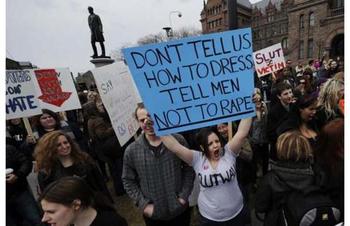
The SlutWalkers movement was ignited in Canada by a police officer’s implication that women are victimized because they dress like sluts. It has injected new life into a feminism that has appeared politically moribund in the post-feminist era. Social networking now spreads awareness and solidarity across continents, with demonstrations in major cities of the Americas, Europe, Asia, and Australia making clear that these women have had enough.  

They have taken to the streets in thousands against the stereotypes that blame the victims of abuse for the abuse. The placards point out that “little girl clothes don’t make a paedophile” (excuses for rape having included the sound of women’s footfalls on the pavement). Fact is many men rely on tacit social support to help them evade “responsibility for their own urges”.  Their power over others is offset by their lack of individual self-control. 


Other women, wives and mistresses, assist in perpetrating the practice as the price of their social privileges. These women fight tooth and nail to preserve the patriarchal status quo and their chains, admiring how becomingly they sit.  Self-esteem for them then rests on gender-centricity.  Epstein, who confesses she cannot resist flirting with her son’s age-group as well, writes:

I think flirting at my life stage is, inherently, an issue of self-esteem. A way of believing we remain attractive to men in the light of advancing middle age. A way of flagging up the ‘I’ve still got it’ message. … Indeed, I flirt far more than I ever did in my 20s — it’s a celebration of being far more comfortable in my own skin.

The demonstrating women would perhaps beg to differ with the outlook. The cloying dependence on male approval may instead portray an unhealthy self-esteem. Flirtation has been the ‘safe’ social pastime through generations. But beyond social boundaries, women are expected to remain passive receptacles of tradition. They must toe the patriarchal line to gain their privileges.  Men’s social learning over the same generational time has been that women say ‘no’ when they mean ‘yes’ simply to be dominated.

The double standards of society pressure women to attract men, and yet to remain chaste.  Women are expected to please men, but are called sluts should they choose to please themselves. Dependent women tend to readily apply derogation to describe women not quite like them - just as they would sex workers.

Women of talent, mothers who chose education and/or employment over the traditional dependence, are also socially demeaned. For instance, Kate McCann, whose 3-year old daughter Madeleine was abducted during a family vacation, became the target of hate because her lifestyle did not adhere to the social expectations of motherhood.  Her appearance and successful medical practice perhaps confirmed the stereotype that somehow she was to blame for the crime that befell her family.

Jardine reports:

Men and women have accused Kate, a part-time GP, of being a bad mother and worse, while Gerry, her cardiologist husband, has had a relatively easy ride. Her critics may chiefly wish to reassure themselves that such bad luck could never befall them, but their venom suggests a lingering prejudice against working mothers, especially those who dress neatly, express themselves crisply, go to church and jog in order to keep up some semblance of normality amid emotional chaos.

Some authors have viewed the moral policing of young, attractive, and independent women as sexual harassment.  Marcotte believes that the prurient attacks may be politically motivated. She writes:

Every picture of you available becomes the new Zapruder film, examined endlessly for some tiny detail that could be used to claim you're a slattern, a girl gone wild, a despicable flirt who can't be trusted not to sleep with every man who isn't a rightwing blogger. If you recede from the public view in response, you're accused of hiding something. If you face down your accusers, you're accused of being an attention whore.

Others point out the social hypocrisy runs across the board - in public denouncements of ‘deviant behaviour’ that power group members of all fields secretly indulge in.  When the infidelity is exposed, the individual recourse is to seeking public sympathy, professing great love for the wife they betray and family ideals. Even when the evidence proves overwhelming, the ‘stud’ continues to be socially more acceptable than the ‘slut’. All the women in the equation are but pawns in the organized misogyny. 


The SlutWalkers wear their attitudes like second skins. In many cities, groups of men watch in silence as the demonstrations sweep by – some also join in the march.  The objective of these women is to re-claim words that now have debasing connotations attached.  For instance, the keyword ‘slut’ originally denoted a dirty, untidy appearance.  The meaning of a woman of loose character developed from the 1920s onwards. Wescott explains why:
This was just after the end of World War I. Women had gained independence, this might have frightened men because women were encroaching on areas they used to dominate. Women were going out, they were drinking and they were being referred to in a derogatory way.
More than anything else, the present movement perhaps shows up the growing divide between women and women.  Like the hostile mother-in-law/daughter-in-law dyads rampant in traditional regions, there is no sisterhood between the rival groups. Jones holds that there is  a definite difference of class between feminine groups that goes beyond social positions. She writes:

…the brown, over-manicured young women who weren’t on yesterday’s march, who were half a mile away schlepping in and out of Primark and H&M, might as well have been a million miles away. … women who have only been taught to shop till they drop will, if not be raped, put up with low-paid jobs and expectations, domestic abuse, bad relationships, debt.

The SlutWalkers dress outrageously only because it makes them feel good. They are independent beings that ride high on self-esteem, and the power to self-actualize. And yet they retain awareness of their global citizenship, having also marched in protests against the ‘freedom’ wars in Iraq and Afghanistan. 

Jones writes:
The exposed thighs of the London sluts are the only things that unite them and the young women who dress like hookers to visit the nightclubs and shopping malls of Britain. The slut walkers, with their black clothes and gothic make-up, are well educated and fiercely super-confident young women raised by middle-class mothers to expect everything they want from life. They take no prisoners.
Dines and Murphy are however, critical of the new feminist drive to reclaim words. They believe that the social barriers to doing so are insurmountable, and the attempts to break through change-resistant beliefs are ill-advised. They write:

The organisers claim that celebrating the word "slut", and promoting sluttishness in general, will help women achieve full autonomy over their sexuality. … The term slut is so deeply rooted in the patriarchal "madonna/whore" view of women's sexuality that it is beyond redemption. The word is so saturated with the ideology that female sexual energy deserves punishment that trying to change its meaning is a waste of precious feminist resources. ...Women need to find ways to create their own authentic sexuality, outside of male-defined terms like slut.

I should think that gender hostilities add similar connotations to other references to women. Words do not start out with prejudiced attachments but developed them over time. ‘Diva’, for instance, derives from the Italian, meaning  ‘goddess’ or ‘fine lady’ or even ‘prima donna’ opera singers.  In some Western cultures though, the word’s strongest association now seems to be with immoral, scantily clad performers. 

I had the original ‘goddess’ meaning in mind when I chose the pen name The Diva to write under in a regular magazine column.  Some years later, I was surprised to find that more women than men within the organization were affronted by the usage, and hence set about actively opposing its continuance!

In a global forum, what might be the solution? Do women bow to social dominance of connotations in certain cultures, or do they highlight meanings that make the most sense to them, which also work well elsewhere? Are definitions the prerogative of the adherents of organized patriarchy, or do all women have the right to contribute to the development of meaning in language? I ask you!


Fact is there is no guarantee that new words introduced into the vocabulary will indeed remain connotation-free. Any of them can soon become a euphemism to carry forward the same old social meaning. The women might be left running around in circles to find newer words to denote their sexuality that are untouched by prejudice. Thence, reclaiming words seems appropriate.

However, the concerns of the authors also cannot be denied. Dines and Murphy believe that exposing the social myths about women is more important. They caution that:


 … the label [slut] has dire consequences including being blamed for rape, depression, anxiety, eating disorders, and self-mutilation.

Indeed, a goal of “promoting sluttishness” could prove counterproductive if the process entails the destruction of entrenched moral values. Women cannot forget their responsibility to future generations. Nor can individual women of closed, collectivistic cultures afford to choose reactance over reason, and thus jeopardize their personal safety.

In Germany, for example, family members quickly ostracize the Turkish Muslim model that sought to liberate from the “slavery of her youth” with a Playboy photo shoot. Accused of shaming the religion selling out to the West, she receives death threats from the men, but no public support from peer women of
 the community, also for whom perhaps she acted as she did - “very brave or very stupid”. 

Feminism needs to be proactive to make an impact, its focus being the reclaim of self-esteem for all women. Perhaps an assertive approach through the sustained voicing of convictions/dissent through social networks is required to ensure an exponential spread of the message. Women around the world need to believe emphatically that they are capable of the independent thinking necessary to facilitate social change.


References for this post:


  1. “Slutwalk London: 'Yes means yes and no means no'”11 June 2011.
  2. Denvir, Daniel. “Are we not, like Anthony Weiner, caught in a web of desire?” guardian.co.uk. The Guardian. 10 June 2011. 
  3. Dines, Gail, and Murphy, Wendy J. “SlutWalk is not sexual liberation” guardian.co.uk. The Guardian. 8 May 2011. 
  4. Epstein, Angela. “Hello handsome, want to hear the confessions of a compulsive flirt-a-holic?” dailymail.co.uk. The Daily Mail. 10th June 2011. 
  5. Hall, Allan. “Fanatics fury at Muslim Playgirl” thesun.co.uk. News. The Sun. 27 April 2011. 
  6. Jardine, Cassandra. “Kate McCann: Why didn’t they believe her?” telegraph.co.uk World News. The Telegraph. 09 May 2011. 
  7. Jones, Liz. “Class is the real problem, sisters - not slutty clothes”  dailymail.co.uk. The Daily Mail. 12th June 2011. 
  8. Marcotte, Amanda. “How 'sex scandal' is sexual harassment” guardian.co.uk. The Guardian. 1 June 2011. 
  9. “Why is the word 'slut' so powerful?” bbc.co.uk. News Magazine.  The BBC. 9 April 2011.